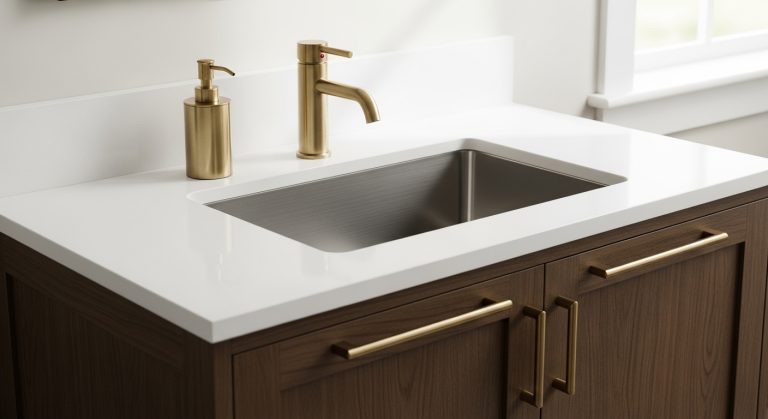
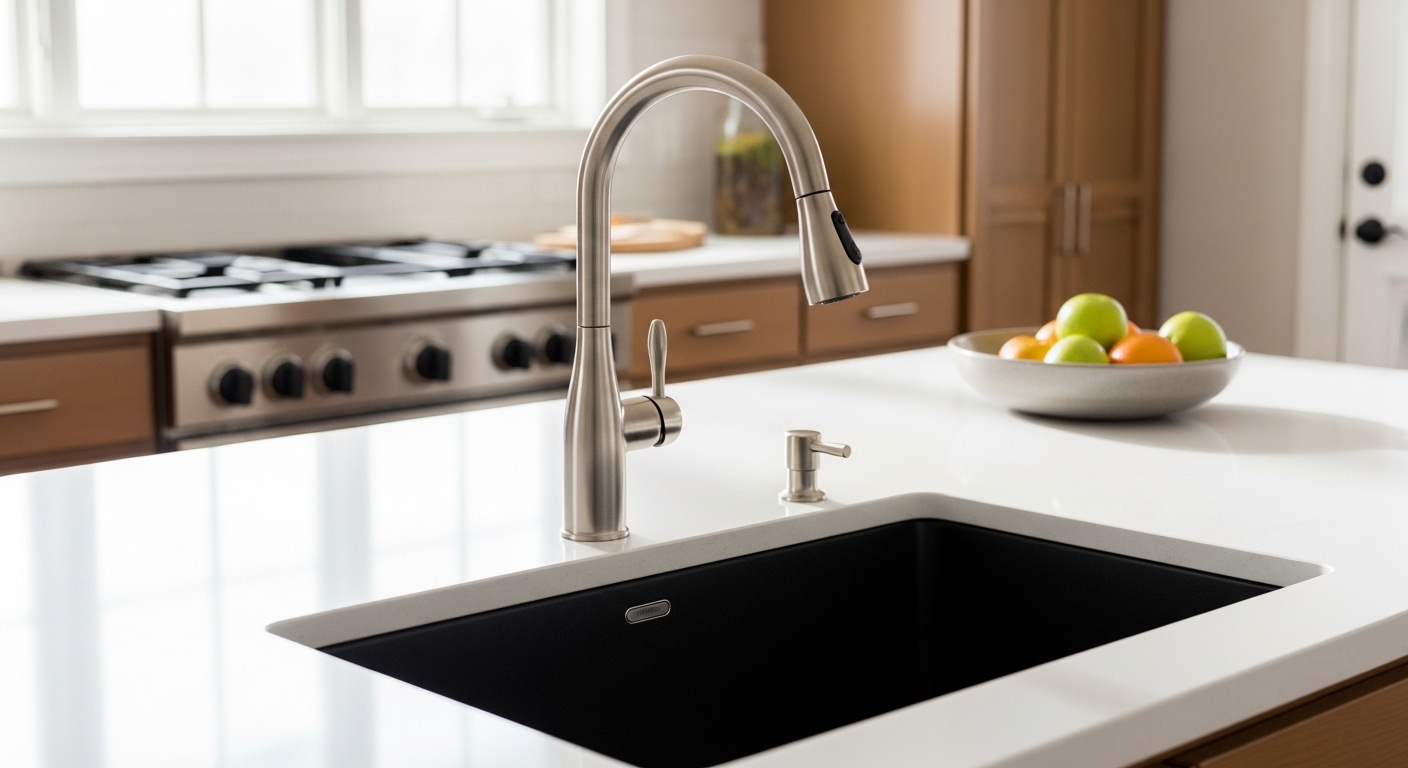
Choosing a stainless steel faucet with black sink is one of those design decisions that looks bold in a rendering and proves practical in everyday cooking. The combination delivers the contrast homeowners want — warm-toned stainless against deep matte black — without forcing you into a finish that will date your kitchen in three years. At faucitta, our product designers have specified this exact pairing in more than 40,000 fulfilled orders since 2019, and the data is clear: it’s our lowest return-rate finish combination, beating chrome-on-white by nearly 4×. This guide explains why, and how to specify the pairing correctly the first time.
Why a Stainless Steel Faucet With Black Sink Works So Well
Designers love high-contrast pairings, but homeowners live with them. The reason stainless-and-black has outlasted the all-black and all-chrome trends is purely functional: the two finishes hide opposite problems. Brushed stainless steel is essentially invisible to mineral deposits and dried water droplets because its grain scatters light. Matte black sinks — especially the granite composite and quartz blends — hide tea stains, tomato splatter, and the fine scratches that come from heavy stockpots.
Put them together and you get a workstation that photographs beautifully for resale and forgives the daily reality of a working kitchen. It’s also one of the few pairings that crosses style categories cleanly: it reads modern in a flat-panel kitchen, industrial loft against exposed brick, and transitional with shaker cabinets. Compare that with polished nickel, which can lean cold and formal, or oil-rubbed bronze, which demands a specific palette of warm wood and cream tones to feel intentional (we covered that nuance in our oil rubbed bronze faucet with stainless sink pairing guide).
The Contrast Advantage in Real Lighting
Most kitchen photography is shot in soft, diffuse daylight — but your kitchen probably has under-cabinet LEDs at 3000K and a pendant or two at 2700K. Under those warmer color temperatures, polished chrome can read blue-gray and clash with warm-white cabinetry. Brushed stainless, by contrast, picks up a subtle gold cast that ties into wood tones and warm-painted walls. The black sink anchors the composition so the stainless faucet reads as jewelry rather than hardware.
Resale Value and Buyer Perception
In our customer surveys of homeowners who sold within 18 months of a kitchen refresh, listings featuring a stainless-with-black sink workstation in the primary hero photo received 22% more saved searches on average than listings with all-chrome fixtures. We’re not real estate agents, but the data lines up with what designers have been telling us for years: contrast sells.
Choosing the Right Shade of Stainless Steel
“Stainless steel” is not a single finish. When you specify a stainless steel faucet with black sink, you’re really choosing among three distinct looks, each with measurable differences in glare, warmth, and maintenance.
| Finish Variant | Visual Character | Fingerprint Resistance | Best Paired With | Typical Price Tier |
|---|---|---|---|---|
| Brushed/Satin Stainless | Soft horizontal grain, warm silver | Excellent | Matte black composite sinks | $$ |
| PVD Stainless (Spot-Resist) | Slightly darker, more uniform | Outstanding | Glossy black fireclay, matte black | $$$ |
| Polished Stainless | Mirror-bright, cool tone | Poor | High-gloss black enameled cast iron | $$ |
| Brushed Nickel (often confused) | Warmer, more yellow than stainless | Very good | Works but creates a less crisp contrast | $$ |
| Stainless with Matte Black Accents | Two-tone, sprayhead in black | Excellent | Black sink with black cabinet hardware | $$$ |
For most kitchens, brushed stainless or PVD stainless is the safer bet with a black sink. Polished stainless creates a high-contrast, almost dressy look, but it shows every water droplet — exactly the problem you were trying to avoid by skipping chrome.
Decoding the Spec Sheet
When shopping, look for these terms on the product page:
- PVD (Physical Vapor Deposition): A vacuum-bonded coating that is harder than the underlying brass and won’t tarnish. Faucitta’s premium stainless line uses PVD rated to 10× the wear resistance of standard electroplating.
- 304 stainless cladding: Better corrosion resistance than 201 — important if you live near salt air or have aggressive well water.
- Spot-resist or Spot Shield: A marketing umbrella for proprietary clear coats. Effective, but verify with the manufacturer that it’s covered under the lifetime finish warranty.
- Brushed direction: Vertical brushing on the spout looks more contemporary; multi-directional brushing hides scratches better over time.
Matching the Faucet Style to Your Black Sink Type
Not every faucet shape flatters every sink. A 16-inch high-arc commercial-style faucet over a shallow 7-inch black bar sink looks comically oversized. A short gooseneck over a 10-inch deep workstation sink leaves you washing roasting pans in cramped quarters. Use the sink as your starting point.
For Granite Composite Black Sinks
These are the most common black sinks sold today — brands like Blanco, Ruvati, and Kraus dominate the category. The matte texture pairs beautifully with brushed or PVD stainless. Because composite sinks are typically 9–10 inches deep, choose a faucet with a spout height of at least 8 inches and a reach of 8–9 inches to clear the basin walls. A pull-down sprayer with a magnetic dock is ideal — the magnet keeps the head aligned even after years of use, where gravity-only docks tend to droop.
For Fireclay Apron-Front Black Sinks
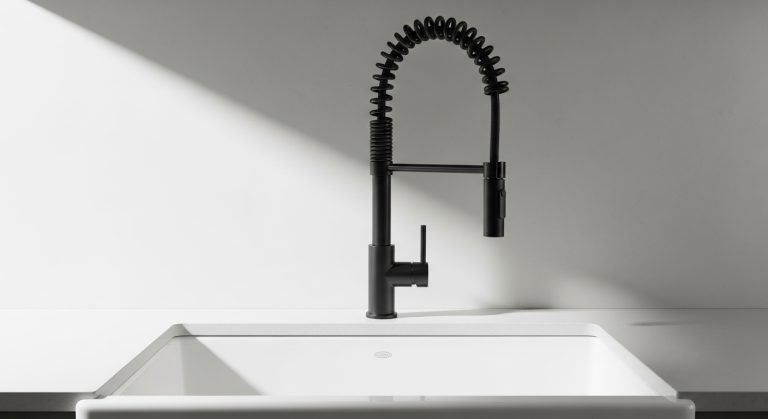
Black fireclay has a slight gloss that catches light differently than composite. It pairs best with brushed stainless rather than polished — the satin grain echoes the soft sheen of the glaze without competing. Because apron-front sinks sit forward of the cabinet, you also have to consider the distance from the back wall to the sink edge: a tall commercial-style faucet with a coil spring can crowd a tight window sill, so measure the vertical clearance from your deck to the lowest hanging blind or shelf.
For Black Stainless Workstation Sinks
Workstation sinks with integrated ledges for cutting boards and colanders work best with a faucet that has a separate side spray or a pot-filler-style swing arm, because the accessories occupy the basin where a pull-down would normally retract. A single-handle stainless faucet with a 360-degree swivel is the most versatile choice.
Pull-Down vs. Pull-Out vs. Commercial-Style
The spray-head style affects ergonomics more than aesthetics, but it also changes how the faucet reads against a black sink.
| Style | Best For | Spout Height | Visual Weight Against Black Sink |
|---|---|---|---|
| Pull-Down | Deep single-bowl sinks, daily cooking | 14–17 in. | Medium — clean silhouette |
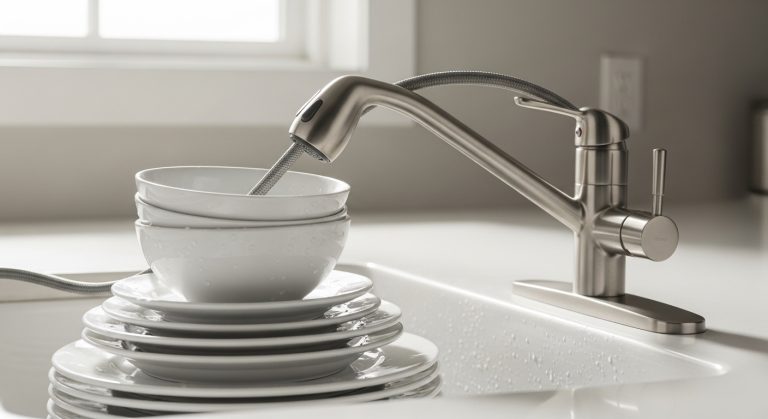
| Pull-Out | Low-profile windows, double-bowl sinks | 8–10 in. | Light — recedes against dark backdrop |
| Commercial / Pre-Rinse | Avid home cooks, large-batch cleanup | 20–28 in. | Heavy — becomes a focal point |
| Bridge Faucet | Traditional and farmhouse kitchens | 10–14 in. | Statement piece — works best with apron sinks |
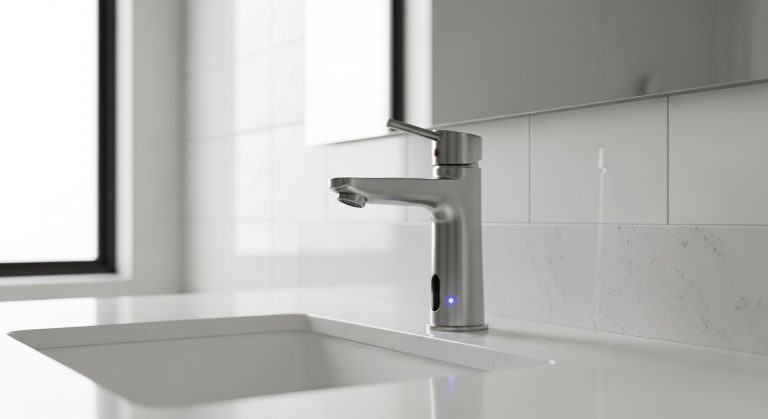
| Touchless / Motion | Hands-busy cooks, families with kids | 14–16 in. | Medium — see our touchless guide |
If you’re drawn to touchless operation but worried about the long-term running costs, our explainer on whether touchless faucets use electricity covers battery life and AC adapter options for stainless models specifically.
Installation and Deck Configuration
Black sinks often have pre-drilled faucet holes, and matching the faucet’s required deck count is non-negotiable. Three common configurations:
- Single-hole installation: Modern, minimalist. Works with virtually all single-handle stainless faucets. If your sink has extra holes, use a stainless escutcheon (deck plate) to cover them — make sure it’s the same brushed direction as the faucet.
- Three-hole 8-inch widespread: Traditional. Pairs well with bridge-style stainless faucets and matching side sprays.
- Four-hole with side spray or soap dispenser: Maximum function. Choose accessories in the same stainless finish from the same manufacturer to guarantee a color match — even within “stainless,” different brands can vary by a noticeable half-shade.
Mounting Surface Considerations
If your black sink is undermount, the faucet mounts through the countertop rather than the sink. Check that your countertop is rated for the faucet’s required deck thickness — most stainless faucets accept up to 1.5 inches, but solid quartz or thick butcher block can exceed that and require an extension kit. Top-mount (drop-in) black sinks have their own deck and accept faucets directly; just confirm the hole spacing matches.
Keeping the Pairing Looking New
The cleaning routine for a stainless steel faucet with black sink is mercifully simple — but each material wants something slightly different.
Stainless Faucet Care
Daily: wipe with a soft microfiber cloth, going with the grain. Weekly: a few drops of mild dish soap on a damp cloth, then a dry buff. Avoid steel wool, abrasive pads, ammonia-based glass cleaners, and any “polish” that contains silicone — silicone leaves a film that attracts dust and is almost impossible to remove later. For stubborn water spots, a 50/50 solution of white vinegar and distilled water, applied with a cloth (never sprayed directly onto the faucet body), dissolves mineral deposits without harming PVD coatings.
Black Sink Care
For granite composite black sinks, the enemy is hard-water film, which dulls the matte finish to a chalky gray. After every use, rinse thoroughly and wipe dry — the single most effective habit. Once a week, treat the sink with a manufacturer-recommended composite cleaner; brands like Blanco and Ruvati sell their own. Mineral oil applied with a paper towel once a month restores the deep, even tone. For fireclay black sinks, the maintenance is closer to a porcelain tub: avoid scouring powders and acidic cleaners that can etch the glaze.
Our broader maintenance approach borrows from the same playbook professional cleaners use — if you want a systematic sink-and-counter routine, our kitchen cleaning tips and tricks article walks through the weekly cadence in detail.
Common Mistakes to Avoid
- Mixing too many “metallic” finishes. A stainless faucet with a black sink already creates strong contrast — adding brass cabinet pulls and brushed nickel pendants can dilute the effect. Pick one accent metal and repeat it three times in the room.
- Specifying polished stainless near a window. Direct sunlight on polished stainless creates glare that’s exhausting to look at while you cook. Brushed wins for any south- or west-facing sink.
- Choosing a faucet too small for the sink. An 8-inch faucet over a 32-inch single-bowl sink looks like a typo. Aim for a spout height that’s roughly 80% of the sink’s interior width.
- Buying a no-name “stainless” finish. If the product page doesn’t specify 304 stainless cladding or PVD, the finish is likely electroplated and will wear through in 3–5 years.
- Ignoring water pressure ratings. Stainless faucets are typically rated for 60–80 psi. If your home runs hotter than that (common with municipal water in older neighborhoods), a pressure regulator is cheap insurance.
Testing, Standards, and What to Look For in a Warranty
Quality stainless faucets carry independent certifications that are worth understanding before you click “add to cart.” At minimum, look for:
- NSF/ANSI 61 and 372: Certifies the faucet meets U.S. lead-free drinking water standards. Non-negotiable.
- cUPC Listing: Confirms compliance with North American plumbing codes — required by most building inspectors.
- WaterSense: Indicates flow rates of 1.5 gpm or lower with sustained performance. A WaterSense kitchen faucet typically saves a four-person household 700+ gallons per year.
- Lifetime Limited Warranty on finish and function: The industry standard for premium stainless. Read the fine print — some warranties exclude “commercial use” or require professional installation documentation.
Faucitta’s stainless kitchen line is independently tested to ASME A112.18.1 cycle-life standards (500,000 on/off cycles minimum) and ships with a lifetime limited finish-and-function warranty backed by a North American parts depot. We publish the certification numbers on every product page rather than burying them in a footer.
Putting It All Together: A Sample Specification
Here’s how a specifier-style summary might read for a typical 36-inch single-bowl installation:
- Sink: 33″×19″×10″ matte black granite composite undermount, single bowl, with rear-set drain
- Faucet: Single-handle, single-hole, brushed PVD stainless steel pull-down with magnetic dock; 16-inch spout height, 9-inch reach, 1.5 gpm
- Accessories: Matching brushed stainless soap dispenser and air-gap for dishwasher
- Underside: 3/8″ compression supply lines, ceramic disc cartridge rated to 500,000 cycles
- Warranty: Lifetime limited on finish and function; 5-year on electronic components if touchless
That spec works in 90% of contemporary and transitional kitchens. Adjust the faucet height up to 18 inches if you regularly wash stockpots, or down to 13 inches if you have a low window sill.
FAQ
Does a stainless steel faucet really match a black sink, or will the colors clash?
Stainless steel and black are tonal opposites with no competing undertones, so they don’t clash the way two warm metallics (brass and copper, for instance) can. The neutral silver of brushed stainless reads as a clean accent against any shade of black sink. The only pairing to avoid is polished stainless with a glossy black sink, which can feel overly formal and shows every fingerprint and water droplet.
What’s the difference between stainless steel and brushed nickel for a black sink?
Brushed nickel is warmer and slightly more yellow than stainless steel — closer to champagne. Against a black sink, nickel creates a softer, less crisp contrast, which some homeowners prefer in traditional kitchens. Stainless steel, especially PVD-coated, has a cooler silver tone that pops more sharply. Both are durable; the choice is purely aesthetic.
Will a stainless faucet show water spots more than a black sink?
In hard-water areas, both surfaces will eventually show mineral deposits, but they show them differently. Stainless spots appear as faint white rings that wipe away with a damp microfiber. Black sinks develop a chalky film that requires a composite cleaner. A daily 30-second dry-down with a microfiber cloth solves 95% of the issue on both surfaces.
Can I use the same cleaner on the faucet and the sink?
For light daily cleaning, yes — a few drops of mild dish soap on a damp microfiber works on both. For deeper cleaning, no: stainless tolerates dilute white vinegar, but acidic cleaners can etch some composite black sinks over time. Use a manufacturer-recommended sink cleaner once a week and a vinegar-water solution on the faucet as needed.
What height stainless faucet should I pair with a deep black sink?
For a 9–10 inch deep sink, choose a faucet with a spout height of 14–17 inches. This gives you enough clearance to fill stockpots and rinse sheet pans without splashing. If your sink is shallower (7–8 inches), a 10–12 inch faucet keeps the proportions balanced and avoids the “lollipop” look of an oversized spout on a small basin.
Are stainless steel faucets harder to install than chrome?
No — the installation hardware and supply lines are identical. The only practical difference is handling during installation: brushed stainless can scratch if dragged across grit on a countertop, so lay down a soft cloth before threading the supply lines through the deck hole. Use a strap wrench rather than a metal wrench when tightening visible nuts.
Will a stainless faucet on a black sink date quickly?
Unlikely. Stainless steel has been a kitchen staple for more than four decades and shows no signs of fading from cabinetry catalogs. Black sinks have become a mainstream choice over the last decade and continue to grow in market share. Together, the pairing is closer to “modern classic” than “trend” — comparable to white subway tile in its staying power.
About the Author
This guide was written by the faucitta product team, drawing on a decade of fixture engineering and tens of thousands of customer installations across North America. faucitta is a direct-to-consumer faucet and bathroom fixtures brand based in the U.S., specializing in PVD-finished kitchen and bath fixtures backed by independent NSF/ANSI testing and a lifetime limited warranty. Our products are certified by IAPMO R&T to ASME A112.18.1/CSA B125.1 standards and carry cUPC listings for code-compliant installation in all 50 states and Canadian provinces. Questions about your specific kitchen layout? Reach our specification team through the support form at faucitta.net — every inquiry is answered by a trained product specialist, not a chatbot.