A roman tub faucet deck mount replacement is the project most people put off because the old faucet still “works” — it just drips, wobbles, or looks dated next to a remodeled bathroom. The good news: replacing a deck-mounted Roman tub filler is one of the more forgiving plumbing swaps, because the valves and spout sit on top of the tub deck where you can reach them, not buried behind a wall. The trick is getting the measurements and the configuration right before you buy, so the new set lands on the existing holes without a single new drill bit. Below, we’ll walk through exactly how to measure, what to look for, and how to install it cleanly.
What exactly is a Roman tub faucet, and how do I know I have one?
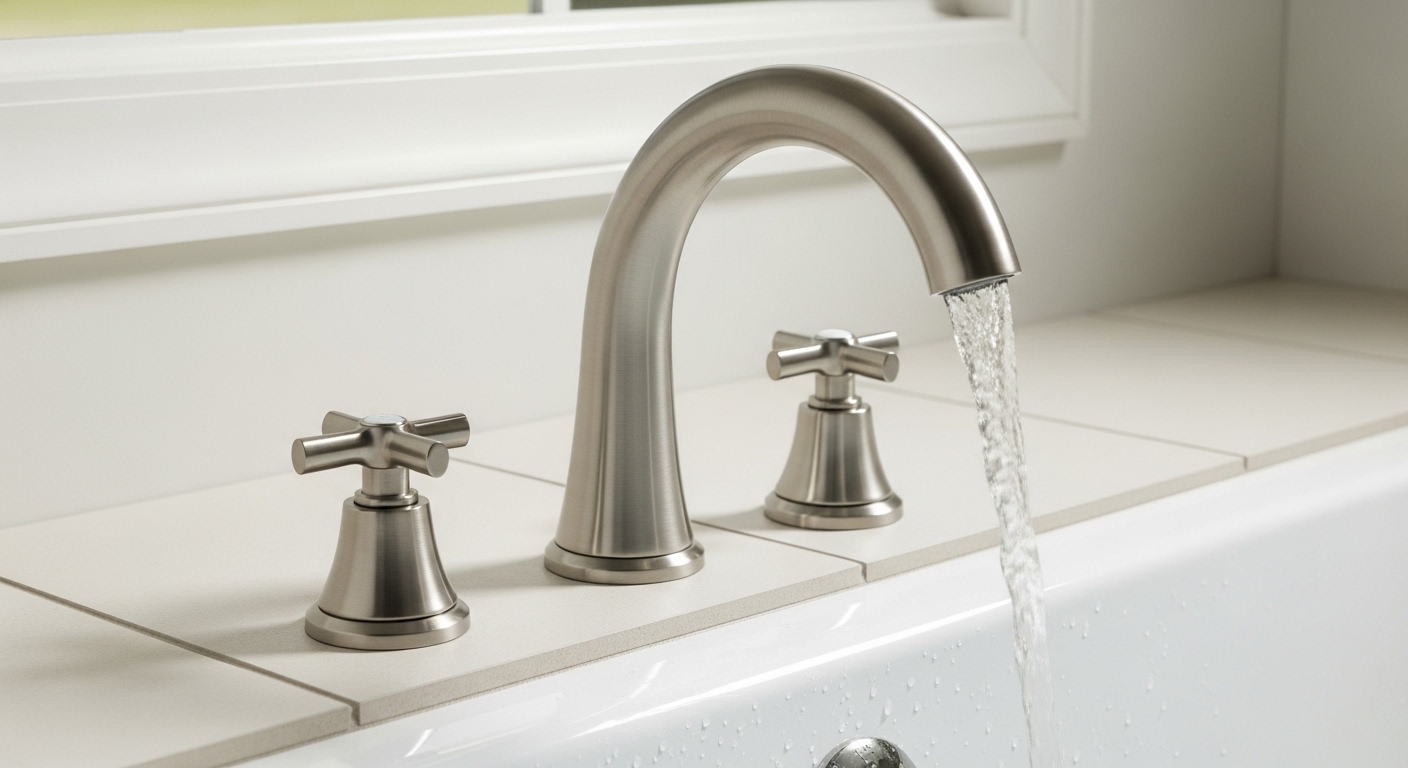
A Roman tub faucet is a bathtub filler that mounts on the flat deck (the rim or surround) of the tub, rather than on the wall or on the floor. If your handles and spout come up through holes drilled in the tile, marble, or acrylic deck around your tub — not out of a wall — you have a deck-mount Roman tub faucet. The name “Roman” just refers to that classic high-arc spout pouring into a tub deck setup.
You can confirm it in ten seconds: look at where the water comes out. If the spout rises straight up out of the horizontal surface beside the tub, and the hot/cold handles are separate units a few inches to either side, it’s a deck-mount Roman set. If everything comes out of a vertical wall, that’s a wall-mount tub faucet and a different replacement entirely. And if the spout and handles are all clustered on one base plate, you may have a single-hole or “monoblock” filler instead of a true widespread Roman.
- 3-hole Roman tub faucet: two handle holes plus one spout hole. The most common residential setup.
- 4-hole Roman tub faucet: two handles, a spout, and a separate handheld sprayer or diverter hole.
- 2-hole / monoblock: spout and a single mixing handle — less common, easy to mistake for a sink faucet at a glance.
How do I measure my tub deck so the replacement actually fits?
Measure the center-to-center distance between the outermost holes and count the total number of holes — that’s 90% of the fit decision. Most Roman tub fillers are sold to span an 8″ to 16″ spread, but “adjustable” valve bodies and flexible supply hoses give you real wiggle room. Write down three numbers before you shop: the hole count, the outer spread, and the diameter of each hole.
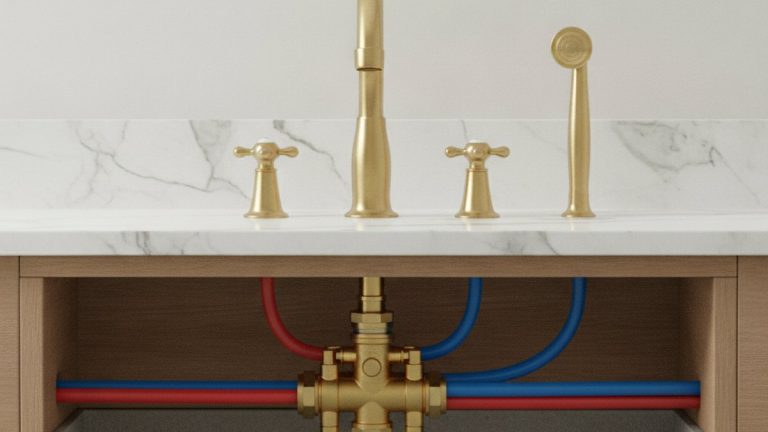
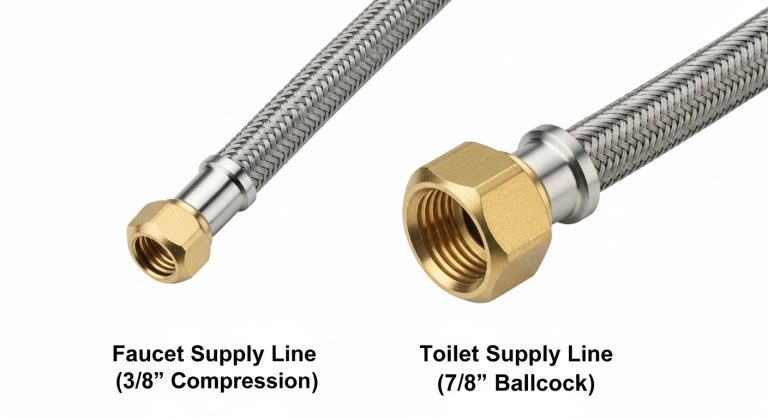
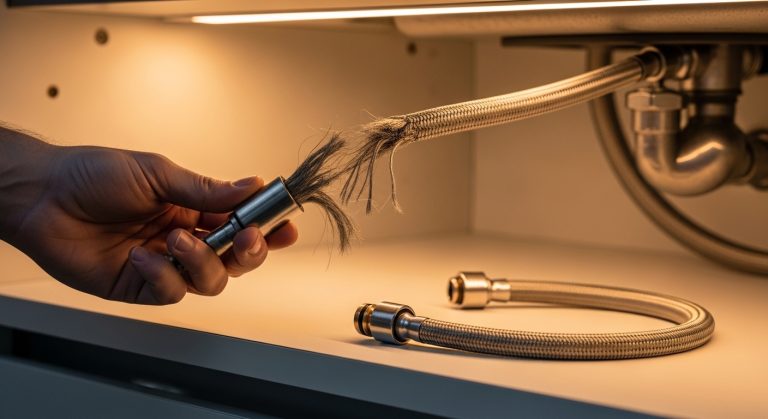
Here’s the part people miss: the holes underneath your deck are often connected by flexible braided hoses to a hidden mixing valve, which means the spacing can flex. But the visible trim — the escutcheons (those decorative base plates) — must be large enough to cover the existing holes even if they don’t perfectly align. When in doubt, choosing a replacement with slightly larger escutcheons hides minor mismatches. If you’ve never identified faucet parts before, our bathroom faucet diagram guide labels every component so these terms click.
| Measurement | Typical Range | Why It Matters |
|---|---|---|
| Hole count | 2, 3, or 4 holes | Must match exactly — you can’t easily add or fill deck holes |
| Outer hole spread (center-to-center) | 8″ – 16″ | Determines whether the new valve bodies reach the existing holes |
| Hole diameter | 1-3/8″ (standard) up to 1-1/2″ | New shanks must pass through; escutcheons must cover |
| Deck thickness | 3/4″ – 2-1/2″ | Mounting hardware must be long enough to clamp through |
| Spout reach | 5″ – 9″ | Spout must clear the tub rim and pour inside, not onto the deck |
What if my new faucet’s spread doesn’t match the old holes?
If the spreads are close but not identical, you’re usually fine, because the valve bodies connect to the central mixer with flexible hoses that absorb a 1″–2″ difference. If they’re far off — say your deck is drilled for 14″ and the faucet wants 8″ — you have three options: buy a faucet rated for your wider spread, use a faucet with oversized escutcheons that simply cover the gap, or (last resort) have a fabricator redrill a solid-surface deck. Never try to “make it work” by over-tightening; you’ll crack the deck or stress the supply connections.
Can I replace a deck mount Roman tub faucet myself, or do I need a plumber?
Most homeowners can do a Roman tub faucet deck mount replacement themselves in 2–3 hours with basic tools, as long as the shutoff valves work and the deck holes match. The job is mechanical, not technical — you’re disconnecting hoses, lifting out old hardware, and clamping new hardware down. You only need a pro if the shutoffs are seized, the access panel is sealed shut, or the deck is solid stone that needs redrilling.
The single biggest variable is access. Deck-mount Roman fillers connect to their valves from underneath the tub deck, so you need to reach that space — through an access panel, an adjacent cabinet, or an open apron. If you can get a hand and a wrench under there, you can do this. If your tub deck is fully tiled-in with no panel, opening access is the hard part, and that’s where some people call a plumber just for the cut-in.
- Shut off the water at the tub’s dedicated stops or the main, then open the old faucet to relieve pressure.
- Disconnect the supply hoses from the underside of each valve body and the spout. Keep a towel and bucket handy — there’s always residual water.
- Unscrew the mounting nuts holding each handle, the spout, and any sprayer to the deck, then lift the old trim out from the top.
- Clean the deck — scrape off old plumber’s putty or silicone so the new escutcheons seat flat.
- Set the new valve bodies, seal with the supplied gaskets or a thin bead of silicone, and hand-tighten the mounting hardware before snugging with a wrench.
- Reconnect supplies, turn the water back on slowly, and check every joint for leaks before you celebrate.
If your old unit only drips and the trim is fine, you may not need a full replacement at all — a worn cartridge could be the culprit. Our guide on the bathtub faucet valve cartridge walks through how to tell whether a cartridge swap will fix it for a fraction of the cost.
What’s the difference between deck mount, wall mount, and floor mount tub fillers?
The mount type is decided by where the water plumbing already exits — deck mount comes up through the tub surround, wall mount comes out of the wall behind the tub, and floor mount rises on a freestanding pillar from the floor. For a replacement, you almost always stay with the same type you already have, because switching means moving plumbing inside walls or floors.
| Mount Type | Where It Sits | Best For | Replacement Difficulty |
|---|---|---|---|
| Deck mount (Roman) | On the tub deck/rim | Drop-in and undermount tubs with a surround | Easy–Moderate (top access + under-deck reach) |
| Wall mount | Out of the wall | Alcove tubs, tiled walls | Moderate–Hard (in-wall valve) |
| Floor mount | Freestanding floor riser | Standalone soaking tubs | Hard (floor plumbing) |
This is why a Roman deck-mount replacement is the most DIY-friendly of the three: nothing lives inside a wall. If you’re shopping by look as much as by mount, finish coordination matters too — a coordinated tub-and-shower set keeps the room consistent. For matte-black bathrooms specifically, our breakdown of whether a matte black tub faucet set is worth buying covers durability and finish trade-offs that apply directly to Roman fillers.
Which finish and valve type should I pick for a long-lasting replacement?
Pick a finish based on your water and cleaning habits, and pick a ceramic-disc cartridge valve for longevity — it’s the standard for drip-free performance and easily outlasts old rubber-washer compression valves. Finish is mostly cosmetic, but it also affects how forgiving the faucet is about water spots and cleaning chemicals.
- Brushed/satin nickel: hides water spots and fingerprints best — the easy-living default.
- Chrome: brightest and cheapest, but shows every spot in hard-water areas.
- Matte black: dramatic and on-trend; wipe with water only to protect the coating.
- Oil-rubbed/champagne bronze: warm, traditional; living finishes may patina over time.
- Brushed gold: luxe look that needs gentle, non-abrasive care to keep its tone.
On the valve side, insist on ceramic discs. They’re the reason a quality Roman filler can go a decade without a drip. Look for compliance with finish and flow standards too: faucets meeting ASME A112.18.1 / CSA B125.1 and lead-free NSF/ANSI 372 requirements have been third-party tested for safe materials and durable plating — not just marketing claims.
What does a quality Roman tub faucet deck mount replacement cost, and what’s the value range?
Expect to spend $120–$350 for a solid mid-range deck-mount Roman tub filler, with budget units starting around $70 and premium designer sets running $500+. The price jumps come from valve quality (brass vs. zinc bodies), the finish (living finishes and gold tones cost more), and whether a handheld sprayer is included. For most homeowners, the $150–$300 band buys a brass-bodied, ceramic-cartridge filler that will outlast the budget tier by years.
- $70–$120 (budget): often zinc-alloy bodies, basic chrome — fine for rentals or short-term needs.
- $120–$350 (mid-range, best value): brass construction, ceramic cartridges, multiple finishes, sometimes a sprayer.
- $350–$600+ (premium): designer styling, premium living finishes, heavier solid-brass builds, longer warranties.
One quiet cost-saver: if your existing trim is in good shape and only the working parts have failed, you don’t need a full set. Replacing a cartridge or supply hose is far cheaper than a whole filler — the same logic that applies to a pull-out kitchen faucet hose replacement, where swapping one part beats buying the whole faucet.
How do I avoid the three most common Roman tub replacement mistakes?
The three mistakes that sink most DIY Roman tub swaps are buying the wrong hole configuration, ignoring spout reach, and skipping the leak test. Each is avoidable with five minutes of upfront checking, and each is expensive to fix after the fact.
- Wrong hole count or spread. Always count holes and measure the outer spread first. A gorgeous faucet that needs 3 holes is useless on a 4-hole deck.
- Spout too short. If your tub rim is wide, a 5″ spout may pour water onto the deck instead of into the tub. Match spout reach to how far the spout sits from the inner tub wall.
- No leak test. Turn water on slowly and check every connection — under the deck and at the spout base — before you put the access panel back. A pinhole leak inside a sealed deck causes rot you won’t see for months.
FAQ
Can I replace a Roman tub faucet without removing the tub?
Yes. A deck-mount Roman tub faucet is replaced entirely from the top (lifting out trim) and underneath (disconnecting hoses) — the tub never moves. As long as you have access to the underside of the deck through a panel or cabinet, the tub stays exactly where it is.
Are all Roman tub faucet holes the same size?
Most standard deck holes are about 1-3/8″ in diameter, and the majority of replacement fillers are designed to pass through that size. Some heavier valve shanks need up to 1-1/2″. Always check the new faucet’s shank diameter against your existing hole size before buying.
How do I know if my deck mount tub faucet is leaking from the cartridge or the connections?
If water drips from the spout when the faucet is fully off, the cartridge is worn. If water pools under the deck or around the base while running, it’s a connection or gasket leak. Cartridge drips are an internal-parts fix; base leaks usually mean re-sealing or replacing a supply hose.
Do I need a plumber to replace a deck mount Roman tub faucet?
Usually not. With working shutoff valves and matching deck holes, most homeowners finish the job in 2–3 hours using an adjustable wrench, a basin wrench, and silicone. Call a pro only if shutoffs are seized, access is fully sealed, or a solid-stone deck needs redrilling.
What’s the difference between a Roman tub faucet and a regular bathtub faucet?
“Roman tub faucet” specifically means a deck-mounted filler with a high-arc spout that pours into the tub from the deck, typically with widespread handles. A “regular” bathtub faucet often refers to a wall-mounted tub spout fed by an in-wall valve. The mounting location is the core difference.
Can I change the finish of my tub faucet without replacing the whole thing?
No — finishes are factory-applied to the metal and can’t be reliably changed at home. If you want a new finish, you replace the trim or the full faucet. The upside is that since Roman trim lifts out from the top, swapping to a new finish is straightforward once your holes match.
Author note: This guide was written by the faucitta fixtures team, drawing on hands-on installation and bench-testing of deck-mount tub fillers across nickel, chrome, matte black, and bronze finishes. About faucitta: faucitta designs and supplies bathroom and kitchen fixtures built to ASME/CSA flow and finish standards, with ceramic-disc cartridges and lead-free (NSF/ANSI 372) waterways, backed by a limited lifetime warranty on finish and function. We test every Roman filler design for drip-free shutoff and leak-tight deck sealing before it ships.