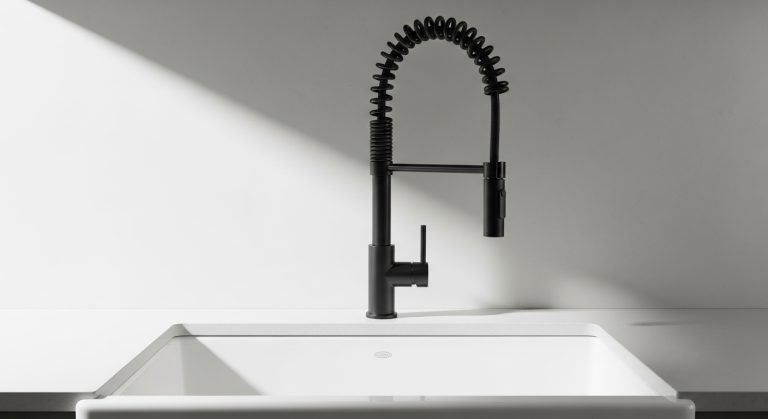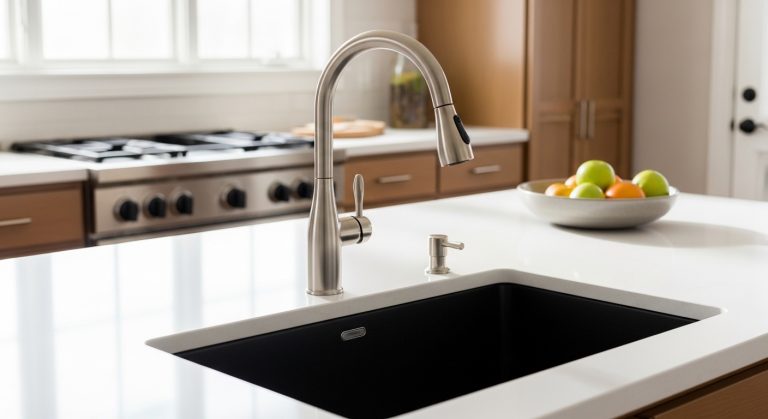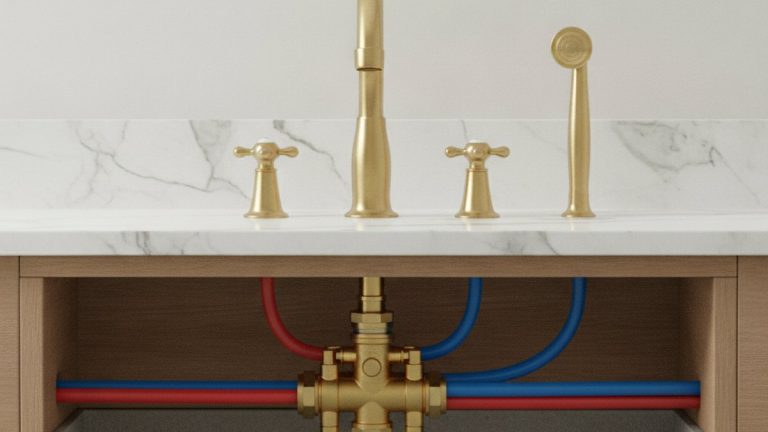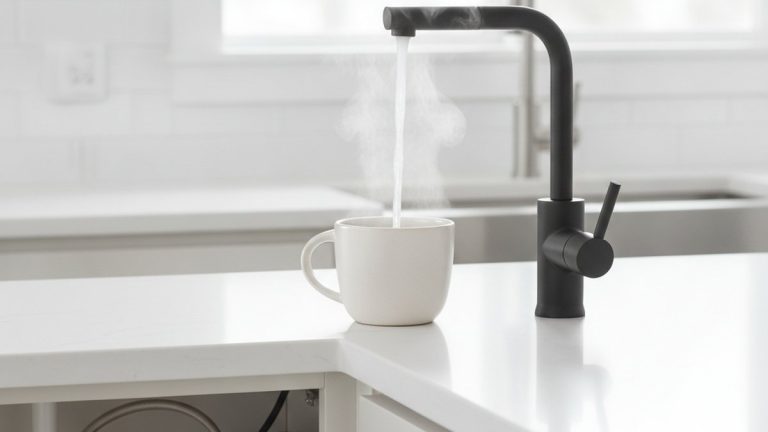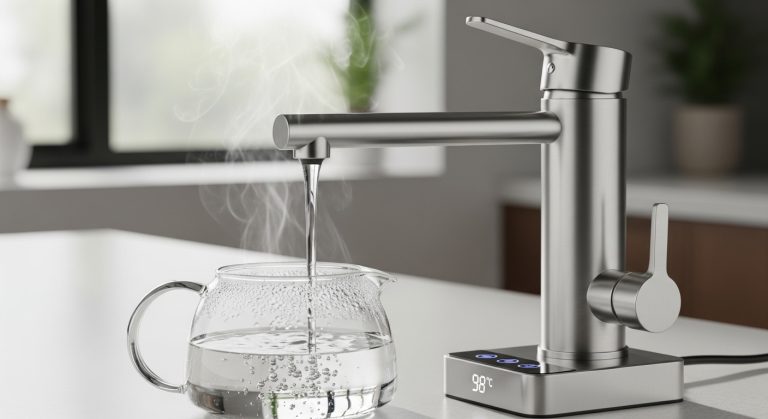
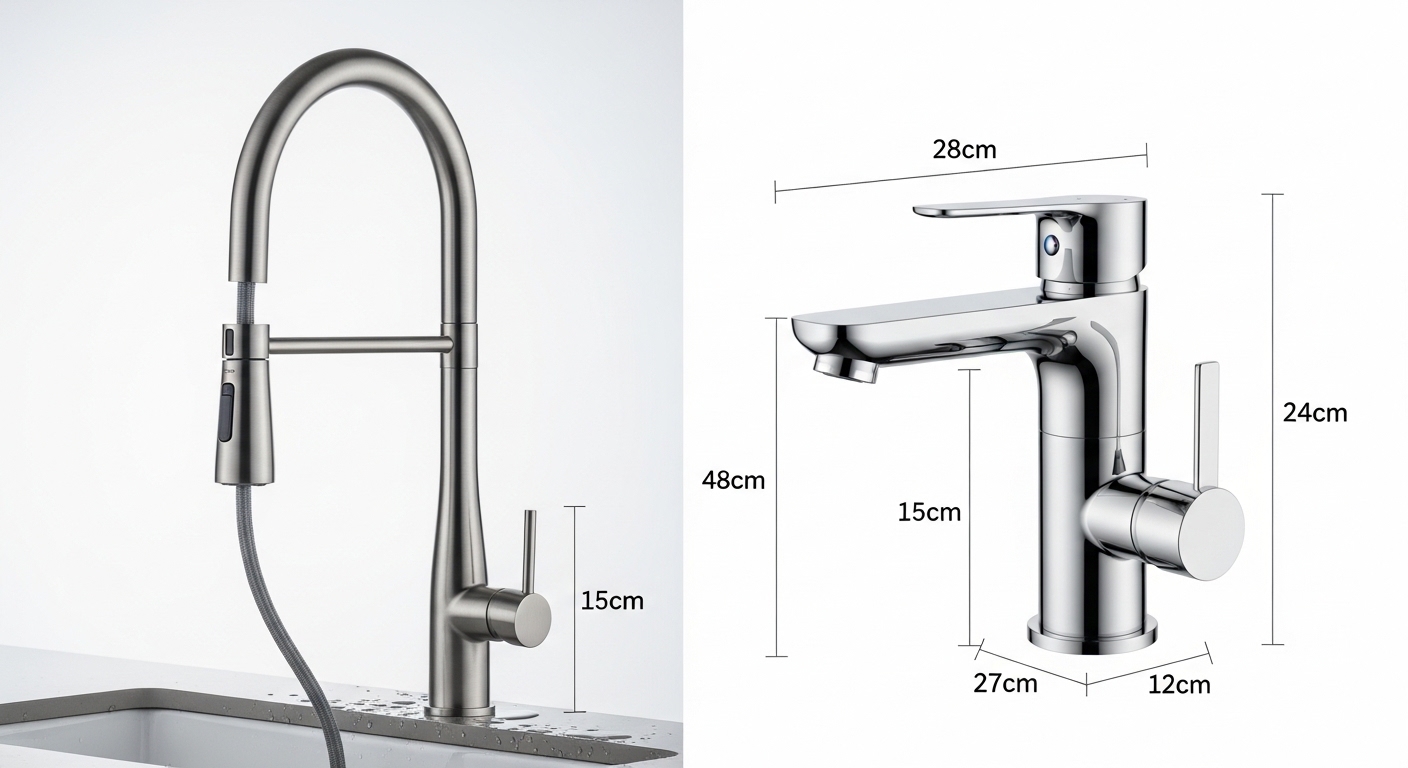
If you’ve ever stood in the plumbing aisle wondering whether a kitchen faucet vs bathroom faucet really matters — or whether that good-looking kitchen model would work on your vanity — the short answer is that they’re cousins, not twins. They both mix hot and cold water and they both bolt onto a sink, but almost everything else (height, reach, flow rate, hole spacing, and the guts inside) is engineered for a different job. Put the wrong one in the wrong place and you’ll either splash water all over your countertop or end up with a faucet that won’t even line up with your mounting holes.
Below, we’ll walk through the actual differences that matter when you’re buying, the ones people get burned by, and the handful of situations where crossing over actually does make sense. This is the explanation we give customers at faucitta every week — plain talk, real specs.
What’s the actual difference between a kitchen faucet and a bathroom faucet?
The core difference is size, flow, and mounting. A kitchen faucet is built tall and high-arc so you can fit a stockpot under it, and it’s allowed to flow more water (typically 1.8 gallons per minute) because you’re filling and rinsing big things. A bathroom faucet is short, sits over a shallow basin, and is legally capped at a lower flow (1.2 GPM or less in most U.S. markets, 0.5 GPM in California and other strict states) because all you’re doing is washing hands and brushing teeth.
That single decision — “what is this water for?” — drives every other spec. Once you understand that, the rest of the comparison makes sense at a glance:
| Spec | Kitchen Faucet | Bathroom Faucet |
|---|---|---|
| Spout height | 8″–18″ (high-arc common) | 3″–6″ (low profile) |
| Flow rate (max) | 1.8 GPM (1.5 GPM eco) | 1.2 GPM (0.5 GPM in CA) |
| Mounting holes | 1 hole (or 1–4 with deck plate) | Single-hole, 4″ centerset, or 8″ widespread |
| Spray feature | Pull-down / pull-out sprayer common | None (aerated stream only) |
| Supply lines | 3/8″ compression, longer | 3/8″ compression, shorter |
| Drain | No drain assembly (sink has basket strainer) | Usually includes pop-up drain assembly |
| Typical price (quality mid-range) | $120–$350 | $70–$220 |
Notice the drain row — that’s a sneaky one. Bathroom faucets often ship with a pop-up drain assembly because the basin needs to hold water; kitchen faucets never do, because kitchen sinks use a basket strainer you buy separately. People who try to repurpose a faucet across rooms get tripped up by exactly these “extras.”
Can I use a kitchen faucet in a bathroom (or a bathroom faucet in a kitchen)?
You can physically install a kitchen faucet on a bathroom vanity, but it’s usually a bad idea — and going the other way (a bathroom faucet in a kitchen) is almost always a mistake. The mounting and water connections are the same 3/8″ standard, so it’ll “fit,” but the proportions and performance won’t work.
Here’s what actually goes wrong in each direction:
- Kitchen faucet on a bathroom sink: The tall spout sits high over a shallow basin, so water drops a long way and splashes everywhere. The higher flow rate also overwhelms a small bowl. And a single-hole kitchen faucet won’t cover a vanity drilled for a 4″ centerset — you’ll be staring at two open holes.
- Bathroom faucet in a kitchen: The spout is too short and too low to fit pots, dishes, or even a tall water bottle. The capped flow makes filling anything painfully slow, and there’s no sprayer for rinsing. You’ll regret it within a day.
The one exception that genuinely works: a tall, single-hole bathroom vessel faucet can read as a clean, modern look — but that’s a bathroom faucet designed tall on purpose, not a kitchen unit moved over. If you’re matching holes and layout, our bathroom faucet diagram guide shows exactly how the deck holes and spacing line up so you don’t buy the wrong configuration.
Why does flow rate (GPM) differ so much between the two?
Flow rate differs because the two faucets do different work and answer to different water-efficiency rules. Kitchen tasks — filling pots, rinsing produce, washing pans — need volume, so kitchen faucets are allowed up to 1.8 GPM. Bathroom tasks need barely a trickle, so federal and state codes push bathroom faucets down to 1.2 GPM, and stricter states like California, Colorado, and Washington cap them at 0.5 GPM.
This matters more than people think for two reasons:
- Water bills and code compliance. If you live in a low-flow state, a faucet must carry the right GPM rating to be legally sold and installed. Look for the WaterSense label — it certifies the faucet meets EPA efficiency standards (1.5 GPM for kitchen, 1.2 GPM or lower for bathroom) while still performing well.
- Aerator swaps. The flow is controlled mostly by the aerator (the little screen at the spout tip). You can lower a faucet’s flow by swapping in a lower-GPM aerator, but you generally can’t safely raise a bathroom faucet’s flow to kitchen levels — the internal cartridge and waterways aren’t sized for it.
So when you compare a kitchen faucet vs bathroom faucet on a spec sheet, GPM isn’t a minor footnote — it’s a hard line drawn by both physics and plumbing code.
Do kitchen and bathroom faucets use different cartridges and parts inside?
Mostly yes — the internal cartridges, valve sizes, and spray mechanisms are different, even within the same brand. A kitchen pull-down faucet has a diverter and a hose-and-pulley system that a bathroom faucet simply doesn’t have. Bathroom faucets, especially widespread three-piece models, often use two separate valve cartridges (one per handle) instead of the single mixing cartridge in a one-handle kitchen unit.
What this means in practice: when something breaks, you can’t grab a bathroom cartridge to fix a kitchen faucet, or vice versa. You match the cartridge to the specific faucet model. If you’re choosing a simpler, easier-to-service setup, a single-handle design keeps parts to a minimum — our breakdown of how to choose the best single-handle faucet for a sink covers why one cartridge means fewer leak points and cheaper repairs.
And if you’ve got a kitchen pull-down whose sprayer hose has worn out, that’s a kitchen-specific repair entirely — the hose retraction system doesn’t exist on a bathroom faucet. Our step-by-step on replacing a pull-out kitchen faucet hose without a plumber walks through that exact job.
Which should I buy first if I’m renovating on a budget?
Prioritize the kitchen faucet. If you can only invest in one quality fixture right now, put it where the water runs hardest and most often — the kitchen. A good kitchen faucet gets used dozens of times a day under heavy duty (hot water, grease, hard-water scale), so a durable cartridge and a solid finish pay off fast. Bathroom faucets see lighter use, so a mid-range model holds up fine.
A realistic budgeting framework:
| Budget tier | Kitchen faucet pick | Bathroom faucet pick |
|---|---|---|
| Entry ($80–$150 total) | Single-handle pull-down, ceramic-disc cartridge | Single-hole single-handle, chrome |
| Mid ($200–$400 total) | Pull-down with dual spray + magnetic dock | 4″ centerset, brushed nickel or matte black |
| Premium ($450+ total) | Touchless or pull-down, brass body, lifetime finish | 8″ widespread, solid brass, designer finish |
One money-saving tip: finish coordination doesn’t require buying matching faucets across rooms — finishes don’t have to be identical house-wide, just intentional within each space. If you want a high-contrast, designer look in the kitchen, the pairing logic in our stainless steel faucet with a black sink guide shows how to get a showroom result without overspending.
How do mounting and installation differ between the two?
The biggest install difference is hole configuration. Kitchen faucets are mostly single-hole now (with an optional deck plate to cover extra holes from older 3- or 4-hole sinks), while bathroom faucets come in three distinct layouts you must match to your sink or vanity: single-hole, 4-inch centerset, and 8-inch widespread.
Quick orientation before you buy:
- Single-hole: One faucet body, one deck hole. Easiest install, works on both kitchen sinks and many modern vanities.
- 4″ centerset (bathroom): Handles and spout on one base plate, holes 4 inches apart center-to-center. Most common in older U.S. bathrooms.
- 8″ widespread (bathroom): Three separate pieces — spout plus two handles — holes spaced 8 to 16 inches apart. A more upscale look, slightly more work to install.
Beyond the holes, the rest of the install is similar: shut off the supply stops, connect the 3/8″ supply lines, tighten the mounting nuts from below, and check for leaks. Bathroom installs add one step — fitting the pop-up drain assembly and adjusting the lift rod. Kitchen installs add a different step — securing the sprayer hose and weight (on pull-down models) so it retracts smoothly.
Kitchen Faucet vs Bathroom Faucet: the quick decision guide
Still deciding? Match the faucet to the task, not the price tag. Use this shortcut:
- Filling pots, rinsing dishes, washing produce? Kitchen faucet — tall spout, 1.8 GPM, pull-down sprayer.
- Washing hands, brushing teeth, light vanity use? Bathroom faucet — low profile, 1.2 GPM or less, matched to your hole layout.
- Vessel sink that sits on top of the counter? A tall bathroom vessel faucet — not a kitchen faucet.
- Bar or prep sink? A compact kitchen-style bar faucet, not a bathroom unit.
The faucitta engineering team designs each line to its room’s real-world duty cycle, so when you buy “to spec,” you’re getting a fixture tuned for exactly how often and how hard that water runs.
FAQ
Are kitchen and bathroom faucet connections the same size?
Yes — both use the same 3/8-inch compression supply connections and standard 1/2-inch or 3/8-inch shutoff valves, which is why a faucet from either room will “hook up.” The connections are identical; it’s the spout size, flow rate, and mounting layout that differ. So fit at the supply line is never the deciding factor.
Can I put a bathroom faucet on a kitchen sink to save money?
No, don’t. A bathroom faucet’s spout is too short and too low to fit pots or fill pitchers, its capped flow rate makes filling slow, and it has no sprayer for rinsing. You’ll save a little upfront and be frustrated daily. Spend the extra $40–$60 on a real kitchen faucet.
Why is my bathroom faucet weaker than my kitchen faucet?
It’s by design and by law. Bathroom faucets are capped at 1.2 GPM (0.5 GPM in states like California) for water efficiency, while kitchen faucets are allowed up to 1.8 GPM. If yours feels weaker than expected even for a bathroom faucet, check the aerator for mineral buildup — clogged aerators are the number-one cause of sudden low flow.
Do bathroom faucets come with a drain and kitchen faucets don’t?
Generally, yes. Most bathroom faucets include a pop-up drain assembly because the basin needs to hold water. Kitchen faucets never include a drain — kitchen sinks use a separate basket strainer. Factor that into your shopping cart so you’re not surprised by a missing or extra part.
Is it okay to mix finishes between my kitchen and bathroom faucets?
Absolutely. Finishes only need to be coordinated within each room, not matched across the whole house. A matte black kitchen and a brushed nickel bathroom can both look intentional. Pick the finish that suits each space’s lighting and fixtures rather than forcing one finish everywhere.
Which lasts longer, a kitchen or bathroom faucet?
With equal build quality, a bathroom faucet often outlasts a kitchen one simply because it sees lighter use — fewer cycles, less hot water and grease. That’s exactly why it pays to buy a higher-grade cartridge (ceramic disc) and a solid brass body for the kitchen, where the duty cycle is brutal.
About the author: This guide was written by the faucitta product education team and reviewed by our in-house fixture specialists, who spec and pressure-test faucets across kitchen and bath lines every week. We’ve fielded thousands of “can I swap these?” questions from real customers, and this article reflects the answers that actually hold up at the sink.
Why trust faucitta: faucitta designs and supplies kitchen and bathroom faucets engineered to U.S. plumbing standards. Our fixtures are built with ceramic-disc cartridges and brass bodies, tested to ASME A112.18.1 / NSF 61 performance and material standards, carry WaterSense-eligible flow ratings, and are backed by a limited lifetime warranty on finish and function — so the spec on the box is the spec you get at home.