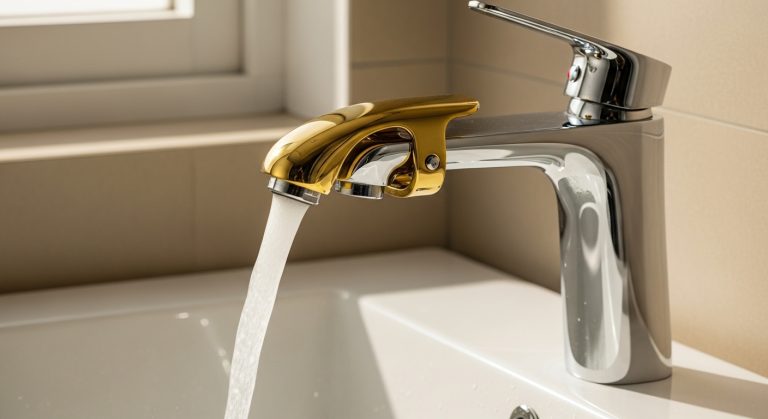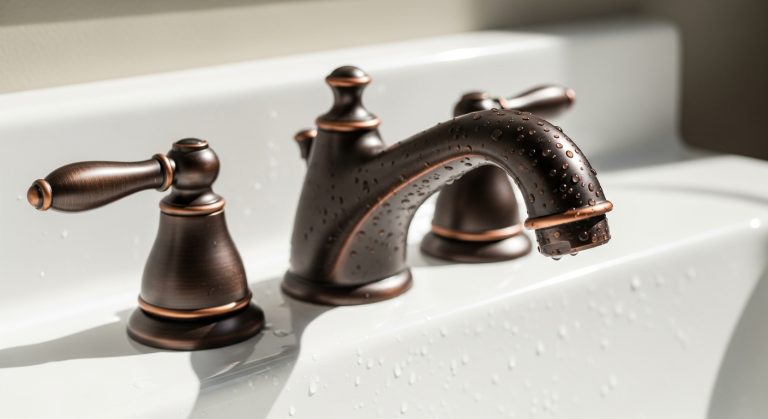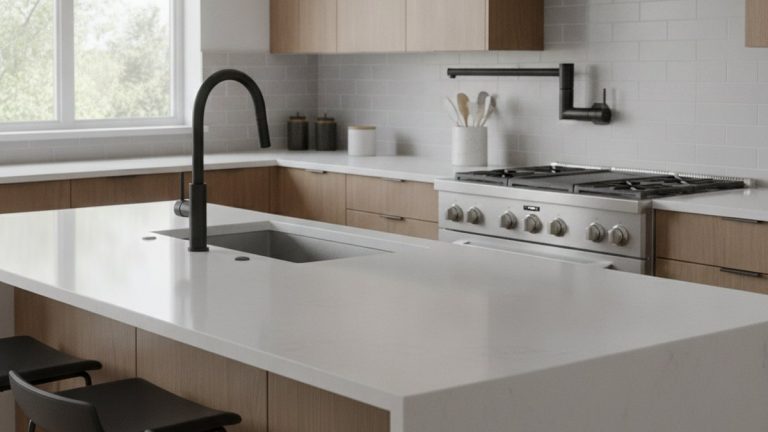
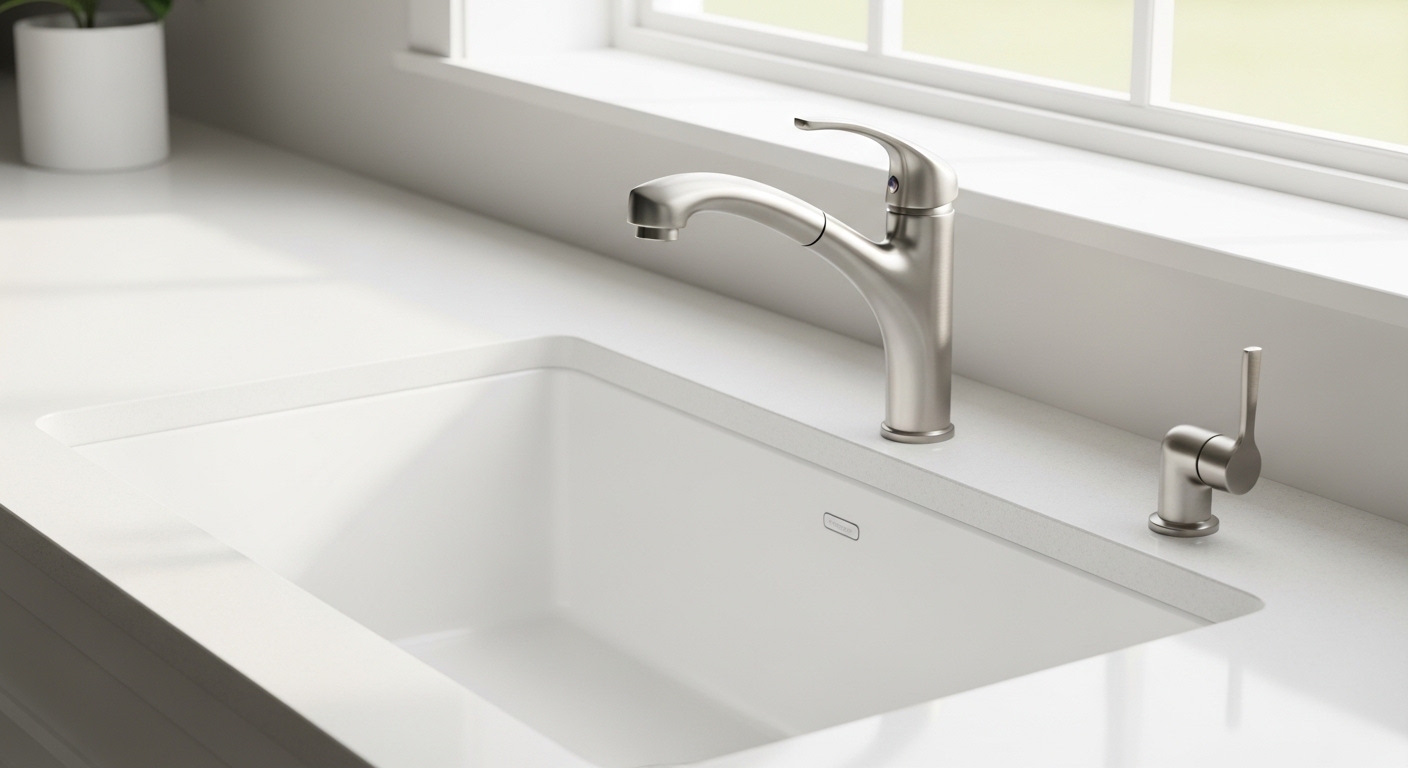
If you’ve ever wrestled with two separate knobs just to get the water temperature right, a single handle faucet sink setup is the upgrade you’ve been looking for. One lever does everything: push it up for more flow, swing it left for hot and right for cold. It’s the most popular faucet style sold in North America right now, and for good reason — it’s faster to use, easier to keep clean, and far simpler to fix than the old two-handle “widespread” designs. This guide walks you through exactly how to choose the right one for your sink, what specs actually matter, and where people get it wrong.
Below, we answer the real questions shoppers ask before buying: how single-handle faucets work, whether they fit your existing sink, kitchen vs. bathroom differences, what finishes hold up, and how to install or repair one without a plumber. Let’s get into it.
What exactly is a single handle faucet sink, and how does it work?
A single handle faucet sink is any sink fitted with a faucet that uses one lever or knob to control both water temperature and water volume. Inside, a single cartridge — usually a ceramic-disc cartridge — mixes hot and cold water based on which way you move the handle. Move the lever up and down to change flow rate; move it side to side to change temperature.
This is different from a two-handle faucet, where one handle controls hot, the other controls cold, and you blend them yourself. The single-handle design puts that mixing job inside the cartridge instead of in your hands, which is why it feels so much more intuitive — especially when your hands are full or covered in raw chicken.
Single-handle faucets generally come in two body styles. A single-hole faucet drops through one hole in your sink or countertop. A centerset single-handle faucet sits on a base plate (often 4 inches wide) that spans the area where older 3-hole sinks had separate handles. That base plate matters a lot for fit, which we’ll cover next.
Will a single handle faucet fit my existing sink, or do I need to change the sink?
In almost all cases, a single handle faucet will fit your existing sink — even a sink drilled for three holes — as long as you add a deck plate (also called an escutcheon). You do not need to replace the sink. The key spec to check is how many mounting holes your sink or countertop has and how far apart they’re spaced.
Here’s the quick way to know what you’re working with: look under the sink or at the back deck. Standard configurations are 1 hole, 3 holes at 4-inch spacing (centerset), or 3 holes at 8-inch spacing (widespread). A single-handle faucet handles all three:
- 1 hole: A single-hole faucet drops straight in. Easiest possible swap.
- 3 holes, 4 inches apart: Buy a single-handle faucet that includes a 4-inch deck plate to cover the two outer holes.
- 3 holes, 8 inches apart: Choose a single-handle model with an 8-inch (widespread-compatible) base plate, or use a large universal deck plate.
If you’re not sure what the holes and parts under your sink are called, our bathroom faucet diagram guide labels every component so you can measure with confidence before you buy. Measuring once saves you a frustrating return.
Single handle kitchen faucet vs. bathroom faucet — what’s the difference?
The core mechanism is identical, but kitchen and bathroom single-handle faucets differ in height, reach, spout style, and flow rate. Kitchen versions are taller with a longer reach (often a pull-down or pull-out sprayer) to fill pots and rinse dishes; bathroom versions are shorter, with a fixed spout sized for a small basin. Picking the wrong category is the most common buying mistake.
Here’s a side-by-side breakdown to make the choice obvious:
| Feature | Single Handle Kitchen Faucet | Single Handle Bathroom Faucet |
|---|---|---|
| Typical spout height | 8–18 inches (high-arc common) | 4–7 inches |
| Sprayer | Often pull-down / pull-out | Rarely; fixed spout |
| Flow rate (US max) | 1.8 GPM | 1.2 GPM |
| Handle position | Top-mounted or side lever | Top-mounted lever |
| Typical price range | $120–$300 | $70–$180 |
| Best for | Pot filling, dish rinsing | Handwashing, grooming |
One detail people overlook: a side-mounted lever on a tall kitchen faucet needs clearance so the handle doesn’t bang into a backsplash or window when you push it all the way up. Measure the distance from your sink’s back edge to the wall before committing to a high-arc model. If you’re replacing a worn pull-down sprayer rather than the whole faucet, our walkthrough on pull-out kitchen faucet hose replacement can save you the cost of a full unit.
What should I look for in a quality single handle faucet under $200?
Under $200, prioritize three things: a ceramic-disc cartridge, a solid-brass (not zinc) faucet body, and a finish backed by a lifetime or limited-lifetime warranty. Those three features separate a faucet that lasts a decade from one that drips within two years. Everything else — pull-down sprayer, magnetic docking, spot-resistant coating — is a nice-to-have on top.
Here’s why each one matters in plain terms:
- Ceramic-disc cartridge: Two polished ceramic discs slide against each other to control flow. They resist hard-water scale and wear far better than older rubber-washer designs, which is why ceramic cartridges rarely drip and are cheap to replace if they ever do.
- Solid-brass body: Brass resists corrosion and holds threads tightly. Cheaper zinc-alloy bodies can crack or corrode where the water sits. Lift the faucet — brass feels noticeably heavier.
- Quality finish: Look for PVD (physical vapor deposition) finishes on brushed nickel, matte black, or brushed gold. PVD bonds the color to the metal so it won’t flake or tarnish.
- Certifications: Check for NSF/ANSI 61 and 372 (lead-free safety) and a WaterSense label for efficiency. cUPC/UPC certification means it meets North American plumbing code.
A faucet that nails those basics will outlast three cheap ones. And because single-handle faucets use a single replaceable cartridge, even a future drip is usually a 15-minute fix rather than a reason to buy new — more on that below.
Which finish holds up best, and does it have to match my sink?
Brushed nickel and matte black are the most forgiving finishes for a single handle faucet sink — they hide water spots and fingerprints far better than polished chrome. Your faucet does not have to match your sink exactly, but it should either match your cabinet hardware or intentionally contrast for a designer look. Mismatched-by-accident is the only real mistake.
A few field-tested guidelines:
- Stainless or white sink: Brushed nickel, chrome, or matte black all work. Black creates a sharp, modern contrast.
- Black or dark granite sink: Matte black for a seamless look, or brushed gold/nickel to pop. We cover this exact pairing in depth in our stainless steel faucet with black sink guide.
- Warm-toned or farmhouse kitchen: Brushed gold or champagne bronze adds warmth without going full vintage.
One practical note on upkeep: brushed and matte finishes show less, but they’re not maintenance-free. Wipe with a soft cloth and avoid abrasive or acidic cleaners, which can dull the coating over time. Spot-resistant PVD finishes make this easy, but no finish survives steel wool.
Can I install a single handle faucet myself, and how long does it take?
Yes — installing a single handle faucet is one of the most DIY-friendly plumbing jobs, typically taking 30 to 60 minutes with basic tools. Because there’s only one body and one set of supply connections (versus three pieces on a widespread faucet), there’s simply less to align and seal. Most people can do it with an adjustable wrench, a basin wrench, and plumber’s tape.
Here’s the basic sequence:
- Turn off both shut-off valves under the sink and open the old faucet to release pressure.
- Disconnect the supply lines and unscrew the old faucet’s mounting nuts (a basin wrench reaches the tight spots).
- Clean the sink deck, then set the new faucet — with its deck plate and gasket — through the hole(s).
- Tighten the mounting nut from below, connect the supply lines (wrap threads with plumber’s tape), and hand-tighten plus a quarter turn.
- Turn the water back on slowly, remove the aerator, and run water for 15 seconds to flush debris before checking for leaks.
The single supply-line connection per side is what makes this faster than a two- or three-piece faucet. If your shut-off valves are old or seized, replace them while you’re under there — it’s cheap insurance against a future flood.
How do I fix a single handle faucet that drips or won’t turn off?
A dripping single handle faucet almost always means a worn or scaled cartridge — and replacing it costs $10–$40 and takes about 20 minutes, no plumber needed. The cartridge is the heart of a single-handle faucet, so when temperature gets erratic, the handle gets stiff, or water won’t fully shut off, the cartridge is the first and usually only suspect.
The repair, in short: shut off the water, pop off the handle cap, remove the handle screw and handle, pull the retaining clip or nut, and slide the old cartridge straight up and out. Take that exact cartridge to the store or match the model number, because cartridges are brand- and series-specific — they are not universal. Drop the new one in, reassemble, and you’re done.
If you want a detailed, brand-specific walkthrough, our guide on faucet cartridge replacement shows the process step by step, and our explainer on the faucet valve cartridge helps you identify exactly which type you have. Single-handle faucets are genuinely cheaper to live with precisely because this one part is so easy to swap.
Are single handle faucets better than two handle faucets?
For most people, yes — single handle faucets are easier to use, easier to install, and easier to repair, which is why they dominate new construction. Two-handle faucets still win on two fronts: a more traditional or symmetrical look, and the ability to isolate one side if a single handle fails. But for everyday function, the single handle is the practical choice.
Quick decision guide: choose a single handle if you want one-touch temperature control, a cleaner counter with fewer crevices to scrub, and the simplest possible repair down the road. Choose two handles if you’re matching a classic or period bathroom, or you specifically want hot and cold on opposite sides. There’s no wrong answer — it comes down to style preference and how much you value the convenience.
Why buy a single handle faucet from faucitta?
faucitta engineers every single handle faucet sink model around the three things that actually determine lifespan: a ceramic-disc cartridge rated for 500,000 open-close cycles, a lead-free solid-brass body certified to NSF/ANSI 61 and 372, and PVD finishes that resist tarnish and scratching. Each faucet is pressure-tested before it ships and backed by a limited-lifetime warranty on the finish and cartridge.
We focus exclusively on faucets and bathroom fixtures — it’s all we make — so our team obsesses over the details that bigger general-home brands skip, like aerator flow consistency, handle torque, and finish durability under daily cleaning. That focus is why our single-handle faucets are built to be the easy, reliable choice they’re supposed to be.
FAQ
Do single handle faucets need a special sink?
No. A single handle faucet fits single-hole, 4-inch centerset, and 8-inch widespread sinks alike. For sinks with extra holes, a deck plate (escutcheon) covers them. Just confirm your hole count and spacing before ordering, and choose a model that includes the matching deck plate.
What is the cartridge inside a single handle faucet, and is it universal?
The cartridge is the valve that mixes hot and cold water and controls flow. Most quality single-handle faucets use a ceramic-disc cartridge. Cartridges are not universal — they’re specific to each brand and series, so always match the exact part number or bring the old one to the store.
How long does a single handle faucet last?
A well-built single handle faucet with a solid-brass body and ceramic-disc cartridge lasts 10 to 15 years or more. The finish typically outlives the cartridge, and since the cartridge is a cheap, easy swap, the faucet body itself can serve well beyond a decade.
Can I replace a two handle faucet with a single handle faucet?
Yes. If your sink has three holes (the two outer ones held the old handles), choose a single-handle faucet with a deck plate sized to your hole spacing — 4 inches for centerset or 8 inches for widespread. The deck plate hides the unused holes for a clean finished look.
What flow rate should a single handle faucet have?
In the U.S., kitchen faucets are capped at 1.8 GPM and bathroom faucets at 1.2 GPM. Look for a WaterSense-labeled model to save water without losing usable pressure. A quality aerator keeps the stream feeling strong even at lower flow rates.
Why is my new single handle faucet handle stiff?
A stiff handle on a new faucet is usually debris caught in the cartridge from installation or a cartridge that needs seating. Flush the lines (remove the aerator and run water before first use), and make sure the retaining nut isn’t over-tightened. If it persists, reseat or replace the cartridge.
Author’s note: This guide was written by faucitta’s product and installation team, drawing on hands-on testing of single-handle faucet cartridges, finishes, and mounting hardware across kitchen and bathroom builds. All certification and flow-rate figures reflect current U.S. plumbing standards (NSF/ANSI 61 & 372, EPA WaterSense). Always follow your faucet’s included instructions and local plumbing code.