If your sprayer is dribbling, refusing to retract, or spitting water under the cabinet, a pull out kitchen faucet hose replacement is almost always the fix — and it’s one of the most beginner-friendly faucet repairs you’ll ever do. You don’t need a plumber, you don’t need to rip out the faucet, and in most kitchens you don’t even need to disconnect the supply lines. This guide walks you through what to buy, how to size it, how to swap it in under an hour, and how to avoid the three mistakes that send people back to the hardware store.
At faucitta, we design and test pull-down and pull-out kitchen faucets across more than a dozen finishes, so we see hose failures up close — the braided sleeve fraying near the weight, the PEX inner tube cracking at the quick-connect, the rubber gasket that finally gives up after eight years of being yanked. The good news: the hose is a wear part, just like a car’s brake pad. It’s meant to be replaced.
How do I know if my pull-out hose actually needs replacing, or if it’s something else?
If you see water dripping from the hose itself, a kink that won’t straighten, or the sprayer head won’t retract smoothly into the spout — it’s the hose. If the faucet drips from the spout tip when fully off, or the handle is stiff, that’s the cartridge, not the hose. Diagnose before you buy.
Here’s the five-minute test I have customers run before they order a replacement:
- Dry the cabinet floor, then run the sprayer for 60 seconds. Pull the head all the way out, spray into the sink, and retract it. Then check under the sink with a flashlight. Wet hose body = hose failure. Wet only at the supply connections = those connections need tightening, not a new hose.
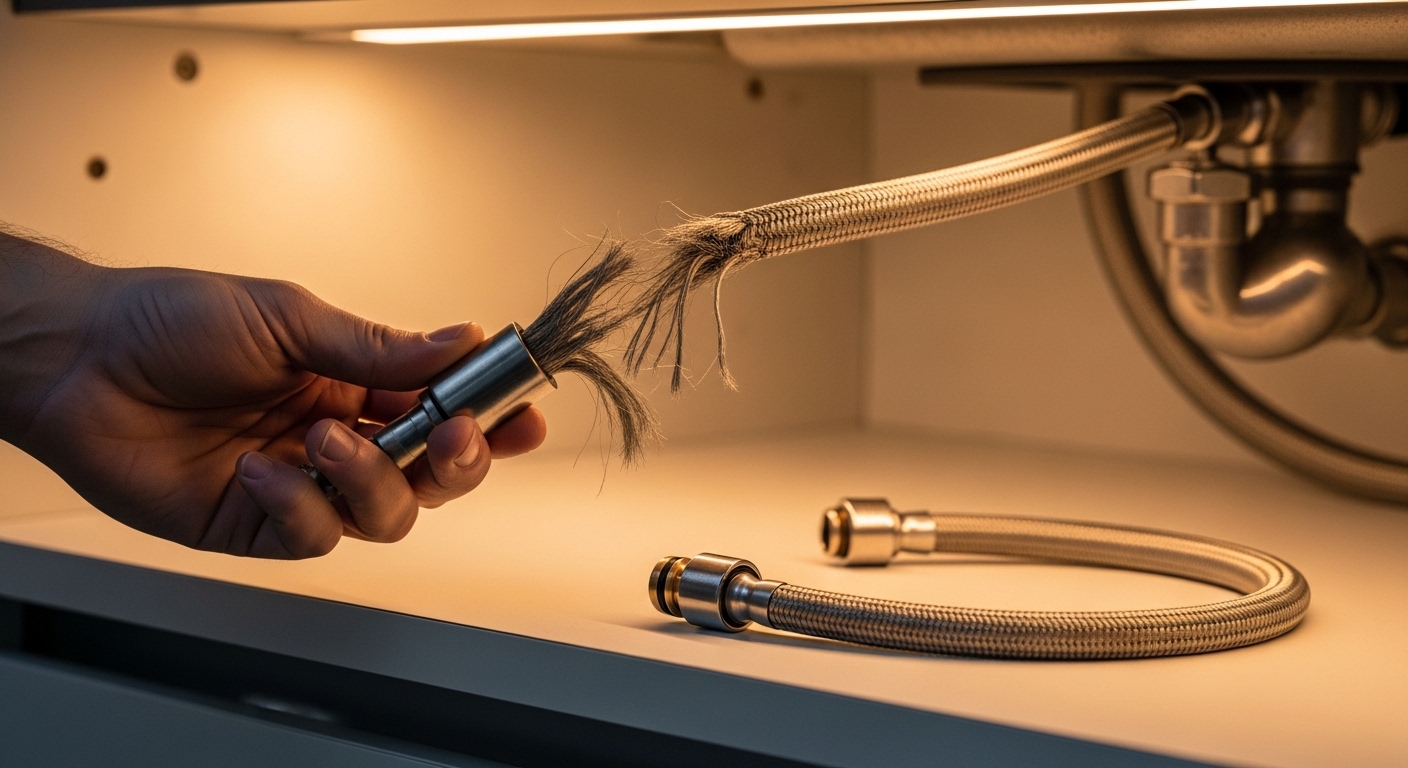
- Squeeze the hose along its length. A healthy braided hose feels firm and round. If you feel soft spots, lumps, or hear a faint crunch (that’s brittle PEX), the inner tube is degrading.
- Test the retraction weight. If the sprayer head won’t pull back into the spout, the issue is usually the counterweight slipping off the hose or hitting a P-trap — not a hose failure. Reseat the weight before spending money.
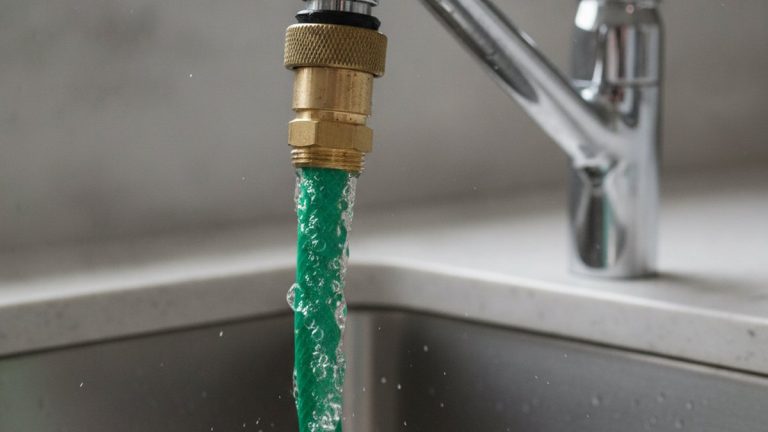
- Check the quick-connect. Pop the head off and look at the brass or plastic fitting. White mineral crust or a green corrosion ring means hard water has eaten the O-ring; a new hose comes with a new O-ring and solves it.
- Smell the water at the sprayer. A faint plastic or rubber taste after the faucet sits unused means the inner liner is breaking down — replace the hose even if it isn’t leaking yet.
If the spout itself is leaking or the water comes out rusty regardless of which faucet you use, the hose isn’t the culprit — see our guide on rusty water out of the faucet to track down the real source before you start ordering parts.
What kind of replacement hose do I actually need to buy?
You need a hose that matches three things: the connector on your sprayer head, the connector on your faucet body, and the length of your old hose (usually 56″ to 80″). Most modern pull-out faucets — Moen, Delta, Kohler, Pfister, and faucitta included — use a standardized 1/2″-14 thread or a brand-specific quick-connect at the faucet head, and a 3/8″ compression or quick-connect at the supply end.
Before you order, take the old hose to the sink and measure:
- Length: Stretch it out fully (not coiled) and measure from fitting to fitting. Under-buying length is the #1 mistake — if you’ve got a deep base cabinet or a garbage disposal, get a 68″–80″ hose so the weight has room to move.
- Sprayer-end fitting: Unscrew the sprayer head. If you see standard threads, a universal 1/2″-14 hose will work. If you see a plastic clip-in (Delta MagnaTite, Moen Reflex, Kohler DockNetik), buy the brand-specific OEM hose.
- Faucet-end fitting: Most are 3/8″ compression nuts. Some Moen and Kohler models use a proprietary quick-connect with a colored collar — those snap on without tools.
- Sleeve material: Braided stainless steel outlasts nylon-braided PVC by roughly 3–5 years in hard water. Worth the extra $5.
- Inner tube: Look for PEX-A or EPDM rubber. Both are NSF/ANSI 61 certified for drinking water; avoid anything that doesn’t list a lead-free or NSF certification.
If you’re not sure what’s behind your spout, a quick look at a labeled faucet diagram can save you a return trip — the same anatomy applies to most pull-out kitchen faucets. Note the connector style at the head and the supply, then match it.
Universal hose vs. OEM brand hose — which one should I get?
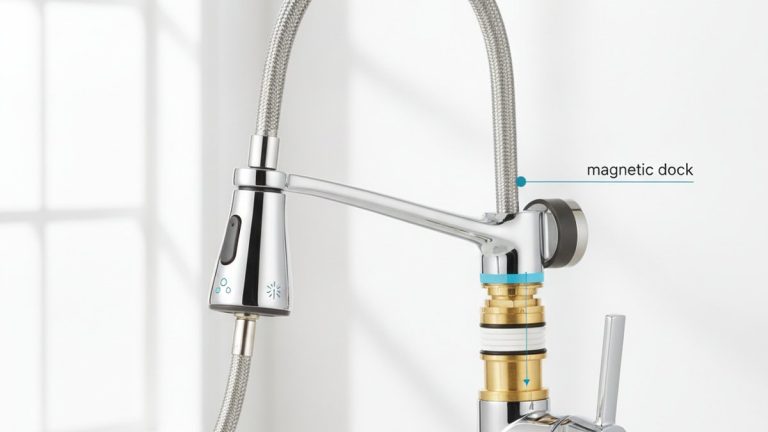
Buy OEM if your faucet has a magnetic or proprietary docking system (MagnaTite, Reflex, DockNetik) — universals don’t dock properly. Buy a universal braided hose for any standard threaded pull-out, because it’s half the price and outlasts most OEM nylon hoses.
Here’s the practical comparison most homeowners need:
| Hose Type | Typical Price | Best For | Lifespan | Notes |
|---|---|---|---|---|
| Universal braided stainless 1/2″-14 | $15–$25 | Most threaded pull-out faucets (faucitta, Pfister, generic) | 7–10 years | Fits 90% of pull-outs; check thread before ordering |
| Moen 150259 (Reflex hose) | $35–$55 | Moen Reflex pull-down models (Arbor, Align, Sleek) | 5–8 years | OEM only — the docking spring won’t work without it |
| Delta RP50390 / RP62057 (MagnaTite) | $30–$50 | Delta Trinsic, Leland, Essa, Cassidy pull-downs | 5–8 years | Magnetic puck at the head must match |
| Kohler GP1059291 (DockNetik) | $40–$70 | Kohler Simplice, Bellera, Artifacts | 6–9 years | Most expensive but includes weight clip |
| Generic nylon-braided PVC | $8–$14 | Short-term fix only | 2–4 years | Skip it — false economy in hard water |
One more buying tip: order a hose that comes with the counterweight included or a separate clamp-on weight. The weight is what pulls the sprayer back into the spout. If yours has gone missing or won’t grip the new (often slimmer) hose, a $6 universal clamp weight saves a frustrating afternoon.
How do I actually replace the pull out kitchen faucet hose? (Step by step)
Shut off the hot and cold supply valves under the sink, disconnect the old hose at the sprayer head and at the faucet body, slide off the counterweight, pull the old hose up through the spout, feed the new hose down through the spout, slip the weight back on, and reconnect both ends. Total time: 20–40 minutes.
Tools you’ll need:
- Adjustable wrench or 14mm/17mm open-end wrench
- Flashlight or headlamp
- Old towel for the cabinet floor
- Small bucket (you’ll get a cup of leftover water)
- Plumber’s tape (PTFE) — only if your fittings are threaded, not quick-connect
The full sequence:
- Turn off both supply valves under the sink. Then open the faucet to relieve pressure. You should get a brief trickle and then nothing.
- Clear the cabinet so you have working room. Lay your towel down. Photograph the existing setup with your phone before you touch anything — this is your reassembly cheat sheet.
- Pull the sprayer head out of the spout until you see the connector. Unscrew the sprayer head from the hose (counterclockwise). On magnetic-dock models, pull firmly; on Moen Reflex, squeeze the white tabs.
- Slide the counterweight off the hose. Most weights are two halves held by a screw or a snap clip — loosen the screw and the weight falls into your hand. Set it aside; you’ll reuse it.
- Disconnect the hose at the faucet body. If it’s a 3/8″ compression fitting, use the wrench (hold the faucet shank with a second wrench or by hand to prevent twisting the supply line). If it’s a quick-connect, push the collar in and pull the hose down.
- Pull the old hose up through the spout. It threads up and out the top. If it sticks, gently rotate while pulling — it’s clearing the cartridge body.
- Feed the new hose down through the spout. Sprayer-head end stays on top, supply end goes down through the faucet body into the cabinet. Don’t kink it.
- Slip the counterweight onto the new hose at roughly the same height as before — usually 8″–12″ below the faucet body. Tighten the screw.
- Reconnect the supply end to the faucet body. Hand-tighten plus a quarter turn with the wrench. Overtightening cracks the plastic shank — don’t muscle it.
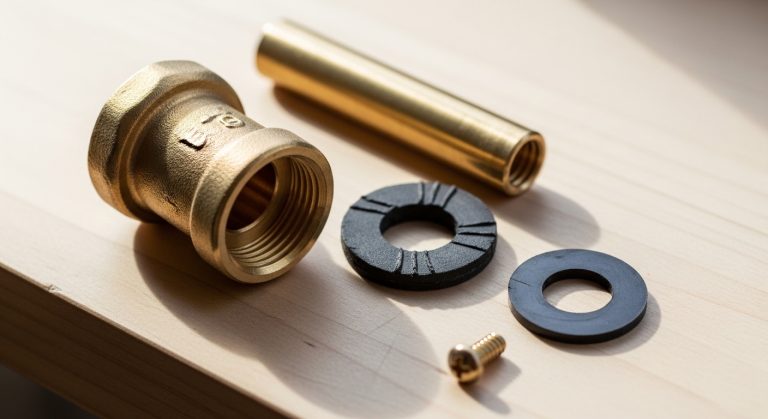
- Screw the sprayer head onto the top of the hose. Use the new O-ring or rubber washer included in the kit. Hand-tight is enough — these are designed to seal on the gasket, not on thread torque.
- Turn the supply valves back on slowly. Run cold and hot for 30 seconds each, check every connection with a dry paper towel, then pull the sprayer out and retract it five or six times to make sure the weight is positioned correctly.
If you’ve ever done a cartridge swap — say, an Empire faucet cartridge replacement or a bathtub faucet valve cartridge — you’ll find the hose job significantly easier. No splines, no temperature limit stop, no surprise springs flying out.
Why does my new pull-out hose keep leaking, or not retract?
Nine times out of ten, post-install problems come from three things: a missing or pinched O-ring at the sprayer head, an overtightened compression fitting that cracked the shank, or a counterweight that’s hitting the P-trap, garbage disposal, or cabinet wall. None of these mean the hose is defective.
The fixes:
- Leak at the sprayer head: Unscrew the head, confirm the rubber O-ring is seated flat in the groove (not twisted), add a thin smear of silicone plumber’s grease, retighten hand-tight.
- Leak at the supply end: If it’s a compression fitting, back it off, wrap two turns of PTFE tape clockwise around the male threads, retighten gently. If it’s a quick-connect, the collar isn’t fully snapped — push it in until you hear a click and tug-test.
- Sprayer won’t retract: The counterweight is either too high (move it 2″–3″ lower), too light (clamp a second weight on), or catching on the disposal. Reroute the hose so the weight has a clear drop zone.
- Sprayer slams back too hard: Weight is too low or too heavy — slide it up the hose until retraction feels gentle.
- Reduced water pressure after install: Unscrew the sprayer head and check for the small mesh aerator screen — debris from the supply line often clogs it during install. Rinse and reinstall.
One under-discussed cause of repeat leaks: hard water. If you live with municipal water above 7 grains per gallon of hardness, mineral buildup will chew through O-rings and the inner PEX liner faster than the hose’s rated lifespan. A whole-house softener helps, but at minimum, descale your faucet head every 3 months by soaking it in 1 part white vinegar to 3 parts water for 30 minutes.
How often should I replace a pull-out hose, and is it worth upgrading the whole faucet instead?
Replace a pull-out hose every 5–10 years, or sooner if you have hard water or a heavily used kitchen. Replacement is worth it when the faucet body, cartridge, and finish are still in good shape; upgrade the whole faucet if it’s over 12 years old, the finish is pitting, or the cartridge has also failed — by then a $25 hose is a band-aid on a $300 problem.
Here’s the rough decision matrix our customer service team uses:
| Faucet Age | Symptoms | Recommended Action | Estimated Cost |
|---|---|---|---|
| 0–6 years | Hose leak only | Replace hose | $15–$35 |
| 6–10 years | Hose leak + slow drip from spout | Replace hose + cartridge | $30–$70 |
| 10–12 years | Multiple issues, finish still good | Replace hose, cartridge, aerator | $45–$90 |
| 12+ years | Pitted finish, stiff handle, recurring leaks | Replace entire faucet | $180–$450 |
| Any age | Magnetic dock no longer holds | OEM hose + dock magnet kit | $40–$80 |
If you’re already in the cabinet and considering a full upgrade, this is also the moment to think about finish coordination — a fresh pull-down in brushed stainless next to a matte black sink or a warmer oil-rubbed bronze paired with stainless can transform the kitchen without a remodel. But if you’re happy with the look you have, a hose swap is the most cost-effective faucet repair on earth.
What about safety, standards, and warranty on replacement hoses?
Always buy a hose certified to NSF/ANSI 61 (drinking-water safety) and NSF/ANSI 372 (lead-free). The inner liner is in constant contact with your drinking water, and uncertified hoses — especially cheap import PVC — can leach lead and BPA. Reputable brands list these certifications on the package or product page; if you can’t find them, don’t buy it.
At faucitta, every replacement hose we sell carries:
- NSF/ANSI 61 + 372 drinking water certification
- Lead-free brass fittings (≤0.25% lead by weighted average per the Safe Drinking Water Act)
- 500,000-cycle bend test rating (roughly 30+ years of normal household use on the sleeve itself)
- A 5-year limited warranty when installed per the included instructions
Two safety notes most guides skip: never use a hose rated for cold water only on a hot/cold mixed line — pull-out hoses carry tempered water from the cartridge, so they must be dual-temp rated. And don’t reuse old O-rings. They take a permanent set after a year of compression and won’t seal reliably on a new hose, even if they look fine.
FAQ
Can I replace a pull-out kitchen faucet hose without turning off the water?
No. Even with the faucet handle in the off position, the supply lines stay pressurized up to the cartridge — disconnecting the hose without shutting off the under-sink valves will spray water into the cabinet within seconds. Always close both hot and cold valves and relieve pressure by opening the faucet before you start.
Are pull-out faucet hoses universal?
Mostly yes, but with one big exception. Universal 1/2″-14 threaded hoses fit roughly 90% of pull-out faucets, including most faucitta, Pfister, and generic models. But Moen Reflex, Delta MagnaTite, and Kohler DockNetik use proprietary quick-connects that only work with OEM hoses — a universal won’t dock properly even if it physically threads on.
Why does my pull-out sprayer keep falling out of the spout?
The most common cause is a counterweight that’s slipped down the hose or fallen off entirely. Look under the sink — the weight should be clamped 8″–12″ below the faucet body. If it’s missing, a $6 universal clamp-on weight from any hardware store fixes it in five minutes. Less commonly, the magnetic or spring dock inside the spout has failed and needs OEM replacement.
How long does a pull-out kitchen faucet hose typically last?
5 to 10 years for a quality braided stainless hose with PEX or EPDM lining, in average water conditions. Hard water (above 7 gpg) cuts that to 4–7 years because minerals attack the O-rings and inner tube. Nylon-braided PVC budget hoses often fail in 2–4 years, which is why we don’t recommend them even though they look identical on the shelf.
Do I need a plumber for a pull out kitchen faucet hose replacement?
No, this is one of the easiest faucet repairs a homeowner can do. If you can use an adjustable wrench and fit your head inside a base cabinet, you can swap a hose in 20–40 minutes. Call a plumber only if the faucet shank is corroded onto the sink, the supply lines themselves are leaking, or you discover the cartridge is also failing and you’d rather not tackle both at once.
Can I use plumber’s tape on a quick-connect hose fitting?
No — PTFE tape goes only on threaded fittings. Quick-connects rely on an internal O-ring and a locking collar; tape will prevent the O-ring from seating and cause a leak. Reserve PTFE for the 3/8″ compression nut at the supply end if your hose uses one, and even there, two turns max wrapped clockwise.
What’s the difference between a pull-out and a pull-down faucet hose?
Functionally, very little — both use the same braided hose construction and similar fittings. Pull-out spouts are shorter and pull horizontally toward you, so the hose travels further and gets more flex cycles, which is why pull-out hoses tend to fail slightly sooner than pull-down equivalents. Replacement procedure is identical.
Author note: This guide was written by the faucitta product team, drawing on 12+ years of in-house faucet design, finish testing, and customer service data across more than 80,000 pull-out and pull-down installations. faucitta engineers test every hose to NSF/ANSI 61 and 372 standards and back replacement parts with a 5-year limited warranty. For questions specific to your faucet model, our support team responds within one business day at faucitta.net.