An 11 spout reach kitchen faucet is a faucet whose spout stretches 11 inches out over the sink, measured from the center of the faucet base to the center of the water stream where it hits the bottom of the bowl. That single number decides whether your water lands squarely over the drain or splashes against the front lip of the sink — so it matters far more than most people realize when they’re staring at product photos online. If you have a large single-bowl sink, a farmhouse apron sink, or you’re constantly rinsing sheet pans and stockpots, an 11-inch reach is often the sweet spot.
Below I’ll walk through exactly what “spout reach” measures (and how it’s different from spout height), who an 11-inch reach is genuinely right for, who should size down, and how to check it against your own sink before you buy. I’ve specced hundreds of kitchen faucets, and reach is the number people get wrong most often.
What exactly does “11 spout reach” measure on a kitchen faucet?
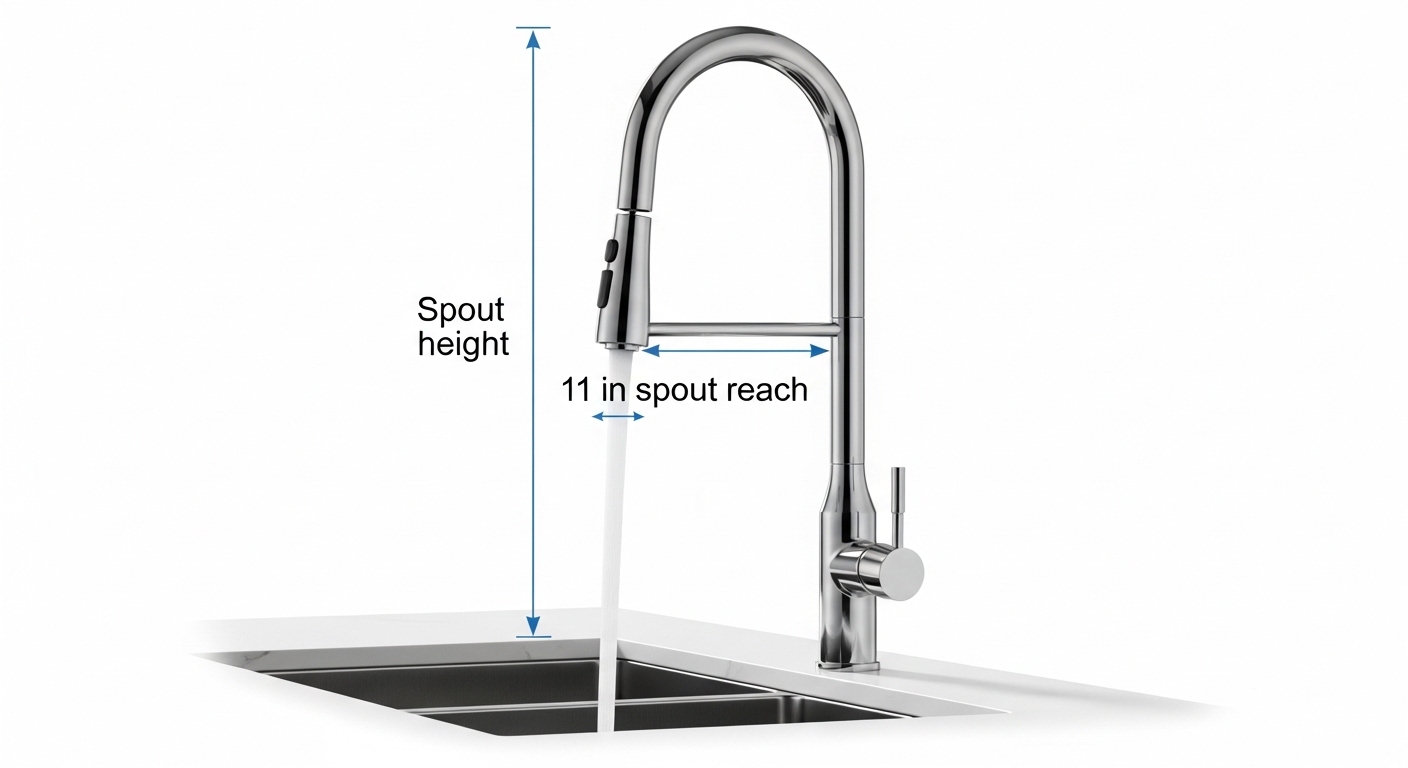
Spout reach is the horizontal distance the water travels out from the faucet base — 11 inches, in this case — measured to the center of the aerator stream, not to the tip of the spout. It’s a horizontal measurement, taken looking straight down at the sink from above. This is the single most important number for making sure your water actually lands over the drain instead of near the back wall or over the front edge.
People constantly confuse three different measurements, so let’s separate them cleanly:
- Spout reach (11 in): how far the water stream lands out from the base. Horizontal.
- Spout height: how far the spout rises up from the deck — usually 8 to 18 inches on kitchen faucets. Vertical. Controls how tall a pot you can slide underneath.
- Total height: the very top of the faucet arc, which matters for window clearance behind the sink.
An 11-inch reach paired with a tall gooseneck spout (say 9–10 inches of height) gives you that classic high-arc commercial look with plenty of room to wash a stockpot — but the reach is what centers the water. Two faucets can both be “high-arc” and have wildly different reach. Always read the spec sheet, not the silhouette.
Is an 11-inch spout reach too long for a standard kitchen sink?
For most standard sinks, no — 11 inches is a strong, versatile reach. A standard single-bowl kitchen sink is about 22 to 30 inches wide front-to-back and roughly 20–22 inches deep (front to back). With the faucet mounted in the typical rear position, an 11-inch reach drops the stream right around the center of the bowl, which is exactly where the drain usually sits. That’s the goal: water hitting the drain, not the sink wall or your countertop.
Where 11 inches becomes “too long” is on smaller or shallower setups:
| Sink type | Typical front-to-back depth | Is 11″ reach a good fit? |
|---|---|---|
| Large single-bowl / farmhouse | 20–24 in | Excellent — lands over the drain |
| Standard double-bowl | 20–22 in | Good — reaches both bowls |
| Small / bar / prep sink | 12–16 in | Often too long — stream overshoots toward the front lip |
| Shallow drop-in (basic builder) | 16–18 in | Borderline — check faucet mount position |
| Undermount, wide bowl | 21–24 in | Excellent |
The failure mode to avoid: a long 11-inch reach over a small, shallow bowl. The water lands near the front of the bowl or, worse, on the flat sink deck, and you get splash-back all over your shirt and the counter. If your sink is under 18 inches deep, measure carefully before committing to an 11-inch reach — a 9- or 9.5-inch reach may serve you better.
Who actually benefits from an 11-inch reach — and who should size down?
An 11-inch spout reach is the right call if you have a big sink and cook seriously; it’s overkill if your sink is small or your faucet mounts close to the bowl. The reach should be matched to the bowl, not chosen for looks.
Buy the 11-inch reach if you:
- Have a large single-bowl or farmhouse sink 20+ inches deep.
- Regularly fill or wash tall stockpots, canning pots, or sheet pans.
- Run a double-bowl sink and want to swing the spout to cover both bowls easily.
- Want that high-arc, semi-professional kitchen look with real functional clearance.
Size down (to roughly 8–9.5 inches) if you:
- Have a compact, bar, or prep sink under 18 inches deep.
- Have a shallow bowl where a long reach would splash.
- Mount your faucet very close to the front edge of the bowl.
- Have limited clearance and don’t want the spout jutting far into the room.
One important nuance: most modern kitchen faucets are pull-down or pull-out designs. With a pull-down sprayer, the fixed reach matters a little less because you can pull the wand out and aim it anywhere — but the “docked” reach still determines where water lands during hands-free tasks like filling a pot. So even with a sprayer, don’t ignore the 11-inch number. If you’re weighing single- versus double-handle control alongside reach, our guide on the best single-handle faucet for a sink breaks down how handle style affects everyday one-handed use.
How do I measure my sink to confirm an 11-inch reach will fit?
Grab a tape measure and check three numbers before you buy: your sink’s front-to-back depth, the distance from your faucet hole to the front of the bowl, and your rear clearance. Here’s the quick method:
- Measure the bowl front-to-back (inside edges). This tells you how far the water could travel and still land in the sink. For a centered stream, you want your faucet’s reach to land roughly at the middle of this number.
- Find your faucet hole’s setback. Measure from the center of the existing faucet mounting hole to the near (front) inside edge of the bowl. If your hole sits 2 inches behind the bowl’s back edge, subtract that when estimating where an 11-inch reach lands.
- Check rear/window clearance. A high-arc 11-inch faucet needs room behind it. Measure from the faucet hole to any backsplash, wall, or window sill, and compare against the faucet’s total height and how far back the handle swings.
- Do the landing math. Faucet-hole setback + spout reach = distance from the back edge where water lands. If that number is comfortably less than your bowl depth, you’re centered. If it’s close to or beyond the bowl depth, the reach is too long.
Quick example: your bowl is 21 inches deep, and the faucet hole sits 2 inches behind the back edge. An 11-inch reach lands 13 inches from the back edge — that’s about 8 inches from the front, right around center. Perfect. Now imagine a 15-inch-deep prep sink with the same 2-inch setback: 11 inches of reach lands 13 inches back, only 2 inches from the front lip. That’s a splash machine — size down.
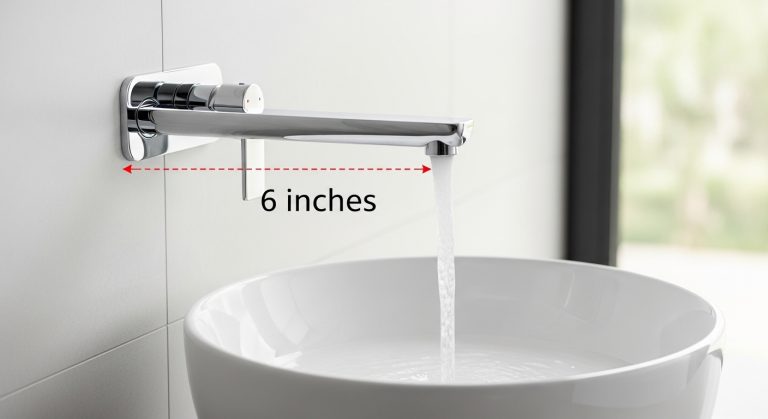
This is the exact same logic we cover for wall-mounted faucets, where reach is even more critical because the faucet sits above and behind the basin. If you want to see how reach math plays out on a shorter spec, our explainer on the 6″ spout reach wall mount faucet walks through the small-sink end of the spectrum.
What spout height should pair with an 11-inch reach?
Pair an 11-inch reach with a spout height of roughly 8–10 inches for a big single-bowl sink, and drop to 6–8 inches if there’s a window behind the sink. Reach and height are independent, and getting both right is what makes a faucet feel effortless instead of awkward.
Here’s how the two numbers work together:
| Use case | Ideal spout reach | Ideal spout height |
|---|---|---|
| Large single-bowl, serious cooking | 10–11 in | 8–10 in (high-arc) |
| Double-bowl, everyday family use | 9–11 in | 7–9 in |
| Sink under a window | 9–11 in | 5–7 in (low-arc) |
| Small prep / bar sink | 7–9 in | 5–8 in |
A tall arc plus an 11-inch reach is the combination you want if filling pots is your daily reality — you get vertical clearance to slide a stockpot under, and horizontal reach to center the fill. But if you have a window sill 12 inches above the deck, that high arc won’t clear it, so you’d keep the 11-inch reach and choose a lower, more angular spout instead. Reach solves the horizontal problem; height solves the vertical one. Don’t trade one for the other.
Does spout reach affect water pressure or splashing?
Reach itself doesn’t change your water pressure, but a longer reach combined with a tall spout increases the drop distance, which can raise splashing if your bowl is shallow or flat-bottomed. The fix is almost always the aerator and the bowl depth, not the reach.
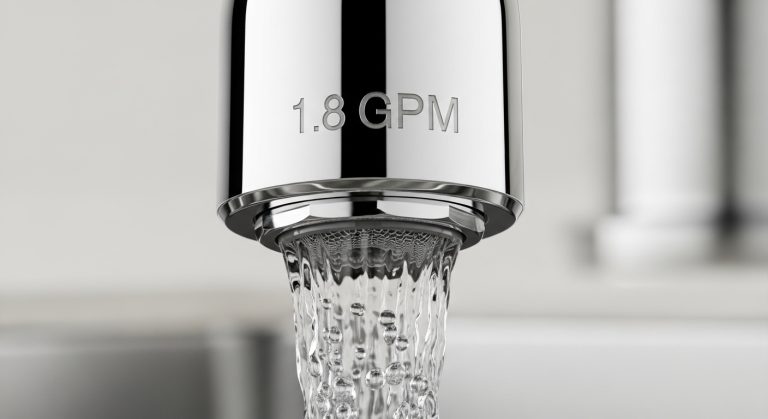
Water pressure at the faucet is governed by your home’s supply pressure, the valve/cartridge, and the aerator flow rate (measured in GPM — most kitchen faucets are 1.5 to 1.8 GPM by federal standard). An 11-inch spout delivers the same GPM as a 7-inch spout from the same faucet body. What a long, tall spout can do is let the stream fall farther before it hits the bowl, so on a shallow sink it lands harder and splashes more.
Three practical ways to keep an 11-inch-reach faucet splash-free:
- Choose a sink at least 8–10 inches deep (top to bottom) to absorb the drop.
- Look for a faucet with a good aerated stream rather than a hard laminar jet for everyday tasks.
- Confirm the reach centers over the drain, so the stream hits the deepest point, not the flat shoulder of the bowl.
If you’re troubleshooting an existing faucet that sprays or dribbles wrong, that’s usually a cartridge, aerator, or hose issue rather than a reach problem — and it’s often a quick DIY fix.
What should I look for in a quality 11-inch-reach kitchen faucet?
Prioritize a solid brass or stainless body, a ceramic-disc cartridge, a physical-vapor-deposition (PVD) finish, and a real warranty — the reach number tells you nothing about durability. A long spout on a flimsy body just wobbles more.
The build-quality checklist I use:
- Body material: solid brass or stainless steel resists corrosion far better than zinc alloy.
- Cartridge: ceramic-disc valves are the industry standard for smooth, drip-free operation over years of use.
- Finish: PVD-coated finishes (brushed nickel, matte black, spot-resist stainless) hold up to scrubbing; cheap electroplating scratches.
- Sprayer docking: on pull-downs, a magnetic dock keeps the wand from sagging over time.
- Certification & warranty: look for products tested to ANSI/NSF and cUPC standards, plus a limited lifetime warranty on the finish and function.
Finish matters for how the faucet ages, not just how it looks day one. If you’re leaning toward a warm, hides-water-spots finish, our deep dive on a brushed nickel kitchen faucet setup covers how those finishes wear. And if you’re still shortlisting manufacturers, the roundup of the best kitchen faucet brands for 2026 is the fastest way to narrow the field before you obsess over the exact reach spec.
FAQ
Is an 11-inch spout reach the same as an 11-inch spout height?
No. Spout reach (11 inches) is the horizontal distance the water travels out from the base to where the stream lands. Spout height is the vertical distance the spout rises from the deck. A faucet can have an 11-inch reach with an 8-inch height, or vice versa — always check both numbers on the spec sheet.
Will an 11-inch reach kitchen faucet fit a double-bowl sink?
Yes, and it’s often ideal. A long 11-inch reach lets you swing the spout to cover both bowls without water hitting the divider. Just confirm the faucet’s swivel range (many rotate 360°) so it clears both basins comfortably.
Is 11 inches too much reach for a farmhouse apron sink?
Usually it’s perfect. Farmhouse sinks are wide and deep — often 20–24 inches front to back — so an 11-inch reach lands the stream near the center over the drain. The deep bowl also absorbs the water drop, keeping splashing low. Just double-check your faucet-hole setback, since apron sinks sometimes mount the faucet farther back.
Does a longer spout reach reduce water pressure?
No. Water pressure and flow rate (GPM) are set by your home’s supply, the cartridge, and the aerator — not by how far the spout extends. An 11-inch spout delivers the same flow as a shorter one on the same faucet body. A longer, taller spout can increase splashing on shallow sinks, but that’s about drop distance, not pressure.
Can I replace my current faucet with an 11-inch reach model without changing my sink?
In most cases, yes, as long as your faucet hole configuration matches (single-hole vs. widespread) and you’ve confirmed the reach centers over your bowl. Measure your bowl depth and faucet-hole setback first. If your existing sink is small or shallow, an 11-inch reach may splash — in that case, a 9-inch reach is a safer swap.
What deck plate or hole setup does an 11-inch reach faucet need?
Reach has nothing to do with mounting — that’s determined by your sink’s hole count. Single-hole 11-inch faucets need one hole; three-hole sinks can use a single-hole faucet with an included escutcheon/deck plate to cover the extra holes. Check whether a deck plate is included before you buy.
The bottom line
An 11 spout reach kitchen faucet is a large, versatile reach that shines over big single-bowl, double-bowl, and farmhouse sinks — landing water over the drain and giving you room to fill tall pots. The only real mistake is pairing that long reach with a small or shallow sink, where it splashes. Measure your bowl depth and faucet-hole setback, match the height to your clearance, and you’ll get a faucet that feels effortless every day. If you’re also weighing budget against features, our breakdown of the best budget kitchen faucet under $200 pairs nicely with this sizing guide.
About the author: This guide was written by the faucitta fixtures team, who spec, install, and stress-test kitchen and bath faucets across hundreds of sink configurations each year. faucitta is a dedicated faucet and bathroom-fixtures brand, and every sizing recommendation here reflects real-world install experience — not marketing copy. We recommend choosing faucets tested to ANSI/NSF and cUPC standards and backed by a limited lifetime warranty on finish and function, so your fixture holds up long after the reach number stops mattering.