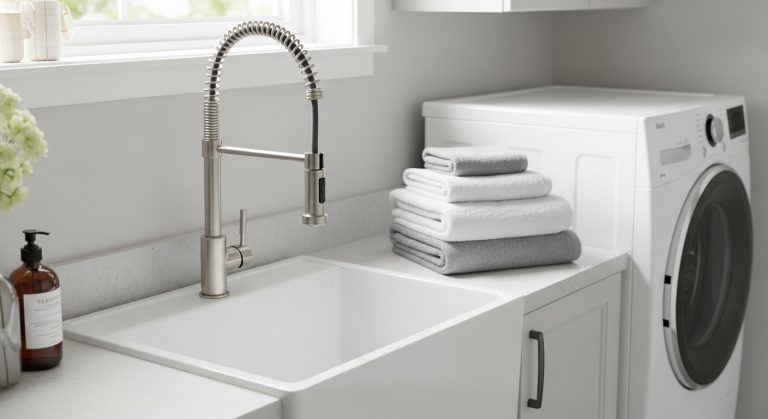
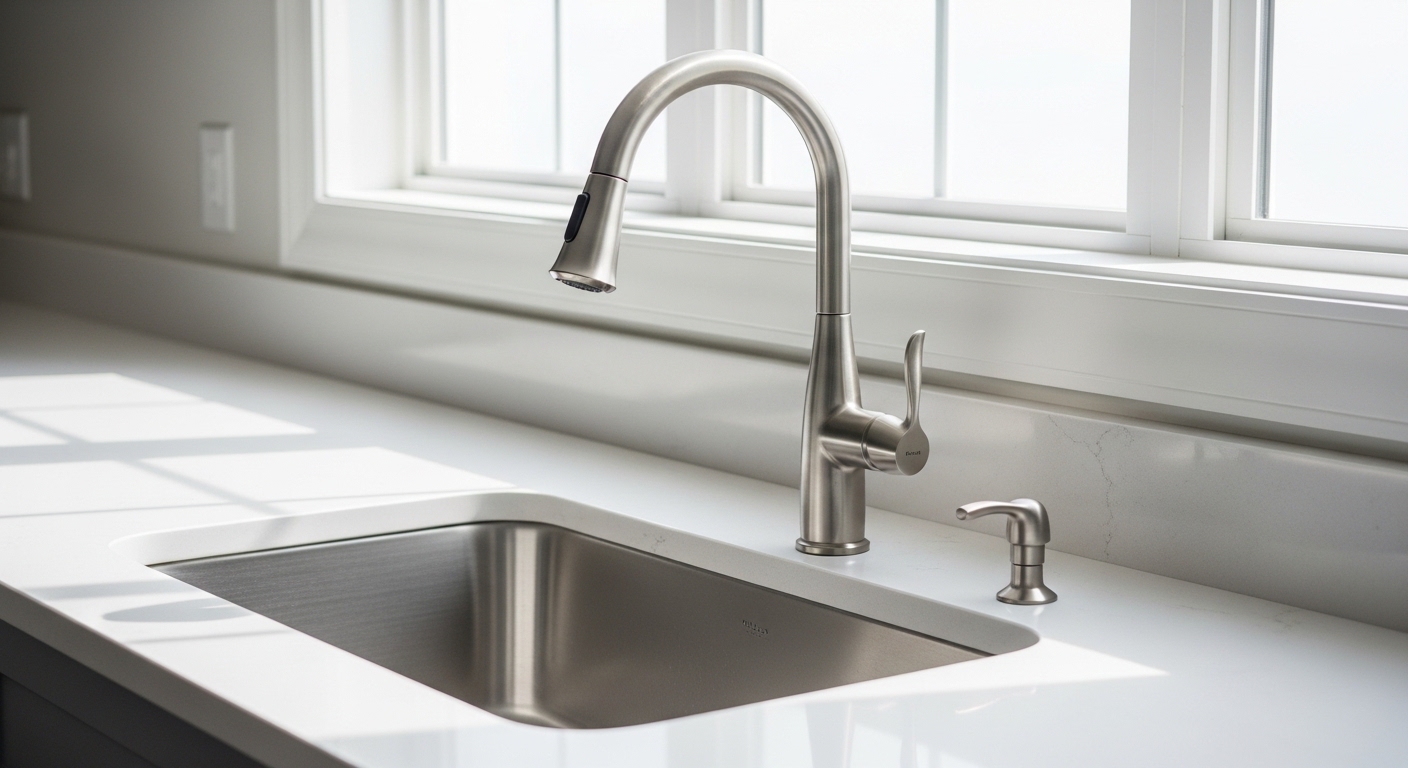
If you’ve been searching for a brushed nickel faucet kitchen Moen option, you’re in good company — it’s one of the most requested finish-and-brand combos we see, and for good reason. Brushed nickel is the “goes with everything” finish, and Moen is the brand most homeowners already trust from their bathroom or their parents’ house. But not every Moen brushed nickel faucet is the same, and the price gap between the entry-level and premium models can be over $200. Below, we’ll answer the exact questions real buyers ask before they hit “add to cart,” so you pick the right one the first time.
What makes brushed nickel a good finish for a kitchen faucet?
Brushed nickel is a good kitchen finish because its soft, matte-satin texture scatters light instead of reflecting it, so water spots, hard-water mineral streaks, and fingerprints are far less visible than on polished chrome or stainless. That means less wiping and a faucet that still looks clean at the end of a busy cooking day.
Here’s what’s actually happening at the surface. Brushed nickel is created by taking a nickel (or nickel-plated) surface and abrading it in one direction with a fine wire brush or abrasive belt. Those micro-scratches break up reflections. On a mirror-polished chrome faucet, a single drop of hard water dries into a bright white dot you can see from across the room. On brushed nickel, that same drop dries into something you almost have to hunt for.
The finish also carries a slightly warm, gray-gold tone. That warmth is why it pairs so easily with wood cabinets, cream and beige countertops, stainless appliances, and even black sinks. If you’re weighing finishes generally, our guide on pairing a stainless steel faucet with a black sink walks through how metal tones read against different sink colors — the same logic applies to brushed nickel.
Is brushed nickel the same as stainless or satin nickel?
Not exactly, and the difference matters when you’re matching your appliances. “Brushed nickel,” “satin nickel,” and “brushed/stainless steel” are cousins, not identical twins. Brushed and satin nickel are usually warmer (a touch of gold), while brushed stainless steel reads cooler and more silver — closer to your refrigerator and dishwasher. Moen’s “Spot Resist Stainless” is the cool-silver option; its “Brushed Nickel” (sometimes called Classic Brushed Nickel or Spot Resist Brushed Nickel) is the warmer one. If matching your stainless appliances exactly is the goal, choose Spot Resist Stainless. If you want a warmer, softer look, choose Brushed Nickel.
Which Moen brushed nickel kitchen faucet should I actually buy?
For most kitchens, buy the Moen Arbor (7594) pull-down or the Moen Adler (87233) pull-down in brushed nickel — the Arbor if you want the premium reflex hose system and a smoother pull-down, the Adler if you want the same look for the lowest possible price. Both come in a brushed nickel / Spot Resist finish and both carry Moen’s limited lifetime warranty.
Moen sells a lot of similar-looking faucets, and the naming can be confusing, so here’s a plain-English breakdown of the models people search for most in brushed nickel:
| Model | Type | Typical price (brushed nickel) | Best for | Key feature |
|---|---|---|---|---|
| Moen Adler (87233) | High-arc pull-down | $130–$170 | Budget buyers who still want Moen | Power Clean spray, duralock quick-connect |
| Moen Arbor (7594) | High-arc pull-down | $220–$300 | Everyday best-value pick | Reflex self-retracting hose, 68% more spray power |
| Moen Sleek (S72308) | Modern pull-down | $260–$340 | Contemporary, low-profile kitchens | Power Boost, slim single-hole look |
| Moen Georgene / Edwyn | Transitional pull-down | $150–$230 | Traditional/farmhouse styling | Spot Resist, coordinating soap dispenser |
| Moen Align (5923) | Bar/prep pull-down | $180–$250 | Small prep sinks & islands | Compact high-arc, MotionSense options |
If your budget is the deciding factor, don’t overthink it — we did a full breakdown of the best budget Moen kitchen faucet under $200, and most of those models are available in brushed nickel. The Adler in particular punches well above its price.
What’s the real difference between “Spot Resist” and regular brushed nickel?
Spot Resist is a factory-applied clear coating on top of the brushed nickel that further repels water spots and fingerprints — it’s Moen’s own finish technology, and it genuinely works. Regular brushed nickel (sometimes labeled “Classic Brushed Nickel”) is the bare brushed finish. Both look nearly identical out of the box, but Spot Resist stays looking clean longer with less wiping. For a kitchen, where the faucet gets splashed constantly, spend the couple of extra dollars for Spot Resist if you have the choice.
How much should I expect to pay, and is Moen worth the premium?
Expect to pay between $130 and $340 for a brushed nickel Moen kitchen faucet, with the sweet spot around $180–$260 for a well-featured pull-down. Moen is worth the premium over no-name brands mainly for two reasons: the limited lifetime warranty and the nationwide parts availability, which means a $12 cartridge — not a whole new faucet — fixes most problems years down the road.
Here’s the honest cost-versus-value picture:
- Under $150: You’re in Adler territory. Fully functional, brushed nickel, lifetime warranty — just a slightly less refined hose retraction and spray than the pricier models.
- $150–$260: The heart of the lineup (Arbor, Georgene, Align). This is where most buyers should land. You get Reflex or Power Boost, better ergonomics, and coordinating accessories.
- $260–$340: Sleek, MotionSense (touchless) versions, and designer shapes. Worth it if you want touchless operation or a specific modern silhouette.
- Above $340: Usually smart/voice-enabled or commercial-style spring faucets. Great, but past the point of diminishing returns for a typical home kitchen.
One thing people underestimate: replacement parts. Because Moen cartridges (like the 1255 or 1225) are stocked at every hardware store, a leaky or stiff Moen faucet is a 20-minute fix, not a call to a plumber. A no-name faucet with a proprietary cartridge often can’t be repaired at all. That repairability is a huge part of the long-term value.
Will a Moen brushed nickel faucet fit my sink, and is it hard to install?
Most Moen pull-down kitchen faucets are single-hole faucets that also include an optional deck plate (escutcheon) to cover 3-hole sinks, so they fit the vast majority of kitchen sinks and countertops. Installation is genuinely DIY-friendly — typically 30 to 60 minutes with a basin wrench, thanks to Moen’s Duralock or MPact quick-connect systems that snap the faucet to the mounting hardware without fussy tools.
Before you buy, check three things:
- Hole count: Count the holes in your sink or countertop. A single-hole faucet needs one hole; if you have three or four holes, use the included deck plate to cover the extras. If you’d rather keep a separate sprayer or soap dispenser in the extra hole, leave the deck plate off.
- Countertop thickness: Very thick stone counters (over ~2.5″) occasionally need longer mounting hardware — check the spec sheet.
- Spout height and reach: High-arc spouts look great but need clearance under upper cabinets or a window. Measure the distance from your deck to the obstruction above.
If you’re replacing an existing faucet, the harder part is usually removing the old one, not installing the new Moen. Old mounting nuts get corroded and cramped. Our step-by-step on a pull-out kitchen faucet hose replacement covers a lot of the same under-sink territory (shutting off supplies, working with the quick-connect hose) if you want to build confidence before you start.
Do I need a plumber, or can I do this myself?
You almost certainly don’t need a plumber for a standard Moen kitchen faucet swap. If you can turn off the two shutoff valves under the sink, disconnect two supply lines, and reach the mounting nut with a basin wrench, you can do this. The only times we’d suggest a pro: your shutoff valves are seized or leaking, you have no shutoffs at all, or you’re moving to a touchless model and want the electrical/battery box mounted cleanly. Otherwise, budget an afternoon and a $15 basin wrench.
How do I keep a brushed nickel Moen faucet looking new?
Clean a brushed nickel Moen faucet with a soft microfiber cloth and mild soapy water, wipe in the direction of the brushed grain, and dry it after use — that’s it. The single most important rule: never use abrasive pads, scouring powders, or acidic/ammonia-based cleaners (like straight vinegar or glass cleaner), because they can dull or etch the finish and, on Spot Resist models, degrade the protective coating.
For stubborn hard-water buildup, lay a cloth dampened with a 50/50 water-and-vinegar mix on the spot for a few minutes, then rinse thoroughly and dry — don’t scrub, and don’t leave acid sitting on the finish. Everyday care is really just a quick wipe-down. The principles are nearly identical across satin finishes; if you want a deeper dive into protecting a warm metallic finish, our brushed gold faucet cleaning guide explains what to avoid in more detail, and the same do’s and don’ts apply to brushed nickel.
Single-handle or two-handle, and pull-down or pull-out?
For a kitchen, choose a single-handle pull-down faucet in almost every case — it’s the most practical layout for cooking. A single handle lets you adjust temperature and flow with one wrist (or elbow) when your hands are messy, and a pull-down spray head with a high arc gives you room to fill pots and rinse the sink.
Quick definitions so the terms are clear:
- Pull-down: The spray head pulls straight down into the sink from a tall, arched spout. Best for deep sinks and pot-filling. This is what most Moen kitchen models (Arbor, Adler, Sleek) are.
- Pull-out: The spray head pulls out horizontally toward you from a lower spout. Better for tight spaces under a window where a tall arc won’t fit.
- Two-handle: Separate hot and cold handles. More traditional look, but less convenient with messy hands. Fine for a bridge or farmhouse aesthetic.
If you’re still deciding on handle configuration for the whole house, our explainer on the best single-handle faucet for a sink lays out where single-handle designs win and where a two-handle setup still makes sense.
How does Moen brushed nickel compare to other brands?
Moen’s brushed nickel competes head-to-head with Delta, Kohler, and Grohe, and its main advantages are the widest parts availability and the easiest DIY cartridge system. Delta (with its DIAMOND Seal and Touch2O tech) is the closest rival on price and warranty; Kohler tends to feel a touch more premium and design-forward but costs more; Grohe and hansgrohe lean European and pricier. For a first-time buyer who wants “buy it, install it, forget about it, and easily fix it in 8 years,” Moen is the safest pick.
A note on finish naming across brands: what Moen calls “Brushed Nickel,” Delta may call “SpotShield Brushed Nickel,” and Kohler may label “Vibrant Brushed Nickel.” They’re broadly similar warm satin finishes, but the exact tone varies slightly between manufacturers, so if you’re matching a Moen faucet to a Moen soap dispenser or pot filler, stay within the Moen line for a perfect match.
Author note & why you can trust this
This guide was written by the faucitta fixtures team — we spec, install, and test kitchen and bath faucets every week, including hands-on time with Moen’s Arbor, Adler, and Sleek lines in brushed nickel. faucitta (faucitta.net) is a specialist faucet and bathroom-fixtures retailer; we don’t cover general home renovation, we cover taps, showers, and sinks in depth. Every finish and price range above reflects current U.S. market pricing as of 2026 and Moen’s published specifications.
On the standards side: Moen’s kitchen faucets are certified to NSF/ANSI 61 and 372 (drinking-water safety and lead-free compliance) and meet ASME A112.18.1/CSA B125.1 faucet standards, and they carry a limited lifetime warranty on finish and function for residential use. Always keep your proof of purchase — Moen honors warranty replacement cartridges and parts, often free, for the original homeowner.
FAQ
Is a brushed nickel Moen kitchen faucet good for hard water?
Yes — brushed nickel is one of the best finishes for hard-water areas because its satin texture hides mineral spotting, and Moen’s Spot Resist coating repels the buildup further. You’ll still get some limescale over months, but a quick wipe with a diluted vinegar cloth removes it. Just never leave acidic cleaner sitting on the finish.
What’s the best-value brushed nickel Moen kitchen faucet in 2026?
The Moen Arbor (7594) in brushed nickel is the best all-around value at roughly $220–$300, thanks to its Reflex self-retracting hose and strong spray. If you want the same look for less, the Moen Adler (87233) at $130–$170 is the best budget pick and shares the lifetime warranty.
Does brushed nickel show fingerprints and water spots?
Far less than chrome or polished stainless. The brushed texture scatters light so smudges and dried water droplets are hard to see. On Moen’s Spot Resist Brushed Nickel models, spotting is reduced even more. For a truly fingerprint-free kitchen faucet, brushed nickel is one of the top two finishes (matte black being the other).
Can I install a Moen brushed nickel faucet myself?
Yes. Most Moen kitchen faucets use a quick-connect (Duralock) system and install in 30–60 minutes with just a basin wrench. Turn off the two under-sink shutoffs, disconnect the old supply lines, drop in the new faucet, and reconnect. The only common snag is removing a corroded old faucet, not installing the Moen itself.
Will a brushed nickel faucet match my stainless steel appliances?
Closely, but not perfectly — brushed nickel is slightly warmer (a touch of gold) than cool-silver stainless. If an exact appliance match matters, choose Moen’s “Spot Resist Stainless” instead. If you like a warmer, softer look that still coordinates with stainless, brushed nickel is a great choice.
How long does a Moen brushed nickel kitchen faucet last?
With basic care, expect 15–20+ years of service. The finish is covered by Moen’s limited lifetime warranty, and the working parts (cartridge, hose) are inexpensive and easy to replace, so the faucet body typically outlasts several cartridges. That repairability is a big reason Moen faucets stay in kitchens for decades.