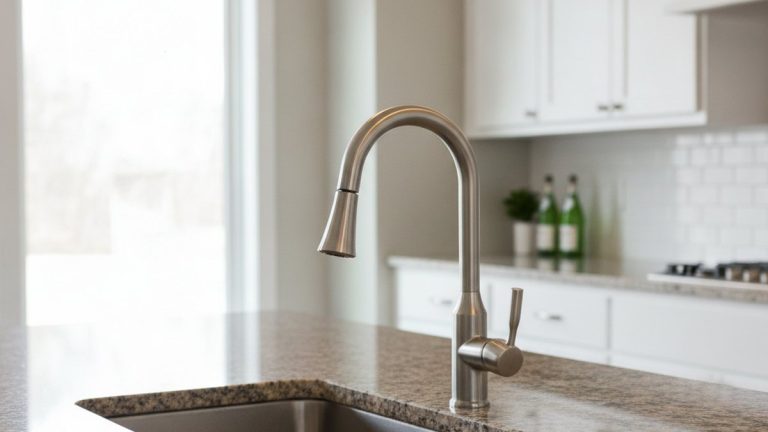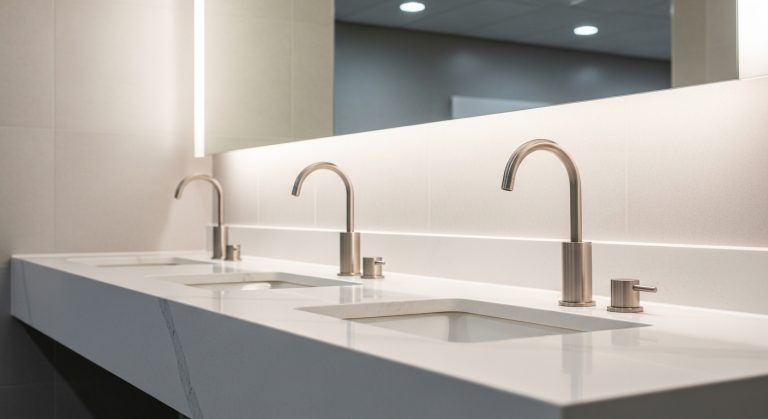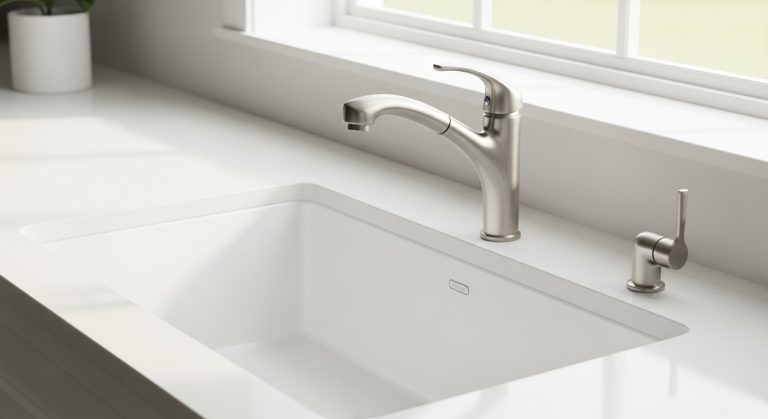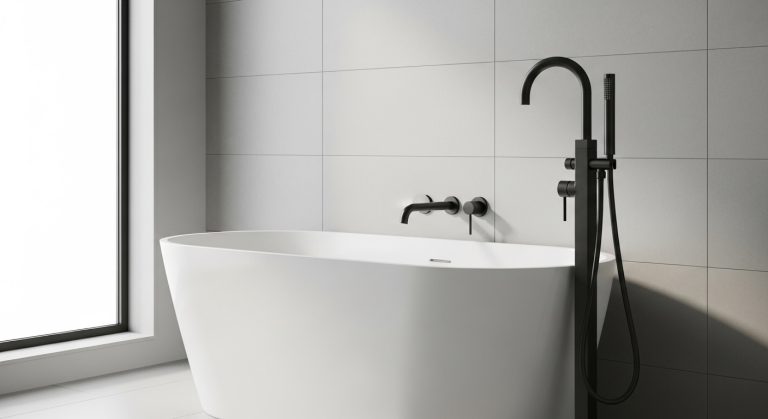
The single most confusing part of installing a bowl-on-counter sink is the vessel sink faucet location — where the faucet mounts, how tall it needs to be, and how far behind the drain the water should land. Get it wrong and you either splash the counter every time you wash your hands or end up with a spout so low the stream barely clears the rim. This guide gives you the exact numbers, the two mounting options, and how to pick a faucet that actually fits the bowl you already bought.
Vessel sinks sit on top of the counter instead of dropping into it, so the whole geometry shifts up by 4–6 inches compared to a normal undermount or drop-in sink. That one difference is why a standard bathroom faucet almost never works, and why “location” is really a conversation about height, setback, and reach all at once.
How high should a vessel sink faucet be above the bowl?
The spout outlet — the tip where water leaves the faucet — should sit about 4 to 6 inches above the top rim of the vessel bowl. That clearance gives you enough room to fit your hands and a bar of soap under the stream without the water hitting your knuckles the second you turn it on, while keeping the drop short enough that it doesn’t splash out of the basin.
Here’s the practical way to figure it out. Measure the height of your bowl from the counter to its rim, then add the clearance you want. Most vessel bowls are 4–6 inches tall. Add 4–6 inches of clearance and you need a faucet whose spout outlet lands somewhere between 8 and 12 inches above the counter. That’s exactly why faucets marketed as “vessel faucets” are tall — typically 10 to 14 inches overall — instead of the 5–7 inches you’d see on a standard lavatory faucet.
- Bowl 4″ tall → aim for a spout outlet around 8–10″ above the counter.
- Bowl 5–6″ tall → aim for a spout outlet around 10–12″ above the counter.
- Bowl taller than 6″ (deep round bowls) → you likely need a 14″+ faucet or a wall-mount setup.
A common mistake is buying a faucet by its total height and forgetting that the outlet is usually an inch or two below the very top of the arc. Always check the spec sheet for “spout height” measured to the water outlet, not the tallest point of the body.
Where does the faucet actually mount — on the counter or the wall?
You have two real vessel sink faucet locations: a tall deck-mount faucet on the counter directly behind the bowl, or a wall-mount faucet installed above and behind the rim. Both work; the right one depends on your bowl height, your counter depth, and whether your plumbing is already roughed into the wall.
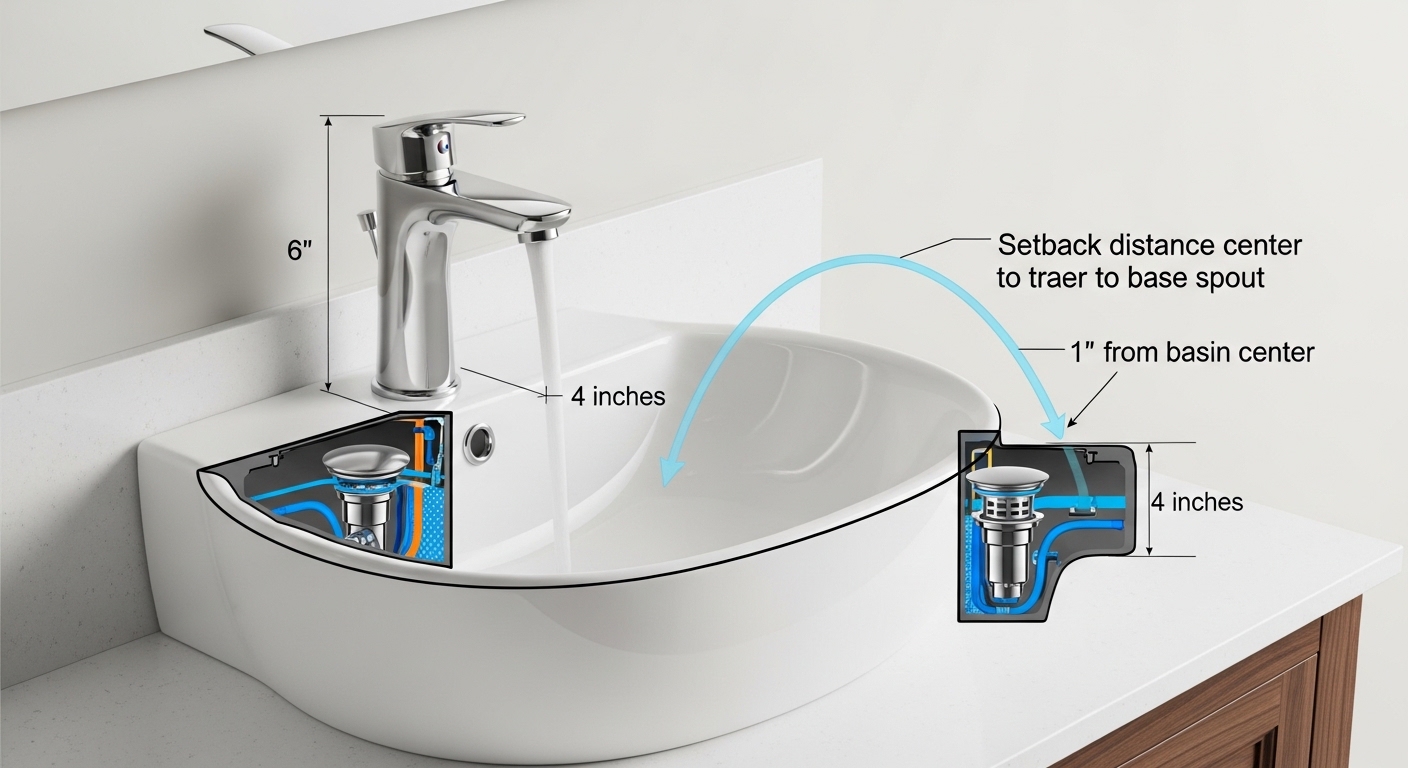
Deck-mount is the default and the easier retrofit — the faucet uses a single hole drilled in the counter, usually 1 to 4 inches behind the back edge of the bowl so the spout can reach over the rim to the center. Wall-mount is the cleaner, more dramatic look and is great for very tall or very wide bowls, but the rough-in has to be planned before tiling because you’re setting the valve and spout height inside the wall. If you’re weighing the two, our breakdown of a wall mount faucet vs a regular deck faucet walks through the trade-offs in detail.
| Factor | Tall deck-mount vessel faucet | Wall-mount faucet |
|---|---|---|
| Best for | Bowls 4–6″ tall, standard retrofits | Tall/deep bowls, wide vessels, modern look |
| Mounting point | Counter, 1–4″ behind bowl | Wall, 6–8″ above rim |
| Spout outlet target | 4–6″ above rim | 5–7″ above rim, spout reach 6″+ |
| Install difficulty | Easy — one drilled hole | Harder — rough-in before finishing |
| Counter cleanup | Base collects water/soap | Nothing on the counter — easiest to wipe |
| Plumbing change | Standard under-counter supply | Supply and drain relocated into wall |
If your counter is shallow (a small powder-room vanity), be careful with deck-mount — a tall faucet plus a wide bowl can crowd the space and push the spout too far forward. In tight rooms, wall-mount often solves the geometry because it takes the faucet body off the counter entirely.
How far behind the drain should the water land?
Aim the spout so the stream hits the basin roughly 1 to 2 inches behind the drain, near the center-back of the bowl — not directly over the drain and never at the front lip. Water that lands dead-center on a flat-bottomed drain tends to bounce straight back up and out; water aimed at the back-center of a curved bowl follows the wall down and drains quietly.
This is where spout reach matters as much as height. Spout reach is the horizontal distance from the faucet body to the water outlet. For a vessel setup you generally want the outlet to clear the rim and reach at least to the center of the bowl. If your bowl is 16 inches across and the faucet mounts 2 inches behind it, you need a spout reach of roughly 8–10 inches to hit center. Too little reach and the water dribbles down the back wall of the bowl; too much and it overshoots toward the front rim.
- Round bowls (14–16″): spout reach ~6–8″ usually lands center.
- Wide oval/rectangular bowls (18–24″): you need more reach or a wall-mount with a longer spout.
- Waterfall-style spouts: land closer to center because the flat sheet of water spreads — see our guide to the best bathroom waterfall faucet if that’s the look you’re after.
Why does my vessel sink splash so much, and how do I stop it?
Vessel sinks splash for three fixable reasons: the spout is too high (long drop = more energy), the water is aimed at the drain or the front rim instead of the back-center, or the flow rate is too high for a shallow bowl. Fix the aim and height first, then the flow.
The quickest wins, in order:
- Lower the effective height. If you haven’t installed yet, choose a faucet whose outlet lands 4–5 inches above the rim rather than 6+. Every extra inch of drop adds splash.
- Re-aim the stream to back-center. Some spouts can be rotated slightly; others you fix by choosing the right spout reach up front.
- Cap the flow at 1.2 GPM. Many vessel faucets ship with a 1.5 or 1.2 GPM aerator; a 1.2 GPM aerator gives a softer, more forgiving stream in a shallow bowl. WaterSense-labeled faucets are capped at 1.5 GPM by standard, and swapping to a 1.2 GPM aerator is a $5 fix.
- Pick a bowl with some depth. Bowls under 4 inches deep will always splash more; if you’re still choosing the sink, a 5–6 inch depth is much more forgiving.
If your bowl sits in a hard-water region and you’re already dealing with mineral spotting on top of splash, the aerator and finish choice matter even more — our roundup of the best bathroom faucet for hard water covers finishes and aerators that resist scale, which keeps the stream clean and predictable over time.
What size and hole configuration do I need for a vessel faucet?
Almost every vessel faucet is a single-hole, single-handle design that needs one 1⅜-inch (35 mm) hole in the counter. If your vanity top is pre-drilled for a standard 4-inch centerset or 8-inch widespread faucet, a single-hole vessel faucet won’t fit those holes — you’d need a new top or a deck plate, though most vessel installs start with an undrilled top so you can place the hole exactly where the bowl needs it.
Plan the hole location around the bowl before you drill:
- Set the bowl in place and mark its back edge.
- Place the faucet hole 1–4 inches behind that edge, centered on the drain.
- Confirm the spout reaches the center of the bowl at that distance before drilling — dry-fit everything.
- Leave at least 1–2 inches of clearance behind the faucet so the handle can travel and you can tighten the mounting nut.
Because the faucet body stands tall and thin, mounting stability matters more than on a squat faucet. Look for a solid brass body and a metal mounting nut rather than plastic — a tall faucet on a thin plastic shank will wobble over time. If you want the specifics on single-hole hardware and how sprayers factor in, our guide to choosing a single hole faucet sprayer covers the deck-plate and hole details that apply here too.
Do I need a special drain or valve for a vessel sink?
Yes on the drain, usually no on the valve. Vessel sinks use a grid drain or a pop-up without an overflow, because most vessel bowls have no overflow hole — so you must match a “no-overflow” drain to a “no-overflow” bowl (and an overflow drain to a bowl that has one). Mismatch them and you’ll either get a leak at the overflow channel or a drain that seals wrong.
The valve inside a good vessel faucet is a standard ceramic-disc cartridge, the same reliable technology in quality kitchen and bath faucets — nothing special is required. What you do want to verify is the supply line length. Because the faucet sits taller, the shank hangs lower under the counter, and cheap included supply lines can come up short or, occasionally, longer than you need; if you’re unsure how length affects performance, we answer that in can faucet supply lines be too long.
For wall-mount vessel setups, the valve and spout are separate and buried in the wall, so the rough-in height is the critical spec — set the spout outlet to land 5–7 inches above where the bowl rim will be, and confirm the projection reaches the bowl center before you close up the wall. A chrome wall-mount is a popular, easy-to-clean choice here; see whether a wall mount faucet in chrome suits your bathroom before committing to the rough-in.
Quick-reference: dialing in your vessel sink faucet location
Put simply, nail these five numbers and the install takes care of itself:
- Spout outlet height: 4–6″ above the bowl rim (≈8–12″ above counter for deck-mount).
- Mounting setback (deck): 1–4″ behind the back edge of the bowl.
- Wall-mount height: spout 6–8″ above the rim, projecting to bowl center.
- Landing point: 1–2″ behind the drain, back-center of the basin.
- Flow rate: 1.2 GPM aerator for shallow bowls, up to 1.5 GPM for deeper ones.
FAQ
How tall should a faucet be for a vessel sink?
Tall enough that the water outlet sits 4–6 inches above the bowl rim. Since most vessel bowls are 4–6 inches tall and sit on top of the counter, that usually means a faucet with a spout outlet 8–12 inches above the counter — which is why dedicated vessel faucets are typically 10–14 inches overall, far taller than a standard 5–7 inch lavatory faucet.
Can I use a regular bathroom faucet with a vessel sink?
Almost never. A standard bathroom faucet’s spout outlet sits about 4–5 inches above the counter, but a vessel bowl raises the rim to roughly that same height — so the water would hit the rim or barely clear it. You need a vessel-height or wall-mount faucet so the spout clears the raised bowl and pours down into it.
How far behind the sink should a vessel faucet be mounted?
For a deck-mount faucet, drill the hole 1–4 inches behind the back edge of the bowl, centered on the drain. The exact distance depends on your spout reach: you want the water to land 1–2 inches behind the drain at the back-center of the basin, so dry-fit the bowl and faucet before drilling to confirm the stream hits center.
Why does my vessel sink splash everywhere?
Usually the spout is too high, aimed at the drain or front rim, or flowing too fast for a shallow bowl. Choose a faucet whose outlet lands 4–5 inches above the rim, aim the stream at the back-center 1–2 inches behind the drain, and switch to a 1.2 GPM aerator. A bowl at least 5 inches deep also splashes far less than a shallow one.
Do vessel sink faucets need a special drain?
They need a drain that matches the bowl’s overflow situation. Most vessel bowls have no overflow hole, so they use a grid drain or a pop-up without overflow. If your bowl does have an overflow, use an overflow-style drain. Matching the two prevents leaks and ensures the drain seals correctly — the faucet valve itself is standard.
Is a wall-mount faucet better than a deck-mount for a vessel sink?
Neither is universally better. Deck-mount is the easier retrofit and works for standard 4–6 inch bowls. Wall-mount is ideal for very tall, deep, or wide bowls, gives a cleaner counter that’s easier to wipe down, and looks more modern — but it requires planning the rough-in height inside the wall before tiling, so it’s harder to install after the fact.
A note on how we tested and who wrote this
Author: Written by the Faucitta fixtures team, drawing on hands-on installation of vessel, deck-mount, and wall-mount faucets across hundreds of bathroom builds and countless customer fit questions. We measured spout outlet heights, spout reach, and splash behavior on real bowls of varying depths to arrive at the numbers above.
About Faucitta: Faucitta designs and sells faucets and bathroom fixtures direct to homeowners at faucitta.net, with a focus on solid-brass bodies and ceramic-disc cartridges. Our vessel-height faucets are pressure-tested and finished to resist corrosion, meet WaterSense flow standards (1.5 GPM or lower), and are backed by a limited lifetime warranty on the finish and drip-free operation — so the faucet you dial in today keeps performing years down the line.