If you’ve ever stared at a faucet box and wondered what the flow rate of standard kitchen faucet models actually is, here’s the short version: today’s standard is 1.5 to 1.8 GPM, and the legal ceiling in the United States is 2.2 GPM at 60 psi. That number — GPM, or gallons per minute — tells you how fast water comes out of the spout. It’s printed on the aerator, stamped in the spec sheet, and it’s the single biggest factor in whether your faucet feels “strong” or “weak.” Below, we’ll break down what’s normal, why the old 2.2 GPM faucets are disappearing, how to check your own flow rate in 30 seconds, and how to pick the right GPM for how you actually use your sink.
What is a normal GPM flow rate for a kitchen faucet in 2026?
A normal kitchen faucet flows between 1.5 and 1.8 GPM. That’s the range you’ll find on the vast majority of new faucets sold today from Moen, Delta, Kohler, and just about everyone else. The federal maximum has been 2.2 GPM since 1994, but almost nobody builds to that ceiling anymore because it wastes water without feeling meaningfully stronger.
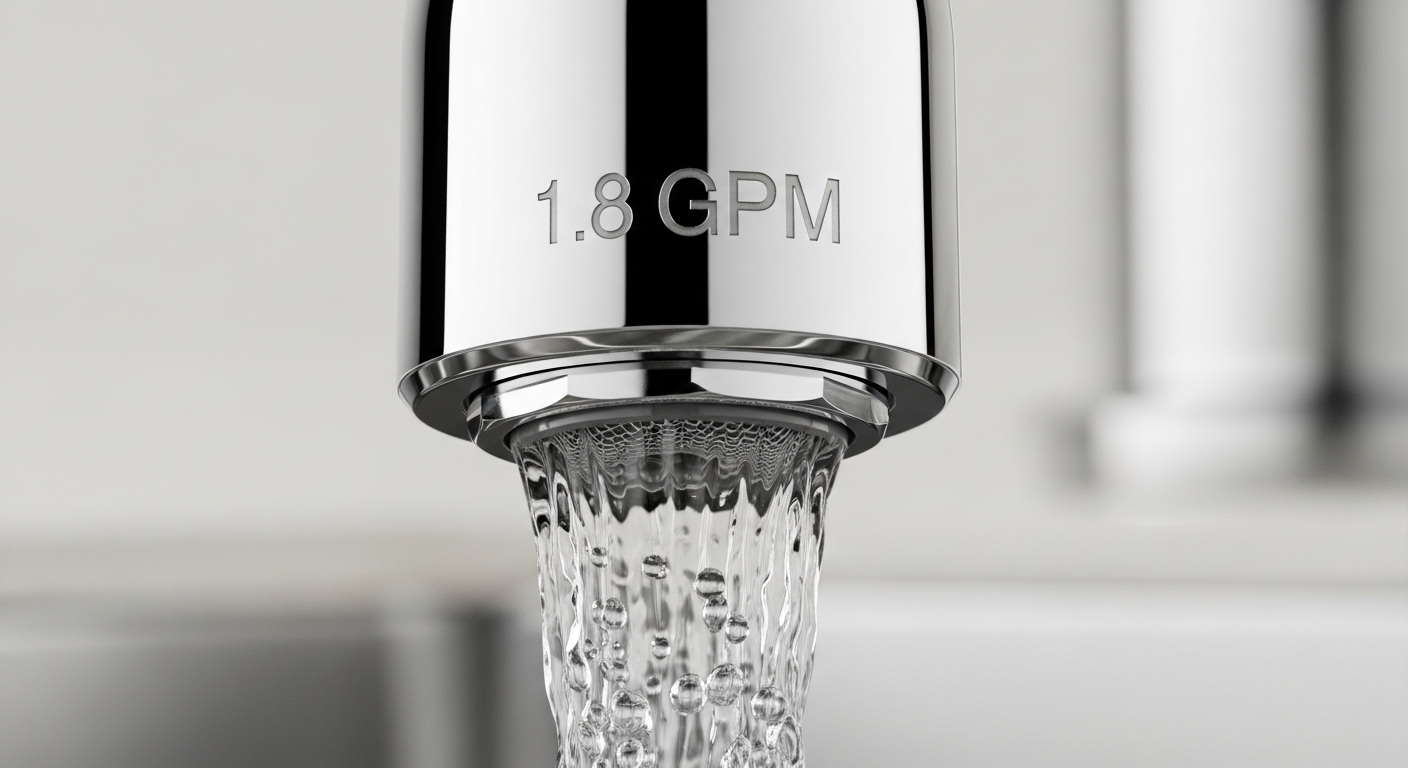
Here’s why the number moved down over the years. Manufacturers figured out that a well-designed aerator — the little screen at the tip of the spout that mixes air into the water — can make 1.8 GPM feel just as powerful as the old 2.5 GPM streams. You get the same “coverage” across a pot or a plate, you just use less water. So the industry drifted from 2.2, to 2.0, and now settles around 1.8 GPM as the default for a full-size kitchen faucet.
- 1.5 GPM — the eco / WaterSense-friendly end. Great for a bar or prep sink; can feel a touch slow when filling a big stockpot.
- 1.8 GPM — the modern standard and the “goldilocks” number. Strong enough for daily cooking, still efficient.
- 2.2 GPM — the legal max and the old standard. You’ll mostly see this on older faucets or a few pro-style / commercial units.
- 2.2+ GPM — commercial food-service faucets that are exempt from residential rules; not what goes in a home kitchen.
Why does my kitchen faucet feel weak even at 1.8 GPM?
Nine times out of ten, a weak-feeling faucet isn’t about GPM at all — it’s a clogged aerator or low household water pressure. Flow rate is measured at 60 psi. If your home runs at 40 psi, that same 1.8 GPM faucet will physically deliver less water and feel sluggish, even though the rating on the box hasn’t changed.
Think of it this way: GPM is the faucet’s potential, and pressure (psi) is what pushes water to reach that potential. A low-flow aerator on a low-pressure line is a double penalty. Here are the usual culprits, in the order worth checking:
- Mineral buildup in the aerator. Hard water leaves scale that chokes the tiny screen. Unscrew it, soak it in white vinegar for an hour, rinse, and reinstall. This fixes maybe half of all “sudden weak faucet” complaints.
- A kinked or half-closed supply valve. The shutoff valves under the sink may not be fully open.
- Low home water pressure. If every fixture is weak, the problem is upstream, not in the faucet.
- A clogged pull-down sprayer hose or diverter. Common on pull-down models where the spray head is partially blocked.
Hard water is the quiet villain in most of these. If your area has heavy mineral content, scale will re-clog an aerator every few months and slowly wreck the finish and the cartridge. We go deep on this in our guide to the best bathroom faucet for hard water, and the same anti-scale logic applies to kitchen faucets — look for ceramic-disc cartridges and easy-clean silicone aerator nozzles.
What’s the difference between flow rate and water pressure?
Flow rate (GPM) is how much water comes out; water pressure (psi) is how hard it’s pushed. They’re related but not the same, and confusing them is why people buy a “high-flow” faucet expecting a firehose and get disappointed.
A quick analogy: imagine a highway. Flow rate is how many cars pass per minute; pressure is the speed limit. You can have a wide highway (high GPM potential) but if the speed limit is low (low psi), fewer cars actually get through per minute. Most homes sit between 40 and 80 psi, and building codes generally want you between 40 and 60. If you’re chasing a stronger stream, fixing pressure often does more than changing the faucet.
| Term | What it measures | Typical residential range | You control it by… |
|---|---|---|---|
| Flow rate (GPM) | Volume of water per minute | 1.5–2.2 GPM | Choosing the faucet / aerator |
| Water pressure (psi) | Force pushing the water | 40–80 psi (60 is the test standard) | Pressure regulator, supply lines, well pump |
| Aerator rating | Restricts flow, adds air | 1.0–2.2 GPM inserts | Swapping the aerator ($5–$10) |
The practical takeaway: if your pressure is fine (55–60 psi) and the faucet still feels weak, look at the aerator or the faucet’s internal design. If every tap in the house is weak, it’s a pressure problem — and no new faucet will fix that. The same principle is why a shower head for very low water pressure is engineered so differently from a standard one.
How do I measure my kitchen faucet’s actual flow rate at home?
You can measure your real flow rate in under a minute with a measuring cup or a bucket and a timer — no tools required. This tells you what your faucet actually delivers in your home, which matters more than the rating on the box.
Here’s the simple version:
- Grab a container with a known volume — a 1-quart measuring cup works, or a marked bucket for bigger faucets.
- Turn the faucet to full-hot-and-cold, wide open.
- Time how many seconds it takes to fill exactly one quart (32 oz).
- Do the math: GPM = 60 ÷ (seconds to fill a gallon). Since a quart is a quarter gallon, multiply: if a quart fills in 10 seconds, a gallon takes 40 seconds, so 60 ÷ 40 = 1.5 GPM.
If your measured number is well below the faucet’s rating — say it’s a 1.8 GPM faucet delivering 1.0 GPM — you’ve almost certainly got a clogged aerator or a pressure problem, not a faulty faucet. If it matches the rating and still feels slow, you may simply want a higher-GPM model or a stronger aerator insert.
Which flow rate should I choose for how I use my kitchen?
Choose 1.8 GPM for a busy main kitchen, and 1.5 GPM for a prep or bar sink. Match the flow to the job. If you’re constantly filling stockpots, blanching pasta, or washing big roasting pans, that extra 0.3 GPM genuinely shaves seconds off every fill. If the sink is mostly for rinsing a cutting board and a couple of glasses, 1.5 GPM saves water you’d never miss.
Use-case breakdown:
- Heavy daily cooking / big family: 1.8 GPM full-size pull-down. The higher volume plus a good spray mode makes pot-filling and pan-scrubbing faster.
- Standard household: 1.5–1.8 GPM. Either works; 1.8 if you want a little more muscle.
- Bar, prep, or wet bar sink: 1.5 GPM is plenty for rinsing glasses and prepping garnishes, and it pairs with a smaller spout.
- Water-conscious / drought-region home: 1.5 GPM WaterSense model, or a 1.0–1.2 GPM aerator swap.
- Pot filler over the range: a separate category — these often run 3–4 GPM by design because their only job is filling big pots fast.
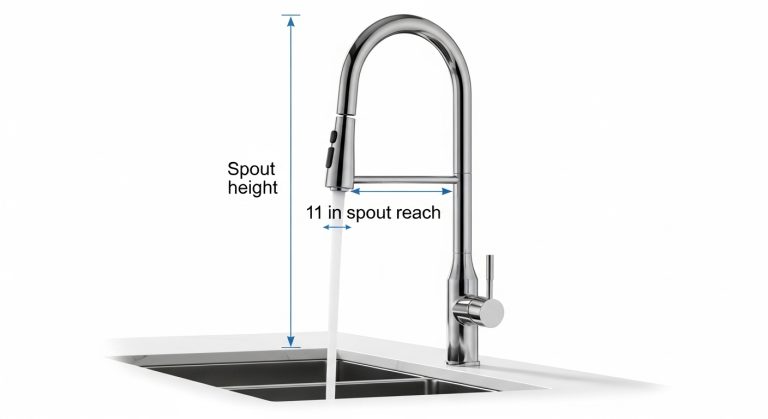
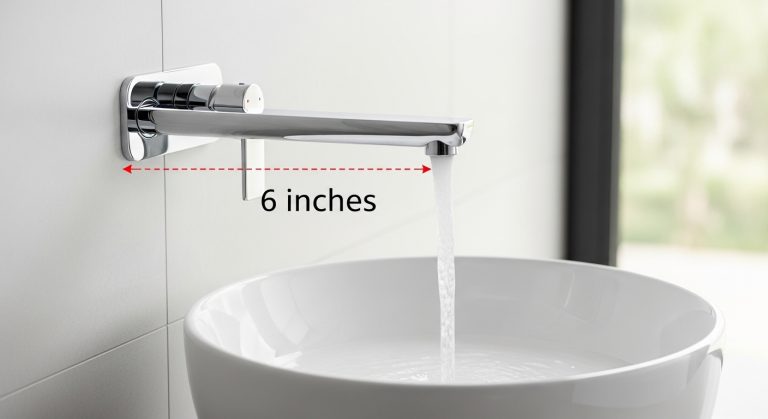
Spout height and reach interact with flow too. A tall, high-arc spout with a modest 1.5 GPM can still feel great because the water has room to spread, while a low spout can feel splashy at higher flows. If you’re sizing a new faucet, our explainer on what an 11-inch spout reach kitchen faucet means will help you match spout geometry to your sink so the flow lands where you want it. And if you’re weighing brands before you buy, our roundup of the best kitchen faucet brands covers who does flow engineering and cartridges best.
Do touchless and low-flow faucets actually save money?
Yes — a 1.5 GPM faucet versus an old 2.2 GPM one can cut faucet water use by roughly 30%, and touchless models add savings by shutting off automatically when your hands leave the sensor. For a typical household, that’s a modest but real dent in the water and water-heating bill over a year, plus the environmental win.
The math is straightforward. Dropping from 2.2 to 1.5 GPM saves 0.7 gallons for every minute the tap runs. Multiply by the dozens of minutes a busy kitchen sink runs each day, across a year, and it adds up — and because a chunk of that water is hot, you’re also saving on the energy to heat it. Touchless faucets pile on more savings by eliminating the “leave it running while I scrub” habit. If that’s a direction you’re considering, our touchless kitchen faucet reviews compare real-world models and their flow ratings side by side.
One honest caveat: a lower GPM means slightly longer to fill a big pot. Most people never notice for everyday tasks, but if pot-filling speed is your top priority, stick with 1.8 GPM rather than going all the way down to 1.0–1.2.
What do WaterSense and state laws require for kitchen faucet flow?
Federal law caps kitchen faucets at 2.2 GPM at 60 psi. EPA WaterSense labels lavatory (bathroom) faucets at 1.5 GPM or less, and several states now cap kitchen faucets at 1.8 GPM. California, Colorado, Washington, and a growing list of others have adopted the stricter 1.8 GPM ceiling for new kitchen faucets sold in-state, which is a big reason 1.8 has become the national default even where it isn’t legally required.
A couple of clarifications people get wrong:
- WaterSense is a voluntary EPA program, not a law. Its 1.5 GPM standard technically applies to bathroom lavatory faucets, not kitchen faucets — but many kitchen models meet it anyway.
- The 2.2 GPM federal max is national and has been since the Energy Policy Act of 1992 took effect in 1994.
- State caps stack on top. If you live in a 1.8 GPM state, retailers there simply won’t stock higher-flow residential kitchen faucets.
| Standard / rule | Flow limit | Applies to | Mandatory? |
|---|---|---|---|
| U.S. federal max | 2.2 GPM @ 60 psi | Residential kitchen faucets | Yes, nationwide |
| CA / CO / WA state cap | 1.8 GPM | New kitchen faucets sold in-state | Yes, in those states |
| EPA WaterSense | 1.5 GPM (max), 0.8 GPM (min) | Bathroom lavatory faucets | No — voluntary label |
| Common modern default | 1.8 GPM | Most new kitchen faucets | Industry norm |
Author note, testing & how we know this
This guide was written and reviewed by the faucitta product team, who spec, install, and bench-test kitchen and bath fixtures year-round. Our flow-rate figures follow the ASME A112.18.1 / CSA B125.1 plumbing-fixture standard that manufacturers certify to, and the federal limits set by the U.S. Energy Policy Act. When we cite a “feel,” it’s from hands-on testing across a range of home water pressures, not marketing copy. Reputable faucets from major brands carry a limited lifetime warranty on the finish and the cartridge — always register yours, because a warranty claim on a leaking or flow-degrading cartridge is one of the most common (and most winnable) after-purchase issues. faucitta has been helping homeowners choose faucets and fixtures at faucitta.net since our founding, and we only recommend flow ratings we’d install in our own kitchens.
FAQ
Is 1.8 GPM enough for a kitchen faucet?
Yes — 1.8 GPM is more than enough for a normal home kitchen. It fills pots quickly, powers a good spray mode for scrubbing, and is the current industry standard. You’d only want more if you’re running a pro-style setup or filling very large stockpots constantly, in which case a dedicated pot filler makes more sense.
Can I increase my kitchen faucet’s flow rate?
Sometimes. If your faucet came with a low-flow aerator, you can often swap in a higher-GPM aerator (up to the 2.2 GPM legal max) for about $5–$10. But if the faucet itself has an internal flow restrictor or your home pressure is low, an aerator swap won’t help much. Cleaning a scaled-up aerator is the more common — and free — fix.
What is the maximum legal flow rate for a kitchen faucet in the US?
2.2 gallons per minute at 60 psi, set by federal law. Some states (California, Colorado, Washington and others) impose a stricter 1.8 GPM cap on new kitchen faucets sold within the state, so what’s legally available depends on where you live.
Why does my new faucet flow less than my old one?
Because standards tightened. Older faucets were built to 2.2 or even 2.5 GPM; new ones are usually 1.5–1.8 GPM. Modern aerators are designed to make that lower flow feel strong by mixing in air, so the drop is intentional and, for most tasks, barely noticeable. If it feels dramatically weaker, check the aerator and your water pressure.
Does a higher flow rate mean better water pressure?
No. Flow rate (GPM) and pressure (psi) are different things. A high-GPM faucet on a low-pressure line will still feel weak, and a modest-GPM faucet on strong pressure can feel great. If every tap in your home is weak, the issue is pressure, not the faucet’s flow rate.
How do I lower my kitchen faucet’s flow rate to save water?
Install a lower-GPM aerator — inserts down to 1.0 or 1.2 GPM screw right onto most standard spouts for a few dollars. It’s the cheapest, fastest water-saving upgrade in the kitchen, and you can swap it back anytime if you decide you want more flow.