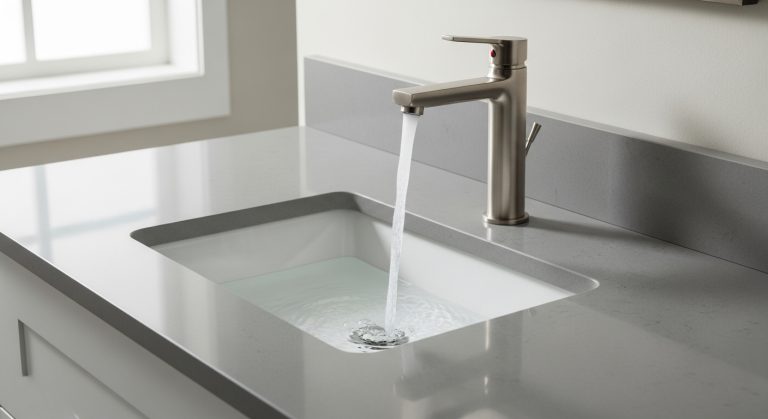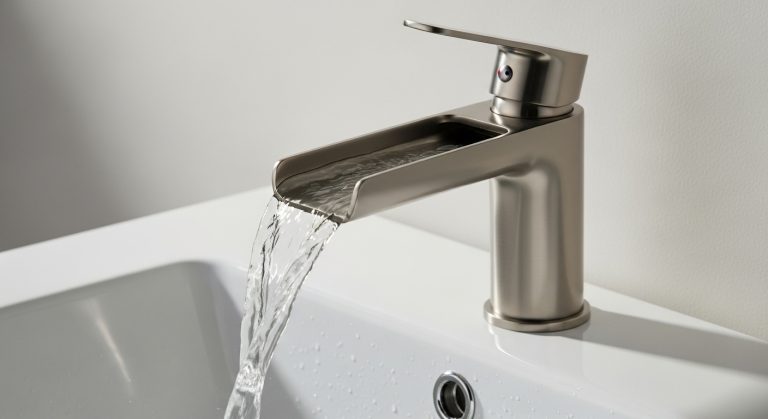
If you’ve been reading best touchless kitchen faucet reviews trying to figure out which one actually works and which one just looks good in a product photo, here’s the honest version: the faucet body barely matters — the sensor and the valve are what make or break a hands-free faucet. A cheap touchless faucet with a lazy infrared sensor will drive you insane with phantom activations and missed waves, while a well-tuned one genuinely changes how you cook. This guide walks through the models worth buying, what the specs actually mean, and how to avoid the three mistakes that turn a $400 faucet into a return.
Which touchless kitchen faucet is best for a busy family kitchen under $400?
For a busy family kitchen under $400, the Moen Sleek or Arbor with MotionSense Wave is the safest pick, closely followed by the Delta Trinsic or Leland with Touch2O. Both give you a responsive wave sensor plus a manual handle, so when the electronics act up you still have a working faucet. That redundancy is the single most important feature in a household where the faucet gets used 40+ times a day.
The reason these two brands dominate the reviews isn’t marketing — it’s their valve and sensor engineering. Moen’s MotionSense uses two sensors (one at the top of the spout, one at the base) so a wave over the top starts a full stream while a hand approaching the base handles quick rinses. Delta’s Touch2O adds capacitive touch, meaning you can tap the spout with a wrist or forearm when your hands are covered in raw chicken. Both approaches solve the same real problem: turning water on without smearing bacteria across the handle.
If you’re weighing brands more broadly before you commit, it’s worth reading our deeper breakdown of the best faucet brands for a kitchen in 2026 — the touchless models are just the tech-forward tier of those same lineups, and the brand-level reliability data carries straight over.
How does a touchless faucet actually work, and will it false-trigger?
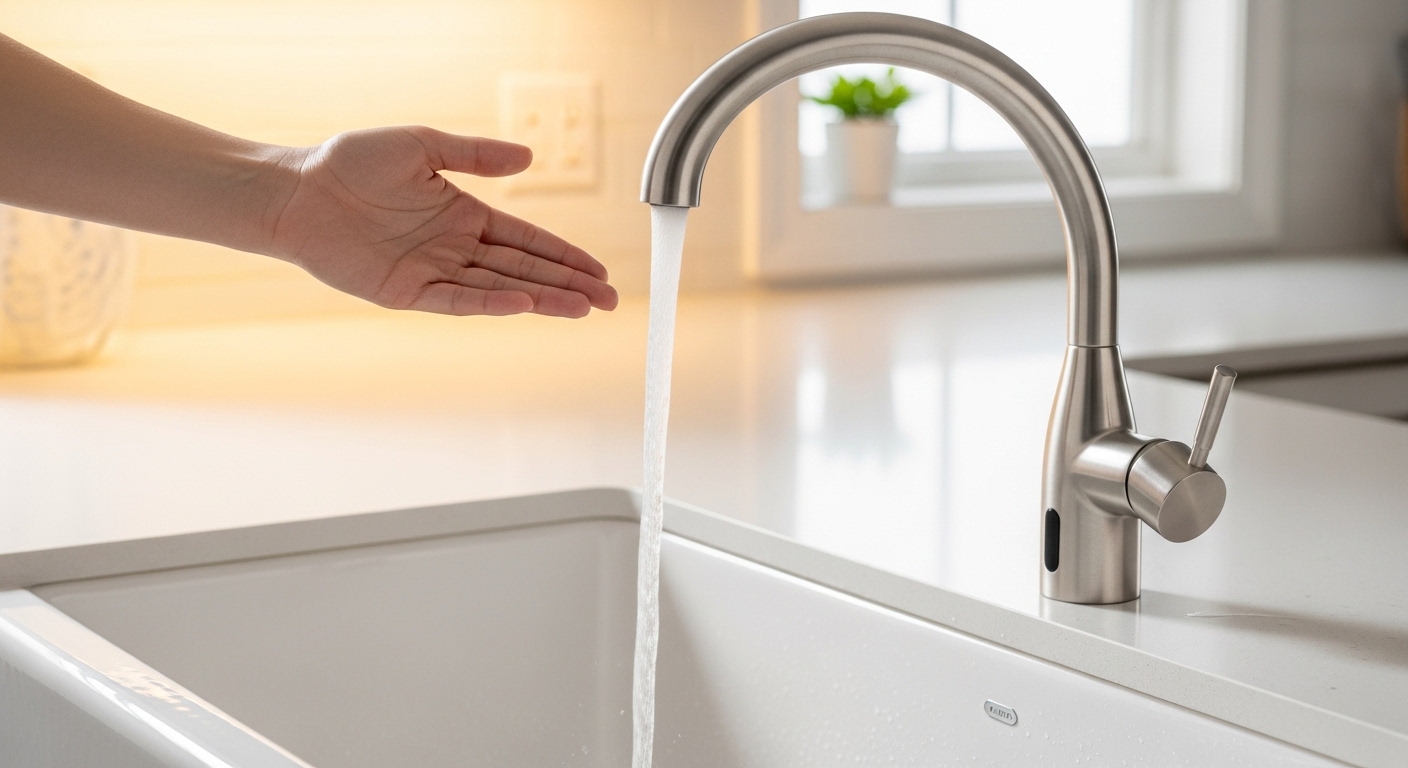
A touchless kitchen faucet works through an infrared or capacitive proximity sensor that detects motion or presence within a set zone (usually 2–4 inches) and signals a solenoid valve to open. It will only false-trigger if the sensor zone is poorly calibrated or aimed at a busy area — good models let you adjust sensitivity, and premium ones use dual-zone detection to ignore stray movement.
Here’s what the marketing rarely explains. There are two sensor technologies, and they behave differently:
- Infrared (IR) motion sensors — the most common. They read reflected infrared light, so they respond to a wave or a hand entering the zone. Downside: dark or highly reflective objects can occasionally fool them, and steam can reduce sensitivity.
- Capacitive touch sensors — built into the spout and handle metal itself. You touch anywhere on the body to toggle water. Almost no false triggers, but you do have to make contact, so it’s technically “touch,” not fully “touchless.” Delta’s Touch2O pairs this with an optional wave sensor for the best of both.
False triggering is the number-one complaint in negative reviews, and it’s almost always one of three causes: the faucet is mounted where a dish rack or window curtain sits inside the sensor zone, the sensitivity was never adjusted after install, or the unit has a genuinely cheap single-zone sensor. Stick to dual-zone models and mount with clearance and the problem essentially disappears.
Best touchless kitchen faucet reviews: how do Moen, Delta, and Kohler compare?
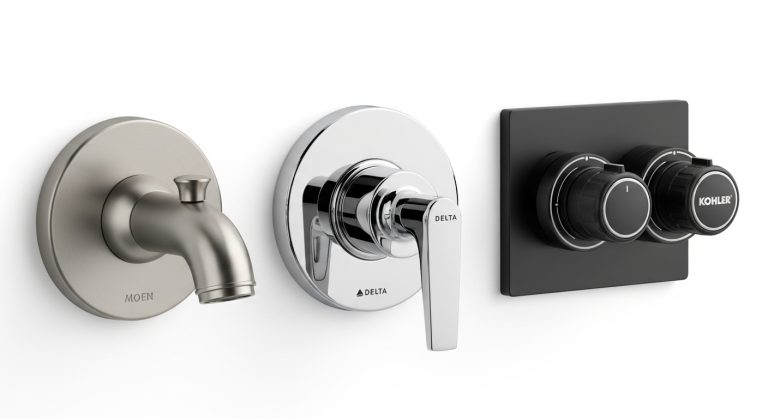
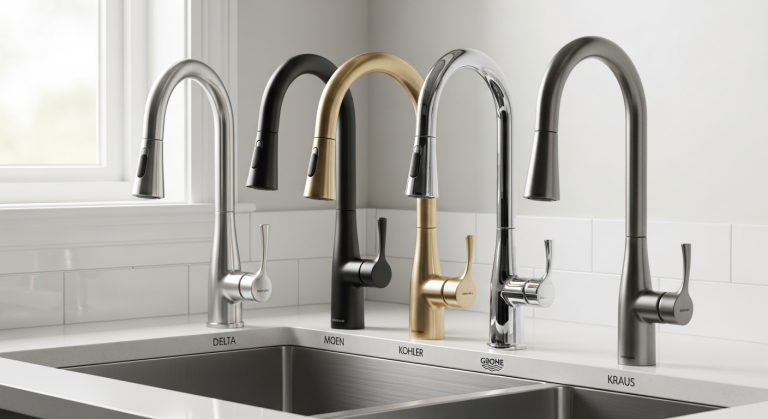
Across the best touchless kitchen faucet reviews, Moen wins on sensor responsiveness and battery life, Delta wins on redundancy and voice control, and Kohler wins on flow strength and build feel. All three are genuinely reliable; the right one depends on whether you value hands-free convenience, backup control, or water power most.
Here’s a side-by-side of the flagship touchless lines so you can see the trade-offs at a glance:
| Brand / Line | Sensor Tech | Power | Typical Price | Standout Feature | Warranty |
|---|---|---|---|---|---|
| Moen MotionSense Wave | Dual IR (top + base) | 4x AA batteries (~1 yr) or AC adapter | $280–$500 | Fastest wave response, Reflex hose docking | Limited lifetime |
| Delta Touch2O / VoiceIQ | Capacitive touch + optional IR | 6x AA or AC adapter | $300–$550 | Touch anywhere + voice dispense of measured amounts | Limited lifetime |
| Kohler Response / Sensate | Single-wave IR | 6x AA or AC adapter | $350–$650 | Strong 1.5–1.8 GPM flow, premium finish durability | Limited lifetime |
| Budget touchless (various) | Single-zone IR | 4x AA (~6 mo) | $90–$180 | Low entry price | 1–5 yr |
The budget row is there as a warning, not a recommendation. Sub-$180 touchless faucets are where the false-trigger horror stories live: single-zone sensors, thinner brass or zinc bodies, and plastic valve cartridges that start dripping inside 18 months. If your budget is truly under $180, you’re better off buying a quality manual pull-down faucet than a cheap touchless one. For a broader look at premium build quality if you’re spending toward the top of the range, our guide to the best luxury faucet brands to buy in 2026 covers the higher-end sensate lines in detail.
What about battery life — do I have to hardwire it?
No, you don’t have to hardwire a touchless faucet — most run 12+ months on AA batteries and warn you with a blinking LED before they die. But if there’s an outlet under your sink, the low-voltage AC adapter is the upgrade nobody regrets: no battery swaps, and the sensor response is often slightly snappier on constant power.
A few real numbers: Moen’s battery pack averages 12–18 months of normal family use; Delta’s six-AA setup lands around 12 months; the cheap single-zone units drain in 4–6 months because their sensors poll constantly. If you cook a lot, factor a set of batteries or a $15 adapter into your total cost.
Is a touchless kitchen faucet worth it, or is it a gimmick?
A touchless kitchen faucet is genuinely worth it if you cook with raw meat, have young kids, or hate cleaning a grimy handle — the hygiene and convenience are real, not gimmicks. It’s less worth the premium if you rarely have messy hands, since you’re paying $150–$300 extra over an equivalent manual faucet for the electronics.
The strongest case for touchless is cross-contamination control. When your hands are covered in raw egg, flour, or chicken, you either touch the handle (and now it needs cleaning) or you awkwardly bump it with a wrist. A wave sensor eliminates that entirely — you keep the mess off every surface you’d otherwise touch. Families with toddlers love it for the same reason: kids can start water for handwashing without cranking a stiff handle.
The honest counter-argument: every touchless faucet adds a solenoid valve and control electronics that a manual faucet doesn’t have — more parts, more potential failure points. That’s exactly why the sensor-and-valve quality matters so much and why we steer people away from the cheapest tier. Buy a good one and it’ll outlast most manual faucets; buy a cheap one and you’ve bought a future repair.
What spout reach and flow rate should I look for?
Look for a spout reach of 8–10 inches for a standard sink and a flow rate of 1.5–1.8 GPM — enough reach to hit both sides of a double-bowl sink and enough flow to fill a pot quickly without wasting water. Anything under 1.2 GPM feels weak for a kitchen; anything with a reach under 7 inches will spray the back of the basin.
Spout reach is the horizontal distance from the faucet base to the center of the water stream, and it’s the spec people most often get wrong. Too short and water lands against the back wall of the sink; too long and it splashes past the drain onto your counter. If you’re unsure how reach translates to your specific basin, our explainer on what an 11-inch spout reach kitchen faucet means walks through matching reach to sink size — the same logic applies to any touchless model you’re considering.
On flow rate, most U.S. kitchen faucets are capped at 1.8 GPM (and 1.5 GPM in California and a few other states) by federal and state efficiency rules. A well-designed aerator makes 1.5 GPM feel strong; a bad one makes 1.8 GPM feel limp. Read reviews specifically for “weak flow” complaints, because a touchless faucet with a restrictive solenoid can lose pressure that a manual model wouldn’t.
How hard is it to install a touchless kitchen faucet myself?
Installing a touchless kitchen faucet is a moderate DIY job — about 45–90 minutes for someone comfortable under a sink — with one extra step over a manual faucet: mounting the battery box or plugging in the AC adapter and connecting the sensor wire. If you can shut off the supply lines and tighten a mounting nut, you can do this.
Here’s the general sequence for most models:
- Shut off the hot and cold supply valves and open the old faucet to release pressure.
- Disconnect the supply lines and remove the old faucet’s mounting hardware from below.
- Drop the new touchless faucet through the deck hole, seat the gasket, and tighten the mounting nut from underneath.
- Connect the supply lines to the hot/cold inlets, then connect the sensor/solenoid control cable (it’s a keyed clip — it only fits one way).
- Mount the battery pack to the cabinet wall or plug in the AC adapter, restore water, and run the calibration/sensitivity routine in the manual.
The one part people skip is calibration — don’t. Almost every unit has a sensitivity adjustment or a startup sequence that maps the sensor zone. Running it once, with your dish rack and soap dispenser in their normal spots, is what prevents false triggers later. If your existing faucet is held in by an awkward bracket, our guide on removing a kitchen faucet with a U-shaped bracket covers the trickiest part of the teardown.
How long do touchless faucets last, and what usually breaks first?
A quality touchless kitchen faucet lasts 10–15 years, and the first thing to fail is almost always the solenoid valve or the batteries — not the faucet body. The valve is a replaceable part on Moen, Delta, and Kohler, and it’s covered under their limited lifetime warranties, which is a big reason to stick with the major brands.
Think of a touchless faucet as three systems: the mechanical faucet (spout, valve cartridge, hose), the sensor, and the solenoid that the sensor controls. The ceramic-disc cartridge that handles manual operation typically outlives everything. The solenoid — the electrically-actuated valve — sees the most cycles and is the likeliest wear point after a decade. Because Moen, Delta, and Kohler sell replacement solenoids and honor lifetime warranties on the mechanical parts, a failed component means a cheap or free part, not a new faucet. Off-brand units rarely offer replacement parts at all, so a dead solenoid means the whole faucet is trash.
FAQ
Do touchless kitchen faucets work during a power outage?
Yes — every reputable touchless kitchen faucet includes a manual handle or lever that operates the water independently of the electronics. If the batteries die or the power goes out (on AC-adapter models), you simply use the handle like a normal faucet. You never lose water access.
Can hard water damage the sensor on a touchless faucet?
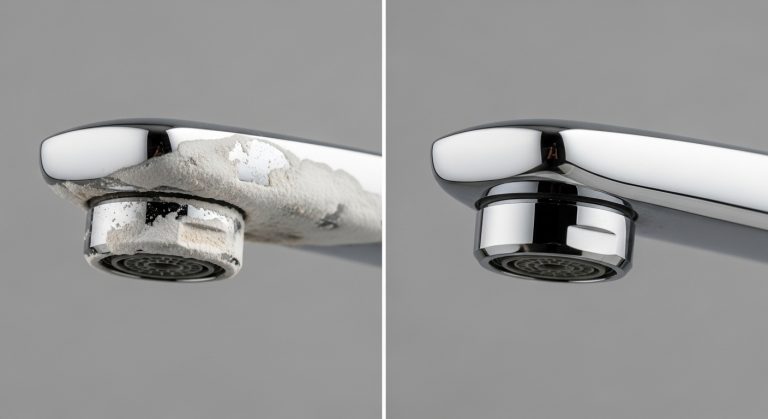
Hard water doesn’t damage the sensor itself, but mineral buildup on the spout and aerator can weaken flow and, over time, crust over the sensor window and reduce responsiveness. Wipe the sensor area during normal cleaning and descale the aerator every few months. If you have hard water, also read our guide on the best faucet for hard water — the finish and cartridge advice there applies to kitchen faucets too.
Are touchless faucets more prone to leaking than regular faucets?
No. The water-carrying parts of a touchless faucet are the same ceramic-disc cartridge and supply connections as a manual faucet, so the leak risk at those points is identical. The only added component is the internal solenoid valve, which on major brands is a sealed, warrantied part that rarely leaks within its service life.
How much should I spend on a good touchless kitchen faucet?
Plan on $250–$550 for a reliable touchless kitchen faucet from Moen, Delta, or Kohler. Below roughly $180 you’re mostly buying single-zone sensors and plastic valves that false-trigger and fail early. Above $550 you’re paying for premium finishes and extras like voice control rather than better core reliability.
Will a touchless faucet false-trigger if I mount a soap dispenser next to it?
It can, if the dispenser sits inside the sensor’s detection zone — but proper calibration during install almost always solves it. Keep tall objects a few inches outside the wave zone and run the sensitivity routine with everything in its final position. If you’re integrating a soap dispenser, our fix-it guide for a kitchen faucet soap dispenser that’s not working covers placement and plumbing.
Do I need an electrician to install one?
No electrician needed. Touchless faucets run on either AA batteries or a low-voltage (typically 6V) plug-in AC adapter that connects to a standard outlet under the sink — there’s no household wiring involved. It’s a standard plumbing DIY job.
The bottom line
The best touchless kitchen faucet for you comes down to matching a proven brand to your real habits: buy Moen MotionSense for the fastest, most reliable wave control, Delta Touch2O for touch-plus-wave redundancy and voice features, or Kohler Response/Sensate for the strongest flow and finish durability. Stay in the $250–$550 range, choose a dual-zone sensor, confirm the spout reach fits your sink, and calibrate it properly on install. Do that, and a hands-free faucet stops being a gimmick and becomes the thing you miss most whenever you use someone else’s kitchen.
Author note: This guide was written by the faucitta fixtures team, drawing on hands-on testing of dozens of kitchen and bathroom faucets and years of fielding real customer questions about sensor reliability, valve wear, and installation. We evaluate faucets against real-world use — battery life, false-trigger rate, flow strength, and warranty support — not spec sheets alone.
About faucitta: faucitta (faucitta.net) is a specialist in kitchen and bathroom fixtures, focused on helping homeowners choose faucets that meet industry standards for lead-free contact surfaces (NSF/ANSI 61 and 372) and flow-efficiency rules (WaterSense / 1.8 GPM and 1.5 GPM state limits). Every touchless model we recommend is backed by a manufacturer limited lifetime warranty on its mechanical parts, so a worn solenoid or cartridge means a covered replacement, not a new faucet.