If you’ve ever crouched under a sink wondering whether that extra loop of braided hose is a problem, here’s the short version: can faucet supply lines be too long? Yes. A supply line that’s dramatically longer than the gap it needs to bridge doesn’t give you a safety margin — it gives you kinks, tight radius bends, connection stress, and a tangled cabinet that’s miserable to work in later. A little slack is good. A lot is a slow-motion leak waiting to happen. Below, we walk through exactly how long is “too long,” how to measure so you buy the right size the first time, and what actually goes wrong when the line is oversized.
At faucitta, we spec, test, and sell faucets and their supply components every day, so this isn’t theory — it’s what we see come back as warranty claims and confused customer emails. Let’s get you the right line.
Can a faucet supply line actually be too long, or is longer always safer?
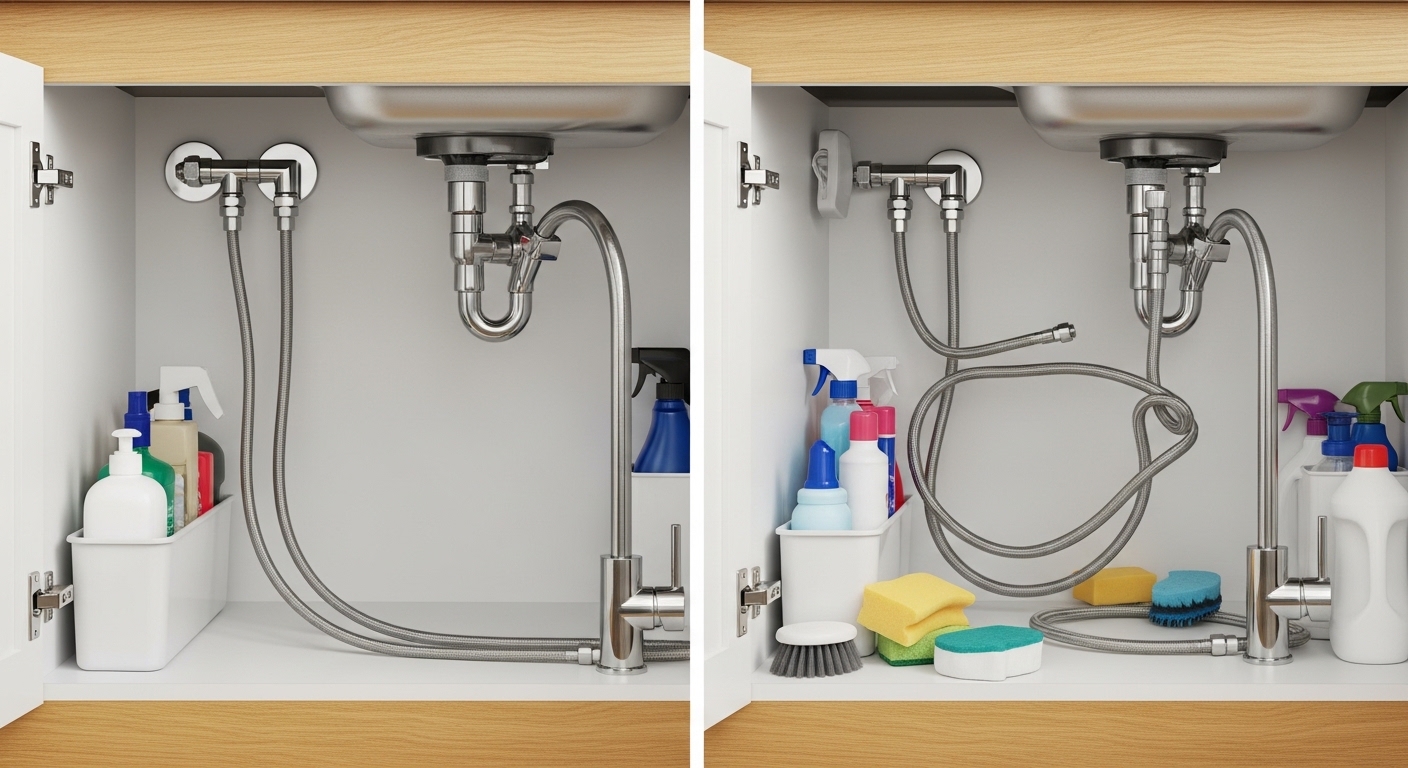
A faucet supply line can definitely be too long, and “longer is safer” is a myth. The ideal supply line is just long enough to reach from the shut-off valve to the faucet tailpiece with a gentle, sweeping curve — roughly 3 to 6 inches of slack beyond the straight-line distance. Anything much longer has to go somewhere, and under a cramped sink cabinet it goes into coils, sharp bends, and loops that press against the cabinet floor or side wall.
Here’s why that matters. Braided stainless supply lines have a minimum bend radius — the tightest curve they can take before the inner EPDM or PEX tube starts to crimp. Force an extra 8 inches of hose into a 4-inch gap and you’ll blow right past that radius. The braid hides the damage, so the line looks fine while the tube inside is pinched, restricting flow and building a weak spot. Over months of thermal expansion and water-hammer pulses, that weak spot is exactly where a pinhole leak shows up.
Excess length also puts leverage on the compression nut and the faucet’s plastic inlet shank. A long line wants to spring back to straight; that constant sideways tension slowly loosens the coupling nut, and a slightly loose nut under 40–80 psi of household water pressure is how you get the dreaded “why is my cabinet damp?” mystery.
How long should a faucet supply line be for a bathroom or kitchen sink?
Measure the straight-line distance from the outlet of your shut-off valve to the faucet’s inlet, then add 3 to 6 inches — that’s your target length. For most bathroom vanities that lands at 12, 16, or 20 inches; for kitchen sinks with the valve mounted lower on the back wall, 20 to 24 inches is common. Supply lines are sold in standard lengths (9″, 12″, 16″, 20″, 24″, 30″, 36″), so you round up to the nearest standard size only if the exact fit isn’t available.
The reason you add a few inches instead of buying dead-on is real: you want a soft curve, not a taut straight run. A line stretched bar-tight puts tension on both fittings and gives you zero room to snug the nut with a wrench. But “a few inches” is the operative phrase. Buying a 30-inch line for a 14-inch gap doesn’t future-proof anything — it just guarantees coiling.
- Standard bathroom vanity: valve-to-faucet gap of ~9–14″, so a 12″ or 16″ line.
- Kitchen sink, deck-mount faucet: gap of ~16–20″, so a 20″ or 24″ line.
- Deep farmhouse or vessel setup: gap can hit 24″+, use a 30″ line and route it cleanly.
- Pull-down kitchen faucet: the faucet often comes with pre-attached hoses — measure to the connection point, not the spout.
If you’re not sure which faucet layout you have, our guide on wall mount versus regular deck faucets explains how the mounting style changes where your inlets sit and, therefore, how long the supply lines need to be.
What happens if a faucet supply line is too long? (The real problems)
An over-long supply line causes four concrete problems: kinking, restricted flow, connection stress, and a cluttered cabinet that hides leaks until there’s damage. None of them are dramatic on day one — that’s what makes an oversized line sneaky.
Kinking and a pinched inner tube
This is the big one. Braided lines look tough, but the braid is just armor over a soft rubber or plastic core. Excess length forces tight bends that crimp that core. A kinked line can cut flow by a noticeable amount and creates a fatigue point. If you’ve ever had weak flow at a brand-new faucet, a kinked over-long supply line is a prime suspect — right up there with a clogged aerator.
Slightly reduced and turbulent flow
Every extra foot of hose and every tight bend adds a little friction loss. On its own, an extra 12 inches of ½” line barely dents household pressure. But combine long length with a couple of sharp bends and a partially open valve, and you can lose enough pressure to feel it — especially in homes that already struggle. If your water is slow everywhere, though, the supply line usually isn’t the culprit; hard-water scale is more likely, which is why we walk through mineral buildup in our piece on the best bathroom faucet for hard water.
Stress on the fittings
A coiled line under spring tension constantly tugs on the coupling nuts. Combine that with vibration from water hammer and you get gradual loosening. Faucet inlet shanks are often plastic; a sideways pull from a too-long line can crack them over time.
A cabinet you can’t work in
Loops of extra hose eat the storage space under your sink and, worse, hide the early signs of a drip. A small weep at a stressed connection can wick along a coiled line and drip somewhere far from the source, so you don’t spot it until the cabinet floor swells. If your shut-off itself is the problem — seized or dripping — see our fix for a stuck bathroom faucet valve before you blame the line.
Too long vs. too short: which is the bigger mistake?
Too short is the worse mistake — a line that won’t reach forces you to over-tighten, strain the threads, or add a coupler that becomes a second leak point. But “too long” isn’t harmless; it’s just a slower failure. The goal is neither. Here’s how the two problems compare so you can aim for the middle.
| Factor | Supply line too short | Supply line too long | Correct length (+3–6″) |
|---|---|---|---|
| Connection stress | High — line pulled bar-tight, threads strained | Moderate — spring tension loosens nuts over time | Low — gentle curve, no pull on fittings |
| Kink risk | Low (but no slack to work with) | High — excess coils into tight bends | Very low — smooth sweep within bend radius |
| Flow impact | Minimal | Slight to moderate if kinked | Full flow |
| Leak likelihood | Higher at install (over-tightening) | Higher months later (loosening/pinhole) | Lowest |
| Ease of future service | Poor — no room to disconnect | Poor — tangled, cluttered cabinet | Good — easy to reach and re-wrench |
Can you coil or shorten an extra-long supply line instead of replacing it?
You can coil a slightly long line into ONE loose loop, but you cannot cut a braided supply line to length — and you shouldn’t rely on a tight coil as a fix. Braided stainless and PEX lines are crimped at the factory with fixed end fittings; there’s no field-cutting them without ruining the seal. If your line is only a couple inches long, gently route the extra into a single wide loop that respects the bend radius. If it’s dramatically oversized, buy the right size. It’s a $5–$15 part; it’s not worth risking a leak to reuse.
A few practical routing rules when you’ve got a little extra to manage:
- One wide loop, never a tight coil. Keep any curve wider than a soda can; if the hose resists the bend, it’s too tight.
- Route away from the cabinet corner. Don’t jam the loop into the corner where the wall and floor meet — that forces a kink.
- Keep hot and cold from crossing. Let them run parallel; crossed lines pinch each other.
- Hand-tighten, then a quarter to half turn with a wrench. Braided-line nuts seal with an O-ring or gasket — you don’t crank them like pipe threads.
- Check for a drip after 10 minutes and again after 24 hours. Slow weeps show up late.
If you’re swapping the faucet entirely while you’re down there and it fights you, our walkthrough on removing a kitchen faucet with a U-shaped bracket covers the mounting hardware that usually causes the headache. And for tub setups, deck-mount valves have their own reach quirks — the Roman tub faucet deck-mount replacement guide covers those.
How do I choose the right supply line material and length together?
Choose braided stainless steel for almost every faucet install, size it to your measured gap plus 3–6 inches, and match the end fittings to your valve and faucet. Material and length work together: the right length means nothing if the connector type is wrong. Most residential shut-offs use 3/8″ compression outlets, and most faucet inlets are either 1/2″ female threads or come with a pre-attached hose ending in a coupling nut.
Quick material rundown:
- Braided stainless (with EPDM or PEX core): the default. Burst-resistant, flexible, handles a gentle curve without kinking. Best all-around choice.
- PEX with poly braid: lighter and cheaper, fine for most jobs, slightly less abrasion-resistant.
- Rigid chrome/copper riser: old-school, cut and bent to exact length — great when you want zero slack in a visible location, but unforgiving to install.
- Vinyl/PVC braided: budget option; more prone to bulging over time. We don’t recommend it for anything permanent.
On connector size, read the packaging carefully. A line labeled “3/8″ comp × 1/2″ FIP × 16 in” tells you both ends and the length. Getting the ends right matters as much as the length — the wrong thread means an adapter, and every adapter is another potential leak.
Is a longer supply line ever the right call?
Occasionally, yes — when your shut-off valve is genuinely far from the faucet, such as a valve mounted on a side wall rather than directly below, or a deep vessel-sink or apron-front setup where the inlet sits high. In those cases a 24″, 30″, or even 36″ line is correct because the actual distance is that long. The rule was never “short is always better” — it’s “match the line to the true distance plus a small margin.” A long line spanning a long gap in a smooth sweep is perfectly fine. A long line stuffed into a short gap is the problem.
So before you assume you overbought, measure. If the straight-line reach really is 22 inches, your 24-inch line is doing its job. If the reach is 10 inches and you’re holding a 24-inch line, that’s the mismatch to fix.
How faucitta tests supply-line fit, and a note on standards
Faucet supply lines sold in North America should carry certification to ASME A112.18.6 / CSA B125.6 (the standard for flexible water connectors) and, for anything touching drinking water, meet NSF/ANSI 61 and 372 for lead-free materials. When we bundle or recommend a line, we confirm it’s rated for continuous household pressure (typically up to ~125 psi) and check the burst rating well above that. Reputable braided lines also list a temperature rating (usually up to ~180–210°F) so the hot side holds up.
A practical tip we give every customer: buy from a source that publishes the exact length, both fitting types, and the certification. If those three specs aren’t listed, you can’t confirm the fit — and fit is the whole game with supply lines. Many quality lines also carry a manufacturer warranty against defects; keep the packaging, because a warranty claim on a failed connector usually needs the model info.
Author note: This guide was written by the faucitta fixtures team — the same people who spec faucets, source their supply components, and field the “why is my new faucet leaking under the sink?” support tickets. faucitta is a dedicated faucet and bathroom-fixtures retailer, not a general hardware store, so supply-line fit is something we deal with in real installs constantly. When a return comes back, the coiled, kinked, over-long supply line is one of the most common avoidable culprits we find.
FAQ
Can a too-long faucet supply line reduce my water pressure?
Slightly, and mostly indirectly. A modest amount of extra ½” hose adds negligible friction loss on its own. The real pressure hit comes when the excess length forces a kink or a tight bend that pinches the inner tube. If your flow is weak, check the supply lines for kinks and the aerator for scale before assuming the pressure into your home is the issue.
How much slack should a faucet supply line have?
About 3 to 6 inches beyond the straight-line distance from the shut-off valve to the faucet inlet. That’s enough to form one gentle curve so the line isn’t pulled tight, without so much extra that it coils or kinks. When in doubt, err toward the shorter standard size that still reaches comfortably.
Can I cut a braided stainless supply line to make it shorter?
No. Braided supply lines have factory-crimped end fittings and a sealed core — cutting them destroys the seal and the fitting. If a line is far too long, buy the correct standard length instead. Only rigid copper or chrome risers are meant to be cut and bent to size, and those require different tools and skills.
What length supply line do I need for a standard bathroom faucet?
Most bathroom vanities need a 12″ or 16″ line, because the gap from the angle-stop valve to the faucet inlet is usually 9 to 14 inches. Measure your specific gap and add 3 to 6 inches. Kitchen sinks typically need 20″ or 24″ lines because the valves sit lower and farther back.
Are longer supply lines more likely to leak?
Yes, over time. An over-long line puts spring tension on the coupling nuts, which can gradually loosen them, and its tight bends create fatigue points where pinhole leaks form. A correctly sized line with a gentle curve keeps the fittings relaxed and is the most leak-resistant option. Check any new connection for drips at 10 minutes and again at 24 hours.