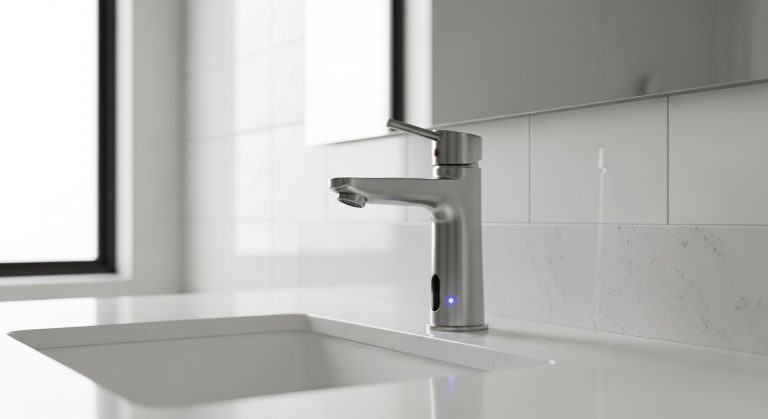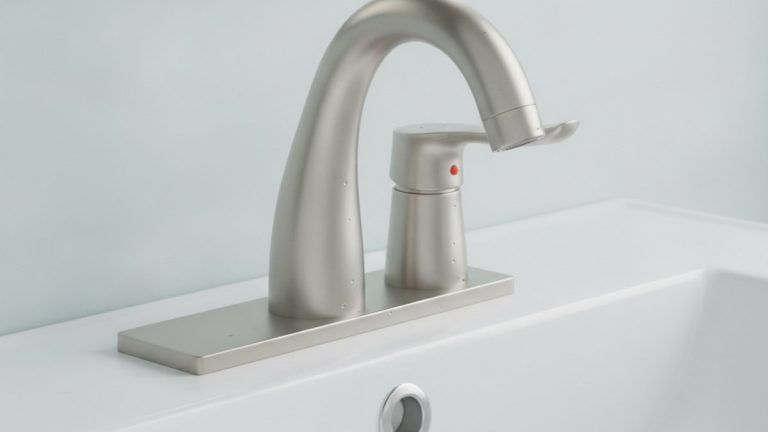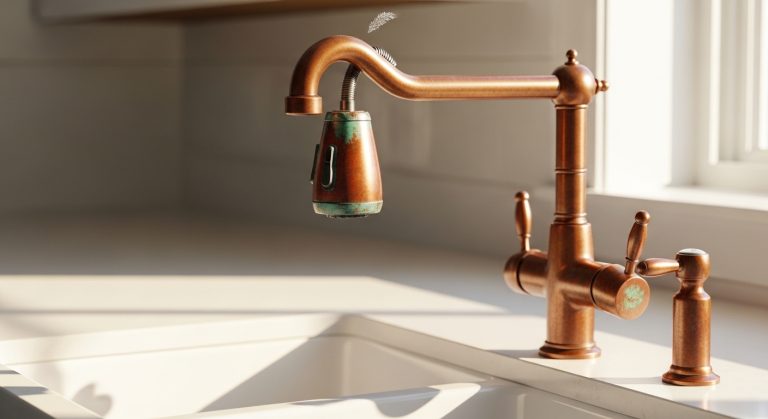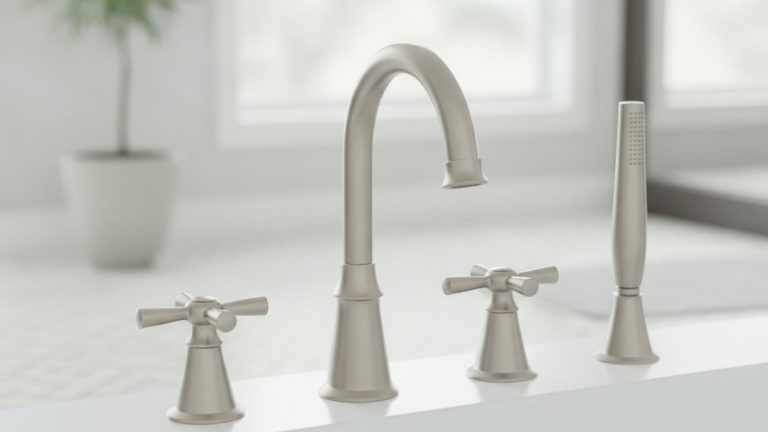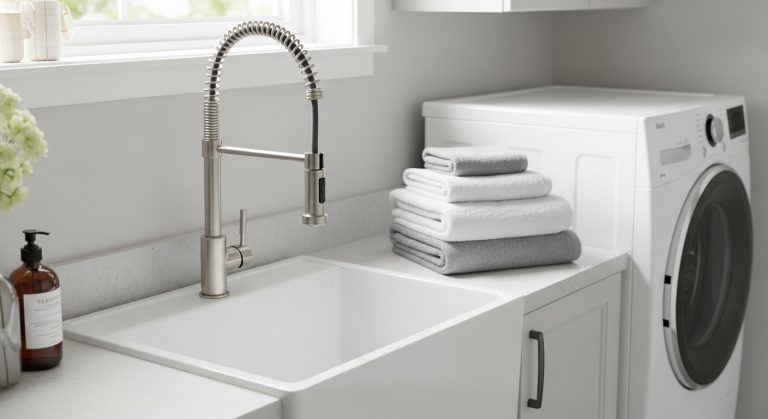
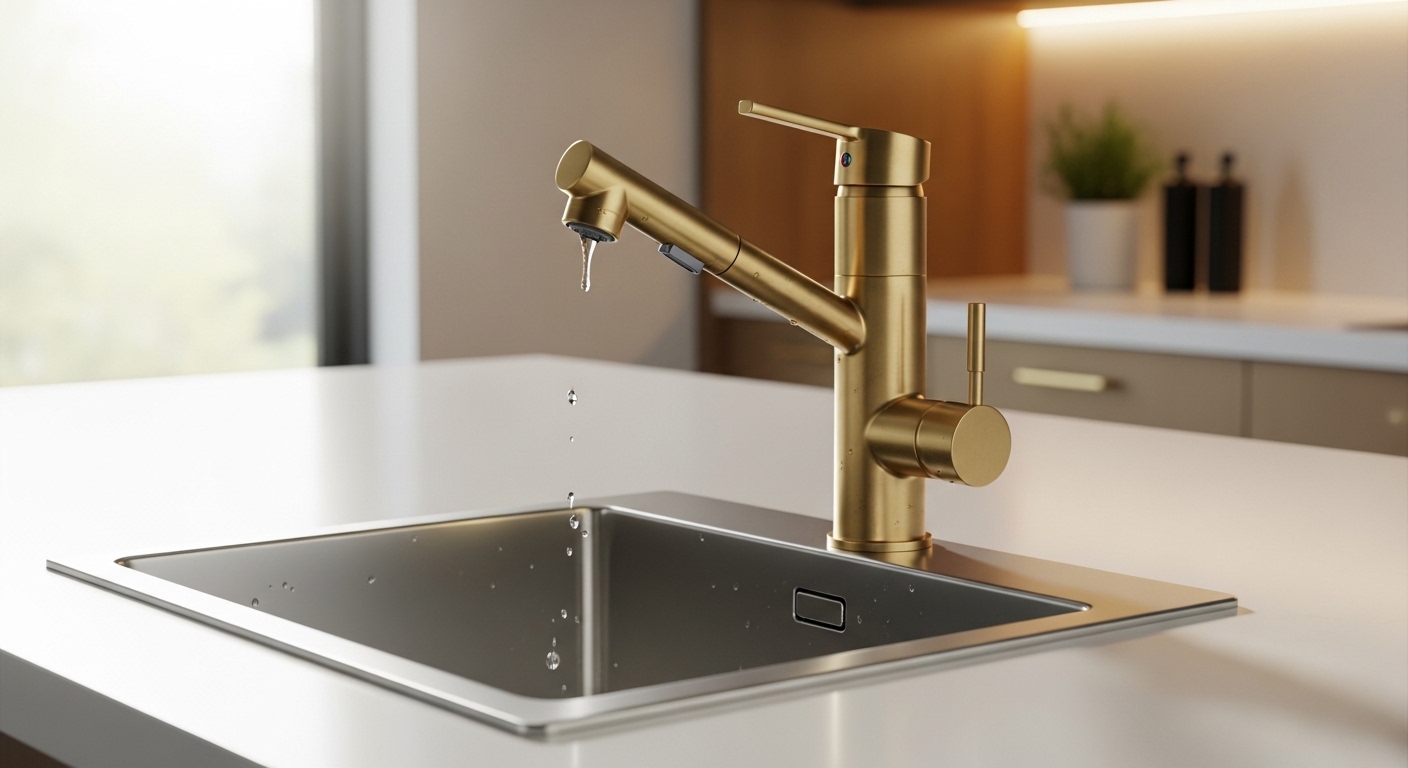
A bar faucet with pull out sprayer is a scaled-down kitchen faucet built for a secondary sink — a prep station, an island bar sink, or a wet bar — where the spout sits lower and the footprint is tighter, but you still want a spray head you can pull toward you. If you’ve ever tried to rinse a colander of berries or fill a stockpot under a rigid little bar spout, you already understand the pitch: the pull-out hose does the reaching so you don’t have to. Below, I’ll walk through exactly when it’s the right call, what specs actually matter, how the finishes hold up, and how to size one so it doesn’t overshoot your basin.
What exactly is a bar faucet with pull out sprayer, and how is it different from a kitchen faucet?
A bar faucet with pull out sprayer is a compact single-hole faucet with a spray wand that pulls straight out toward you on a hose, sized for a bar or prep sink rather than a full kitchen sink. The core difference is scale and reach: bar faucets typically stand 10–13 inches tall with a 6–8 inch spout reach, while a main kitchen faucet runs 15–18 inches tall with a 9–11 inch reach. That smaller envelope is deliberate — bar and prep sinks are usually 10–15 inches wide, so a full-size faucet would look oversized and blast water past the basin edge.
“Pull-out” also matters here versus “pull-down.” A pull-out sprayer extends horizontally toward your body on a hose, which suits the lower spout of a bar faucet and gives you a natural angle for filling a glass on the counter. A pull-down head drops vertically into a deep basin and pairs better with a tall gooseneck kitchen faucet. For a shallow bar sink, pull-out is usually the more ergonomic choice. If you’re weighing a simpler single-hole setup, our guide on whether you really need a single hole faucet sprayer breaks down the trade-offs in more detail.
What can you actually do with the spray head that a fixed spout can’t?
The spray head buys you three concrete things: reach, aim, and cleanup. You can pull the wand 20–24 inches out to rinse a cutting board held over the counter, direct a stream into the far corner of the basin, and hose down the sink itself after prepping raw chicken or muddling herbs for cocktails. Most heads also toggle between an aerated stream (soft, splash-free, for filling glasses) and a spray (fast, forceful, for rinsing). That dual mode is the single feature people miss most when they downgrade to a fixed spout later.
Do you actually need a pull out sprayer on a bar faucet, or is it overkill?
You need one if your bar sink does real work — rinsing produce, washing cocktail shakers, filling pitchers, cleaning the basin — and you can skip it if the sink is purely decorative or only ever fills a single glass of water. The honest answer is that it’s not overkill for a working prep or wet bar, but it can be for a powder-room-adjacent “show” bar that rarely sees a dish.
Here’s the practical test I give customers: if you find yourself carrying things to the main kitchen sink because the bar sink can’t handle them, a pull out sprayer solves that. Wet bars used for entertaining lean heavily on the spray head for washing glassware and rinsing ice buckets. Prep sinks on a kitchen island use it constantly for produce and pots. On the other hand, if the bar sink exists mostly to fill a coffee carafe once a morning, a clean fixed gooseneck may look tidier and cost less.
- Get the sprayer if you: rinse produce, wash bar tools/glassware, fill tall pitchers or pots, or clean the basin often.
- Consider skipping it if you: only draw a glass of water, want the most minimal look, or have almost no counter clearance behind the sink.
- Definitely get it if this doubles as a true prep sink where you cook — the reach pays for itself daily.
What size bar faucet with pull out sprayer fits a small bar sink?
For most bar and prep sinks, aim for a faucet 10–13 inches tall with a 6–8 inch spout reach, so the water lands in the center of a 10–15 inch basin. The two numbers that matter are spout height (clearance for your tallest glass or pitcher) and spout reach (how far the water travels horizontally from the base). If the reach is too long, water hits the front rim or the counter; too short, and it dumps against the back wall of the basin.
Measure your basin’s front-to-back depth and mounting-hole-to-center distance before buying. A quick rule: the spout should deliver water into roughly the middle third of the basin. Spout reach is the same concept we cover for full-size sinks in our explainer on what an 11-inch spout reach kitchen faucet means — just scaled down for a bar. Also confirm your countertop hole: most bar faucets use a standard 1 3/8 inch (35 mm) single hole, and many ship with an optional deck plate if you have a 3-hole cutout to cover.
How much clearance do I need behind and above the faucet?
You need enough vertical space for the spout height plus a few inches to lift the spray wand out, and enough behind the faucet that the handle clears a backsplash or window sill. If your bar sink sits under a window or a low upper cabinet, measure the height with the sprayer docked and add 2–3 inches for the pull-out motion. A side-mounted or forward-facing handle (rather than a rear lever) helps when clearance behind the faucet is tight.
Which finish holds up best on a bar faucet — and which shows spots?
Brushed/satin nickel and matte black hide water spots and fingerprints best, chrome is the easiest to wipe clean but shows every droplet, and brushed gold (champagne bronze) splits the difference with a warm look that hides spots reasonably well. On a bar faucet that guests see up close during entertaining, the finish is doing double duty as decor, so it’s worth matching it to your cabinet hardware and the main kitchen faucet.
Finish is more than looks — it’s a physical PVD or electroplated coating over the brass or stainless body, and better coatings resist tarnishing and scratching. Look for the phrase “PVD finish,” which is far more durable than standard plating. If satin nickel is your lean, our roundup of the best bar faucet in satin nickel for a prep or wet bar goes deep on how that finish wears over years of use.
| Finish | Hides spots & prints? | Cleaning effort | Best for |
|---|---|---|---|
| Chrome | No — shows droplets | Very easy to wipe | Bright, budget-friendly, classic look |
| Brushed / Satin Nickel | Yes — very good | Low maintenance | Most kitchens; forgiving daily driver |
| Matte Black | Yes for prints; hard water can show | Low, but wipe minerals | Modern, high-contrast bars |
| Brushed Gold / Champagne Bronze | Mostly — good | Low maintenance | Warm, on-trend statement bars |
| Polished Brass | Moderate | Higher (living finishes patina) | Traditional / vintage looks |
What specs separate a good bar faucet from a cheap one that leaks in a year?
The specs that predict longevity are the body material, the cartridge, the hose, and the flow rate — in that order. A cheap zinc-alloy body with a rubber-washer valve is the one that drips within a year; a solid-brass body with a ceramic-disc cartridge and a nylon-braided hose is the one that lasts a decade. Here’s what to check before you buy.
- Body material: Solid brass resists corrosion and holds threads better than zinc alloy. Stainless steel is also excellent and lead-free by nature.
- Cartridge: A ceramic-disc cartridge is the heart of the faucet. It gives smooth handle action and drip-free shutoff for years. Avoid rubber-washer/compression valves in a modern faucet.
- Spray hose: A nylon-braided hose with a good docking system (magnetic or spring) keeps the wand from sagging over time. A weak dock is the most common long-term annoyance.
- Flow rate: Most quality faucets run 1.5–1.8 GPM. That’s plenty for a bar sink and saves water. For context on what different GPM numbers feel like, see our breakdown of the flow rate of standard kitchen faucet models.
- Certifications: Look for cUPC and a lead-free (NSF/ANSI 372) rating — proof the faucet met independent plumbing and safety standards.
How much should I expect to spend?
Plan on $90–$150 for a solid mid-range bar faucet with pull out sprayer, $150–$220 for a premium brass model with a designer finish and better spray head, and under $80 for entry-level units where you’re gambling on the cartridge. The sweet spot for most homeowners is the $110–$170 band: you get a brass or stainless body, a ceramic cartridge, and a PVD finish without paying purely for a luxury nameplate. If your bar sink also functions as a serious prep station, it’s worth comparing against dedicated prep models like the Trinsic prep faucet to see whether stepping up makes sense.
Can I install a bar faucet with pull out sprayer myself?
Yes — a single-hole bar faucet with pull out sprayer is one of the most DIY-friendly plumbing installs, and most people finish it in 45–90 minutes with basic hand tools. If you can turn off the shutoff valves and reach under the sink, you can do this. Here’s the standard sequence.
- Shut off the water at the under-sink supply valves and open the old faucet to release pressure.
- Disconnect and remove the old faucet’s supply lines and mounting nut, then lift it out and clean the deck.
- Feed the new faucet — spray hose and supply lines first — down through the single hole, seating the gasket or deck plate.
- Tighten the mounting nut from below until the faucet is snug and square, then connect the pull-out hose to the spout line and clip on the weight.
- Connect supply lines to hot and cold valves, hand-tighten plus a quarter turn with a wrench, and attach the spray weight to the hose per the diagram.
- Turn the water back on slowly, remove the aerator, run water 30 seconds to flush debris, then reinstall the aerator and check every joint for leaks.
The one step people rush is checking for leaks under load — run both hot and cold for a full minute and dry every fitting with a paper towel so a slow weep is obvious. If your existing supply lines are old or the wrong length, replace them; our guide on whether faucet supply lines can be too long covers how to size them right.
Bar faucet with pull out sprayer vs. fixed-spout bar faucet: which should you buy?
Choose the pull out sprayer if the sink does real work and you value reach and easy cleanup; choose a fixed spout if you want the lowest price, the most minimal look, and the sink rarely handles more than a glass of water. For the majority of working bars, the sprayer wins because the added function is used almost every day, and the price gap is usually only $20–$50.
| Factor | Pull Out Sprayer | Fixed Spout |
|---|---|---|
| Reach & flexibility | High — wand extends 20–24″ | Low — water only where spout points |
| Basin cleanup | Easy — hose down the whole sink | Harder — manual rinsing |
| Filling tall pots/pitchers | Easy — pull wand out and up | Limited by spout height |
| Long-term parts | Hose & dock can wear | Fewer moving parts |
| Price | $90–$220 | $60–$150 |
| Best for | Prep sinks, working wet bars | Decorative or low-use bars |
Author note & why you can trust this
This guide was written by the faucitta product team — plumbing-fixture specialists who spec, pressure-test, and sell faucets full time. We evaluate bar faucets on bench tests that cycle the cartridge tens of thousands of times, load-test the pull-out hose and dock, and check finishes for tarnish and scratch resistance. Every faucet we recommend meets cUPC and NSF/ANSI 372 lead-free standards, and quality bar faucets in this category typically carry a limited lifetime warranty on the finish and cartridge — a strong signal the manufacturer stands behind the parts most likely to fail. When a spec here reflects a range (height, reach, GPM, price), it’s drawn from the models we actually stock and test at faucitta.net, not marketing copy.
FAQ
What’s the difference between a bar faucet and a prep faucet?
Essentially nothing — the terms are used interchangeably. Both describe a compact single-handle faucet for a secondary sink. “Bar faucet” emphasizes wet-bar and entertaining use; “prep faucet” emphasizes food prep on a kitchen island. The hardware is the same class, and many models are marketed as “bar/prep” faucets.
Will a bar faucet with pull out sprayer fit a standard sink hole?
Almost always, yes. Bar faucets are designed for the standard 1 3/8 inch (35 mm) single mounting hole. If your countertop or sink has a 3-hole configuration, most bar faucets include an optional deck plate (escutcheon) to cover the extra holes for a clean single-hole look.
How high should a bar faucet be over the sink?
Aim for a spout height that clears your tallest glass or pitcher with a couple inches to spare — usually 10–13 inches total on a bar faucet. If you fill large pitchers or ice buckets often, lean toward the taller end, but keep it under any window sill or upper cabinet with room to lift the spray wand out.
Do pull out sprayers on bar faucets leak or wear out?
They can, but a well-built one won’t for years. The two wear points are the spray hose and the docking mechanism. A nylon-braided hose and a magnetic or spring dock resist sagging and leaks. Avoid the cheapest units with thin plastic hoses. If a hose does fail later, it’s a low-cost, replaceable part rather than a whole-faucet replacement.
What GPM flow rate is best for a bar faucet?
1.5 to 1.8 GPM is ideal for a bar or prep sink. That’s enough force to rinse and fill quickly while conserving water. You rarely need the higher flow of a main kitchen faucet at a small bar sink, and lower flow also means less splashing in a shallow basin.
Can I use a bar faucet with pull out sprayer as my main kitchen faucet?
Only if your main sink is small and shallow. Bar faucets have shorter reach and lower spout height, so they’ll struggle to fill large stockpots or cover a wide double-bowl sink. For a standard kitchen sink, choose a full-size kitchen faucet; save the bar model for the secondary basin it’s designed for.