If you’ve been shopping for a 6 spout reach wall mount faucet and feel unsure whether that “6 inch reach” actually fits your sink, you’re asking exactly the right question. Spout reach is the single spec that decides whether your water lands in the center of the bowl or splashes your countertop — and on a wall-mounted faucet it matters even more than on a deck-mounted one, because once it’s plumbed into the wall, you can’t slide it forward or back. Let’s break down what the number means, who it’s for, and how to confirm it before you buy.
What exactly is “spout reach” on a wall mount faucet, and how is the 6 inches measured?
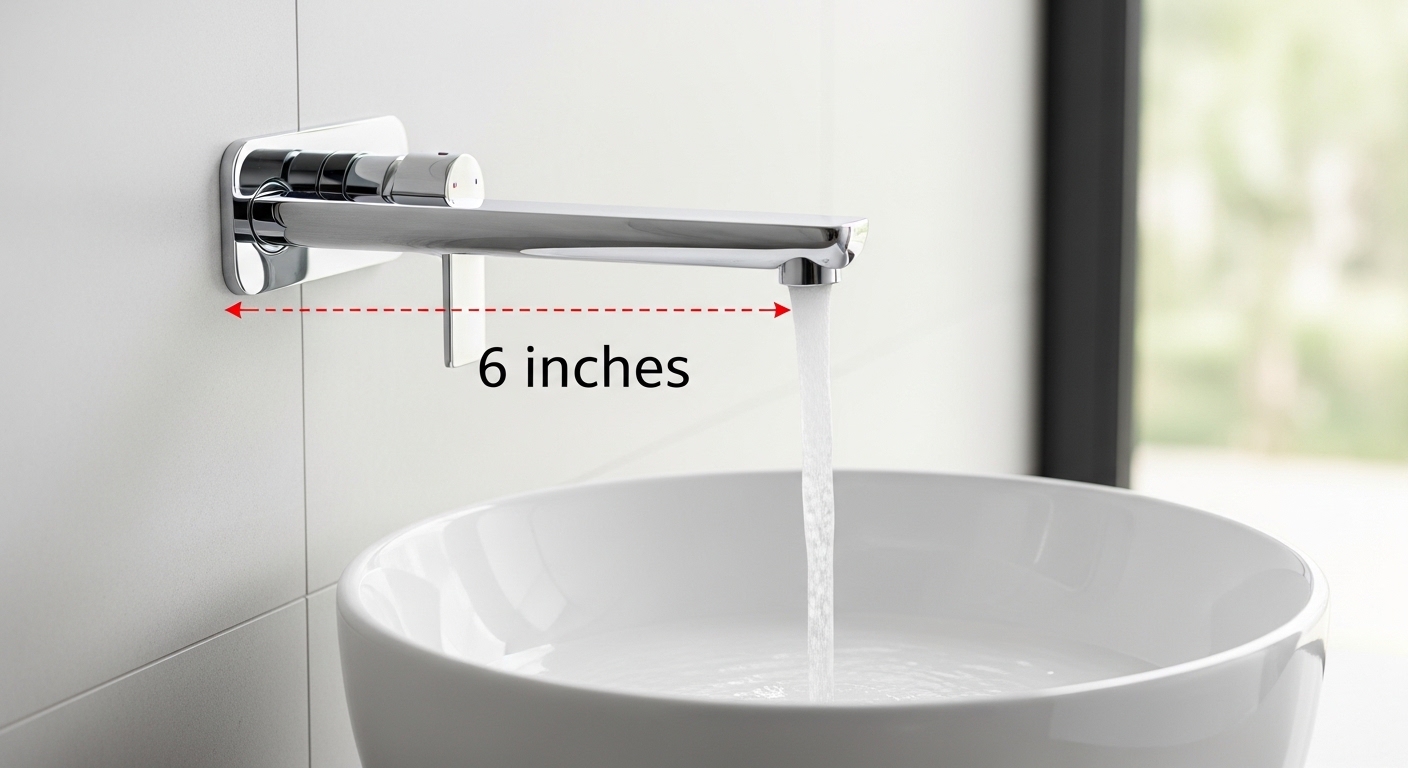
Spout reach is the horizontal distance from the wall (where the spout exits) to the center of where the water falls — and on a 6″ reach faucet, that’s 6 inches straight out. It is not the total length of the spout casting, and it’s not the height. Manufacturers measure reach to the centerline of the aerator stream because that’s the point that actually has to line up with your drain.
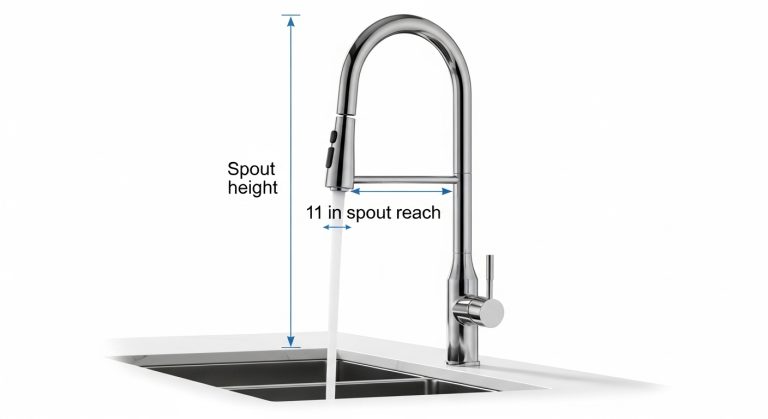
This trips people up constantly. A spout might physically be 7 or 8 inches long because it curves or angles down, but if the water exits closer to the wall, the effective reach is shorter. Always go by the published “spout reach” number, not by eyeballing the casting. Two other numbers travel with it:
- Spout height: how far the aerator sits above the finished wall outlet (and therefore above your basin rim). Typical wall-mount reach-6 faucets run 4″–6″ tall.
- Center-to-outlet / rough-in: on widespread wall-mount sets, the distance between the two handle valves and the spout. This is what your plumber roughs into the wall, so it has to match the trim.
If you’ve ever stared at a parts breakdown and felt lost, our guide to what a bathroom faucet diagram actually shows walks through every one of these measurements and where they’re taken from — worth a two-minute read before you order.
Is a 6 inch spout reach long enough for my vessel sink or undermount basin?
For most vessel sinks and standard undermount basins, yes — a 6″ reach is the sweet spot. Here’s the rule of thumb: you want the water to land between the center and the front third of the bowl, never directly over the drain (which splashes back up) and never so far forward it hits the rim. A 6″ reach clears the back wall of a vessel sink that’s typically 4″–6″ wide at the back and drops water nicely into the basin.
Where it matters most:
- Vessel sinks (above-counter bowls): 6″ reach is the classic pairing. The bowl sits forward of the wall, so you need that extension to clear the back of the bowl and reach the water area.
- Narrow powder-room basins: a wall mount with 6″ reach frees up the entire countertop and deck — no holes drilled in a tiny vanity top — and 6″ usually centers nicely on a 12″–18″ deep basin.
- Undermount sinks: works well, but measure from your finished wall to the drain center. If your sink sits far forward of the wall (deep vanity), you may need 7″–8″.
If an undermount basin is your situation specifically, pair this reading with our deeper dive on the best bathroom faucet for an undermount sink in 2026 — it covers the reach-to-drain math for that exact configuration.
How do I measure to make sure a 6″ reach will actually fit before I buy?
Measure from your finished wall surface (tile included) straight out to the center of your drain — if that number is between 5 and 7 inches, a 6″ reach faucet is your match. This is a five-minute job and it’s the step that prevents the most returns.
- Find your drain center. For an existing sink, measure from the back wall to the middle of the drain opening. For a new sink, use the spec sheet’s drain location.
- Account for finished wall thickness. Tile and backer board can add 3/4″ or more. The faucet exits the finished surface, so measure from there, not the studs.
- Compare to spout reach. Subtract the faucet’s reach (6″) from your wall-to-drain distance. You want the water landing slightly in front of the drain center — a result of 0″ to +2″ forward is ideal.
- Check height/clearance. Make sure the spout sits high enough above the rim to fit your hands and a soap bottle, but not so high it splashes. For vessel sinks, 6″–8″ above the counter is comfortable.
One common mistake: people measure to the back of the sink instead of the drain. The drain is what the water needs to find, so always measure to the drain center.
6″ reach vs. other spout reaches: which one fits which sink?
Short answer: 4″–5″ reach suits tight/shallow basins, 6″ is the all-rounder for vessel and standard sinks, and 8″+ is for deep or forward-set bowls and kitchen-style applications. Here’s how they compare:
| Spout Reach | Best For | Typical Sink Depth (front-to-back) | Watch Out For |
|---|---|---|---|
| 4″ – 5″ | Small powder-room basins, narrow trough corners | 10″ – 14″ | Too short for vessel sinks; water lands near the back wall |
| 6″ (this guide) | Vessel sinks, standard undermount/drop-in basins | 14″ – 20″ | Slightly short for very deep vanities set far from the wall |
| 7″ – 8″ | Deep basins, forward-set bowls, double vanities | 20″ – 24″ | Can overshoot a shallow bowl and splash the rim or counter |
| 9″+ | Kitchen / utility wall-mount, farmhouse sinks | 24″+ | Overkill (and splash-prone) for any bathroom basin |
Notice the overlap: a 6″ reach comfortably covers the largest slice of real-world bathroom sinks. That’s why it’s the most commonly stocked reach for wall-mount bath trim. If you’re cross-shopping faucet styles in general — single-handle vs. widespread — our explainer on choosing the best single handle faucet for a sink helps you match handle layout to your basin and rough-in.
What are the real pros and cons of a wall mount faucet at 6″ reach?
The big win is a clean, open countertop and easier cleaning; the big trade-off is that the rough-in is permanent and reach can’t be adjusted later. Wall-mount trim is a design statement and a practical upgrade, but it asks more of your planning up front.
Pros:
- Nothing on the counter: no deck holes, no gunk collecting around the base, easy wipe-downs across the whole vanity top.
- Works with vessel sinks: the 6″ reach clears the bowl and lands water where you want it.
- Modern, high-end look: a spout floating out of the wall reads as custom and intentional.
- Frees vanity depth: great for shallow floating vanities where a tall deck faucet would crowd the mirror.
Cons:
- Plumbing lives in the wall: valves are roughed into the wall cavity, so installation (or repair) means wall access — best done during a remodel.
- Reach is fixed forever: get the 6″ measurement right the first time; you can’t nudge a wall faucet forward like a deck one.
- Finish wear shows: water runs down the wall finish between spout and basin, so your wall material and faucet finish both need to handle moisture.
That last point is worth dwelling on. Because water tracks down the wall on a wall mount, the faucet’s finish does real work. A finish like oil-rubbed bronze hides spotting beautifully and ages gracefully — if that look appeals to you, see how it behaves day-to-day in our piece on the oil rubbed bronze faucet and whether it’s the right pick for your bathroom.
What should I check on the spec sheet besides the 6″ reach?
Beyond reach, confirm the valve type, flow rate, rough-in compatibility, and finish standard — these four decide reliability and code compliance. The reach gets you aimed at the right sink; these get you a faucet that lasts and passes inspection.
- Cartridge / valve type: ceramic-disc cartridges are the gold standard for drip-free, long-life operation. They’re rated for tens of thousands of cycles and resist hard-water wear far better than older rubber-washer designs.
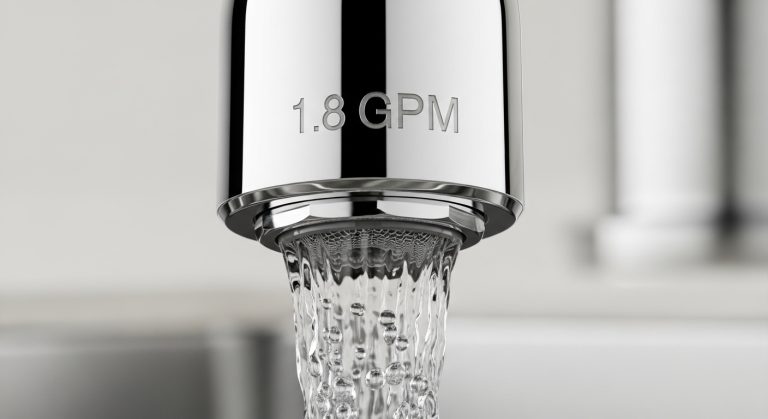
- Flow rate (GPM): U.S. bathroom faucets are capped at 1.2 GPM at 60 psi by federal standard; WaterSense-labeled models meet that while still feeling strong. Check the GPM so you’re not surprised by a trickle — or by failing local code.
- Rough-in valve body: some wall-mount trims include the in-wall valve; others are “trim only” and need a matching rough-in body. Confirm which you’re buying, or you’ll be missing half the assembly.
- Finish standard: look for PVD (physical vapor deposition) finishes for scratch and tarnish resistance, and for compliance marks like ASME A112.18.1 / CSA B125.1 and NSF/ANSI 61 for drinking-water safety.
A faucet that brags about its looks but hides its valve type and certifications is a faucet to be skeptical of. The good ones publish all of it.
FAQ
Is a 6 inch spout reach too long for a small bathroom sink?
Usually not — 6″ is comfortable for basins 14″–20″ deep, which covers most powder-room and standard sinks. It only becomes “too long” on very shallow basins (under about 12″ front-to-back), where the water could land near or past the front rim. If your basin is that small, step down to a 4″–5″ reach and measure to the drain to confirm.
Can I install a 6″ reach wall mount faucet on an existing deck-drilled sink?
Not directly. A wall mount faucet roughs into the wall, while a deck-drilled sink expects the faucet to come up through holes in the counter or sink. You’d either need to cover/plug the deck holes and run new in-wall plumbing, or choose a deck-mount faucet instead. Switching from deck to wall is a remodel-level change, not a swap.
How high above the sink should a 6″ reach wall faucet be mounted?
Aim for the spout outlet sitting roughly 4″–8″ above the basin rim, depending on whether you have a vessel sink (go higher, 6″–8″ above the counter) or a standard basin (4″–6″ above the rim). The goal is enough clearance to wash your hands and fit a soap bottle, without so much drop that the stream splashes out of the bowl.
Does a longer or shorter spout reach affect water pressure?
No — spout reach doesn’t change your water pressure; pressure is set by your supply lines and the faucet’s aerator and valve. What reach affects is where the water lands and how much it splashes. If you’re chasing weak flow, look at the aerator, the valve/cartridge, and your home’s supply pressure rather than the spout length. Our low-pressure troubleshooting guide walks through the same diagnostic logic (aerators, restrictors, supply) that applies to faucets too.
Are wall mount faucets harder to repair than deck faucets?
They’re a bit more involved because the valve body lives inside the wall, so cartridge service means reaching the valve behind an access panel or removing the trim plate. That said, the trim and cartridge themselves replace much like any other faucet once you reach them. Buying a model with a widely stocked ceramic-disc cartridge and a solid warranty makes future service far easier.
What finish holds up best for a wall mount faucet where water runs down the wall?
PVD-coated finishes — brushed nickel, matte black, brushed gold, and oil-rubbed bronze — handle constant moisture best and resist spotting and tarnish. Living (uncoated) finishes will patina over time, which some people love and others don’t. Whatever you choose, a quick daily wipe keeps water spots from etching in, and a non-abrasive cleaner protects the coating.
Author note & brand credibility
This guide was written by the faucitta product team, who spec, test, and photograph bathroom and kitchen fixtures full-time. We bench-test spout reach and flow on real basins, and we cross-check every faucet against ASME A112.18.1/CSA B125.1 construction standards, NSF/ANSI 61 drinking-water safety, and federal 1.2 GPM efficiency rules before we recommend it. faucitta (faucitta.net) specializes in faucets, shower heads, and bath fixtures, and the wall-mount trims we stock carry manufacturer warranties on the finish and cartridge — because a faucet that’s plumbed into your wall should be one you don’t have to think about again for years.