If you’ve been searching for an oil rubbed bronze 4 inch faucet, you’re almost certainly standing in front of a standard bathroom sink with three holes drilled close together — and you want a faucet that looks rich and traditional without showing every fingerprint and toothpaste splatter. Good news: this is the single most common bathroom faucet configuration in American homes, and oil rubbed bronze (often abbreviated ORB) is one of the best finishes for hiding the daily mess. Below, I’ll walk you through exactly what “4 inch” means, who this faucet is right for, how ORB holds up over time, and how to avoid the two or three mistakes that send people back to the store.
What does “4 inch” actually mean on a bathroom faucet?
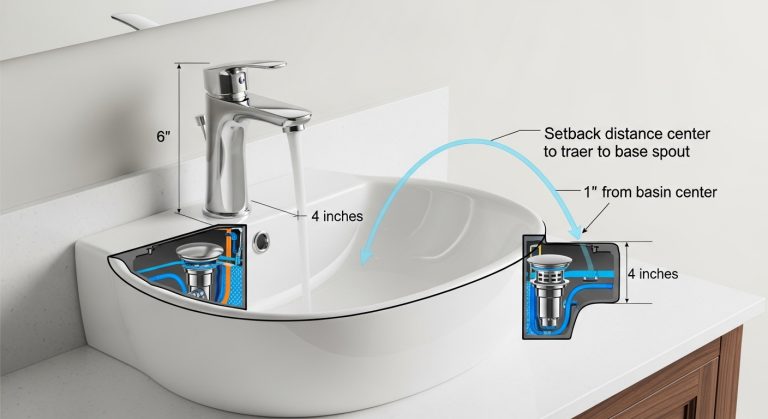
“4 inch” refers to the distance between the centers of the two outer mounting holes on your sink — 4 inches center-to-center. This is called a centerset configuration, and a 4 inch faucet is built so the handles and spout sit on a single base plate (or are joined together) to fit that exact spacing.
Here’s the part that trips people up. A standard bathroom sink usually has three holes: two outer holes for handles and one center hole for the spout. When those outer holes are 4 inches apart, you need a 4 inch centerset faucet. If they’re 8 inches apart, you need a “widespread” faucet, which is a completely different, separated three-piece design. If your sink has only one hole, you need a single-hole faucet. They are not interchangeable, so this measurement matters more than the finish does.
To measure: lay a tape measure across your sink and read the distance from the dead center of the left hole to the dead center of the right hole. If it reads roughly 4 inches, an oil rubbed bronze 4 inch faucet will drop right in. If you’re staring at the sink and the holes don’t make sense, our bathroom faucet diagram guide breaks down exactly what each hole and part is for.
Is a 4 inch centerset the same as 4 inch spread?
Mostly yes — “4 inch centerset” and “4 inch spread” describe the same hole spacing. The phrase “4 inch spread” just emphasizes the distance, while “centerset” describes the style where everything sits on one unified base. As long as your outer holes are 4 inches apart, both terms point you to the same faucet. The thing to avoid is confusing a 4 inch centerset with an 8 inch widespread, because those have very different installation footprints.
Who is an oil rubbed bronze 4 inch faucet actually right for?
An oil rubbed bronze 4 inch faucet is right for you if you have a standard three-hole sink with 4 inch spacing and you want a low-maintenance, traditional or transitional look that hides water spots, soap scum, and fingerprints better than chrome or polished nickel. It’s a particularly smart choice for guest bathrooms, kids’ bathrooms, and any sink that gets a lot of daily traffic.
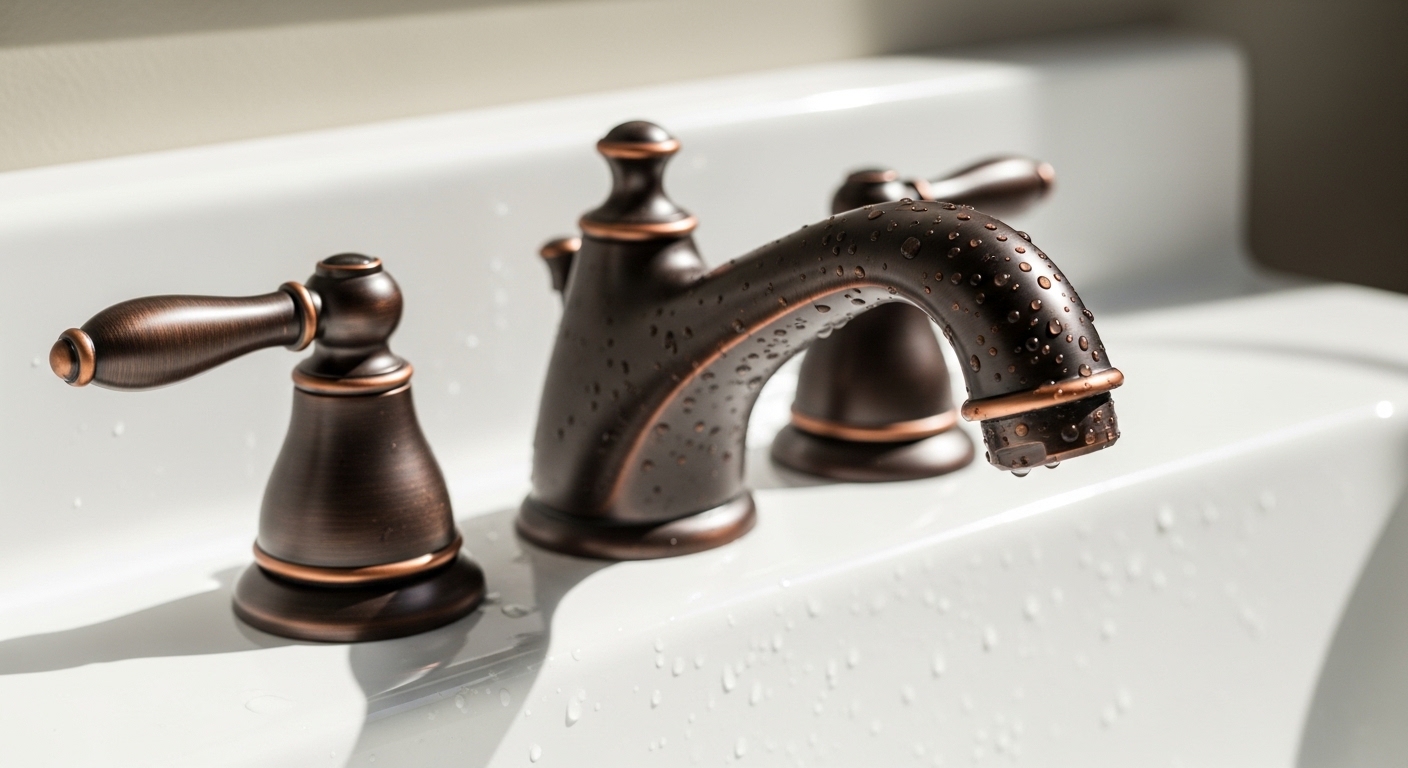
Here’s the practical reasoning. ORB is a dark, warm brown-black finish, often with faint copper or bronze highlights on the raised edges. Because it’s dark and slightly varied in tone, it’s forgiving in a way that shiny finishes simply aren’t:
- Hides water spots — hard-water spotting that shows up white and obvious on chrome basically disappears on a dark finish.
- Hides fingerprints — no more wiping the faucet down twice a day in a busy bathroom.
- Warms up a room — pairs beautifully with cream, beige, tan, and warm-wood vanities, plus white or biscuit sinks.
- Forgiving with age — minor wear on ORB tends to look intentional and “lived-in” rather than damaged.
It’s less ideal if your bathroom leans cool and modern — lots of cool gray, stark white, and chrome accents — where a brushed nickel or matte black faucet would feel more cohesive. ORB is fundamentally a warm finish, so it sings in warm rooms and can feel out of place in an icy-cool palette.
How does oil rubbed bronze hold up over time — does it wear or fade?
Oil rubbed bronze holds up very well day-to-day, but it’s important to know there are two completely different kinds of ORB finish, and they age in opposite ways. One is a “living finish” designed to patina, and the other is a sealed, permanent finish designed to stay exactly as you bought it.
A true living finish ORB is a chemically darkened layer over solid brass or bronze. Over years of touching and cleaning, the high spots — the handle tips, the front of the spout — gradually rub back to reveal lighter copper or brass underneath. Some people love this antique, hand-worn character. Others are surprised by it.
A sealed/coated ORB (the more common type today, often a powder-coat or PVD-style finish over a base metal) is locked in with a clear protective layer. It won’t patina and it won’t rub through under normal use — it stays consistent for the life of the faucet, as long as you don’t scrub it with anything abrasive.
| Finish type | How it ages | Best for | Care level |
|---|---|---|---|
| Living-finish ORB (solid brass/bronze) | Patinas; high spots wear to copper/brass over years | Antique, farmhouse, character-driven looks | Hands-off — let it age |
| Sealed/coated ORB (PVD or powder-coat) | Stays consistent, won’t patina | Buyers who want a permanent, even color | Wipe with soft cloth, no abrasives |
| Chrome (for comparison) | Stays bright but shows every spot | Cool/modern bathrooms | Frequent wiping |
| Brushed nickel (for comparison) | Very stable, hides spots moderately | Transitional bathrooms | Low |
If a permanent, never-changing color matters to you, ask the seller specifically whether the ORB is a sealed/PVD finish or a true living finish — the product description doesn’t always say, and it makes a real difference. The good news is that ORB pairs gracefully with more than just white sinks; if you’re mixing metals or surfaces, our guide on the oil rubbed bronze faucet with a stainless sink pairing shows how that warm-meets-cool combination can actually work in your favor.
How do I clean an oil rubbed bronze faucet without ruining it?
Clean ORB with nothing more than a soft damp cloth and, if needed, a drop of mild dish soap — then dry it. That’s genuinely it. The cardinal rule is no abrasive pads, no scouring powder, and no harsh chemical cleaners (especially anything acidic, ammonia-based, or containing bleach), because those can strip the dark finish or eat through a sealed coating and create permanent light patches.
For everyday spots, a microfiber cloth handles it. For stubborn buildup, dish soap and warm water is the strongest thing you should reach for. Never use a Magic Eraser-type melamine sponge on ORB — it’s mildly abrasive and will dull the finish. The whole appeal of ORB is that it needs less cleaning than shiny finishes in the first place, so resist the urge to over-scrub it.
Can I install a 4 inch faucet myself, and what do I need?
Yes — installing a 4 inch centerset faucet is one of the most beginner-friendly plumbing jobs in the house, and most people finish in 30 to 60 minutes with basic tools. Because the centerset design is unified, you’re essentially dropping in one piece rather than aligning three separate parts like you would with a widespread faucet.
Here’s the basic sequence:
- Shut off the water at the two supply valves under the sink, then open the old faucet to release pressure.
- Disconnect the supply lines and the drain linkage, then remove the old faucet’s mounting nuts from underneath.
- Lift out the old faucet and clean the sink deck of old putty or grime.
- Set the new faucet onto the deck (use the included gasket or a thin bead of plumber’s putty under the base if specified).
- Tighten the mounting nuts from below, hand-tight plus a quarter turn — don’t overtighten.
- Connect new supply lines, reconnect the drain pop-up, turn the water back on, and check for leaks.
You’ll typically want an adjustable wrench, a basin wrench (the hero tool for tight under-sink spaces), plumber’s tape for the threaded connections, and a bucket and towel for the inevitable drips. I always recommend buying fresh braided stainless supply lines at the same time — they’re a few dollars and far more reliable than reusing old, stiff ones. If you ever move beyond a simple swap to dealing with a worn-out valve, our walkthroughs on a bathtub faucet valve cartridge and a step-by-step faucet cartridge replacement show how to handle the internal parts when a faucet drips or sticks.
Oil rubbed bronze vs. matte black vs. brushed nickel — which should I choose for a 4 inch sink?
Choose oil rubbed bronze for warm, traditional bathrooms; matte black for modern, high-contrast looks; and brushed nickel for safe, neutral transitional spaces. All three hide spots and fingerprints far better than chrome, so any of them is a low-maintenance win — the decision is really about the mood of your room.
| Finish | Vibe | Best room palette | Hides spots? | Notes |
|---|---|---|---|---|
| Oil rubbed bronze | Warm, traditional, antique | Cream, beige, warm wood, white sinks | Excellent | Watch for living vs. sealed finish |
| Matte black | Modern, bold, high-contrast | White, gray, cool modern | Excellent | Can show dust/limescale as gray film |
| Brushed nickel | Neutral, transitional, safe | Almost anything | Good | Most universally agreeable finish |
| Chrome | Bright, classic, clinical | Cool/modern | Poor | Cheapest, but shows every spot |
A quick rule of thumb I give people: pull your bathroom’s dominant temperature. If your tile, vanity, and walls feel warm (creams, tans, warm grays, wood tones), ORB will feel like it belongs. If everything feels cool and crisp, matte black or brushed nickel will integrate more naturally. There’s no wrong answer mechanically — all of these come in 4 inch centerset versions — but matching the finish to the room’s temperature is what makes a bathroom feel designed rather than assembled. If you’re still weighing whether a bathroom faucet and a kitchen faucet can ever share parts or finishes across your home, our breakdown of the real difference between kitchen and bathroom faucets clears up a surprising amount of confusion.
What should I look for in the spec sheet before I buy?
Before you buy any oil rubbed bronze 4 inch faucet, confirm five things on the spec sheet: 4 inch centerset hole spacing, ceramic disc valve construction, a standard 1.2 GPM flow rate, solid brass body if available, and a finish/warranty backed by recognized standards. These five details separate a faucet you’ll forget about (in a good way) from one you’ll be replacing in two years.
- Hole spacing: 4 inch centerset — non-negotiable for fit.
- Valve type: ceramic disc cartridges last far longer and drip far less than rubber-washer designs. This is the single biggest predictor of a leak-free life.
- Flow rate: most modern bathroom faucets run 1.2 GPM (gallons per minute), which is efficient and meets common water-conservation rules. WaterSense-labeled models cap at 1.5 GPM or below.
- Body material: a solid brass body resists corrosion and feels substantially more durable than thin zinc-alloy or plastic.
- Standards & warranty: look for compliance with safe-drinking-water lead-content standards and a finish/function warranty — many quality bathroom faucets carry a limited lifetime warranty on the finish and cartridge.
One more real-world tip: if you’ve struggled with discolored or rusty water from an old fixture, that’s almost always a plumbing or supply issue rather than the faucet itself — our guide on rusty water out of the faucet explains how to tell the difference before you spend money on a new faucet that won’t fix it.
FAQ
Will a 4 inch faucet fit my sink?
It will fit if your sink has two outer holes spaced 4 inches apart, center-to-center, with a third hole in the middle for the spout. Measure from the dead center of the left hole to the dead center of the right hole. If it reads 4 inches, a 4 inch centerset faucet fits. If it reads 8 inches, you need a widespread faucet instead; if there’s only one hole, you need a single-hole faucet.
Is oil rubbed bronze going out of style in 2026?
No. ORB remains a staple finish, especially for traditional, transitional, farmhouse, and warm-toned bathrooms. While matte black and warm metallics like champagne bronze have grown in popularity, oil rubbed bronze stays in steady demand precisely because it’s timeless, forgiving, and pairs with warm palettes that never really go away. It’s a low-risk finish choice, not a trend-of-the-moment one.
Does oil rubbed bronze rust?
Quality ORB faucets don’t rust because they’re built on brass bodies, which don’t rust, and the dark finish is either a chemical conversion of the metal or a sealed protective coating. What can happen on cheaper base metals is corrosion if the coating gets scratched through, which is exactly why a solid brass body and a careful, abrasive-free cleaning routine matter. Genuine rust-colored water is almost always coming from your pipes, not the faucet finish.
What’s the difference between oil rubbed bronze and a living finish?
Oil rubbed bronze is the color/finish family; “living finish” describes whether that finish is allowed to change over time. A living-finish ORB is intentionally unsealed so it patinas and wears to lighter copper tones on high-touch spots, giving an antique look. A sealed or PVD-style ORB is locked under a clear protective layer so it stays the same color permanently. Both look like oil rubbed bronze on day one — they just age differently.
Can I put an oil rubbed bronze faucet on a white sink?
Absolutely — a dark ORB faucet on a white or biscuit sink is one of the most popular and flattering combinations there is. The contrast makes the faucet a warm focal point, and the dark finish hides the water spots that would otherwise be glaringly visible against bright white porcelain. It’s a classic pairing that reads as intentional and high-end without costing much.
Do I need a plumber to install a 4 inch centerset faucet?
For a straightforward swap on an existing 4 inch sink, most people don’t need a plumber — it’s a 30-to-60-minute DIY job with an adjustable wrench, a basin wrench, and plumber’s tape. You’d want to call a pro only if your shutoff valves are seized or leaking, your supply lines are corroded, or you’re changing the hole configuration (for example, going from a single-hole to a centerset). Otherwise, it’s one of the friendliest beginner plumbing projects around.
About the author: This guide was written by the faucitta fixtures team, drawing on years of hands-on testing and installation of bathroom and kitchen faucets across hundreds of real sink configurations. We measure, install, and live with the fixtures we write about before we recommend them.
About faucitta: faucitta is a dedicated faucet and bathroom-fixtures brand focused on helping homeowners choose, install, and care for the right fixtures with plain-English, expert guidance. We evaluate faucets against recognized industry standards for valve durability, lead-content safety in drinking water, and flow efficiency (WaterSense), and we favor products backed by a manufacturer’s limited lifetime warranty on finish and cartridge. Nothing in this guide is a substitute for following your specific faucet’s installation manual.