Here is the complete, publish-ready HTML article fragment:
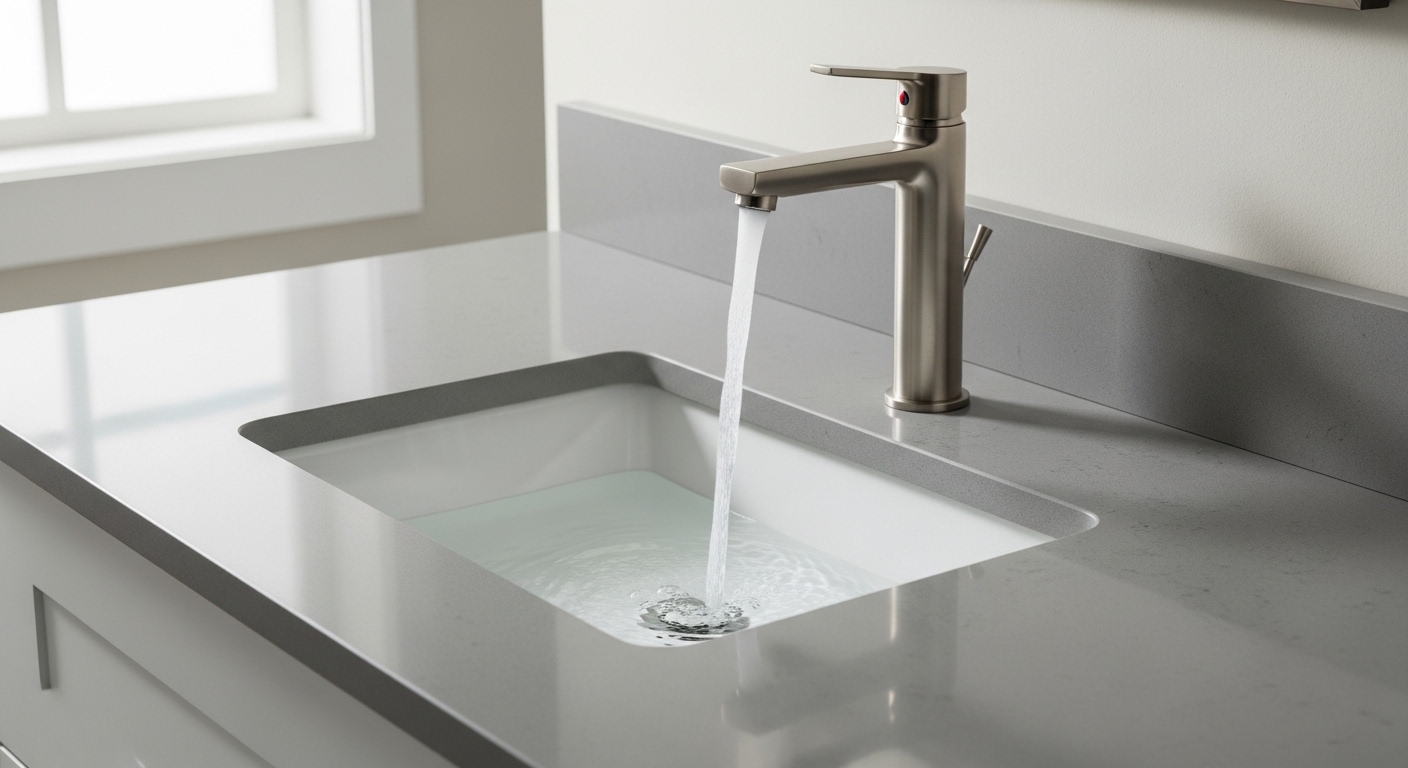
Choosing the best bathroom faucet for undermount sink setups comes down to one thing most product pages never explain: with an undermount sink, the faucet mounts on your countertop, not on the sink itself, so the deck thickness, hole spacing, and spout geometry all have to line up with the stone or solid surface — not with the basin. Get that relationship right and the faucet looks like it was made for the sink. Get it wrong and you end up with water splashing the counter, a spout that reaches past the drain, or a base plate that won’t seal on a thick quartz slab.
This guide walks through exactly how to match a faucet to an undermount sink — the measurements that matter, the mount types, the finishes that survive daily cleaning, and a side-by-side comparison so you can pick with confidence. We’ll keep it concrete: real numbers, real scenarios, real terminology.
Why does an undermount sink change which faucet I should buy?
Because with an undermount sink the faucet bolts to the countertop, the spout has to be tall enough and reach far enough to clear the counter deck and drop water into a bowl that sits below the surface. On a drop-in or vessel sink the faucet relationship is different; here the deck is your reference point, not the rim of the basin.
That has three practical consequences:
- Spout height matters more. The water has to travel from the spout, over the lip of the counter, and down into a recessed bowl. A spout that’s too low creates a short, hard stream that splashes the front edge of the counter.
- Spout reach has to match the bowl center. Undermount bowls are usually mounted so the drain sits 3.5–5 inches back from the front edge of the counter. Your faucet’s reach should land water roughly over that drain — typically 4.5 to 5.5 inches of reach for a standard 16–18 inch wide bowl.
- Deck thickness becomes a real spec. Quartz, granite, and thick solid-surface counters run 1.2–3 cm (about 0.5–1.25 in). Add a sink-reveal buildup and your faucet’s mounting shank and supplied bolts need enough length to clamp through all of it. Cheap faucets ship with short shanks that won’t tighten on a thick slab.
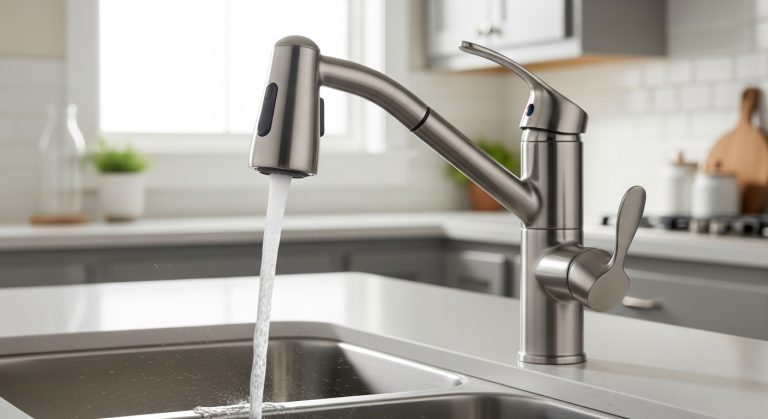
If you’re still deciding between fixture categories at all, our breakdown of kitchen faucet vs bathroom faucet differences explains why you should never repurpose a kitchen faucet over a bathroom undermount basin — the flow rate and spout geometry are wrong for the smaller bowl.
What spout height and reach do I actually need for an undermount bathroom sink?
For a standard bathroom undermount sink, aim for a spout height of 4–6 inches above the counter and a spout reach of 4.5–5.5 inches. That combination drops water into the center of a typical 16–18 inch oval or rectangular bowl without splashing and without forcing you to hunch over the basin.
Here’s the quick way to get your own numbers instead of guessing:
- Measure from the faucet hole to the drain center. That distance, minus an inch or so, is your ideal spout reach. Most undermount vanities land between 4.5 and 5.5 inches.
- Check your bowl depth. Deeper bowls (6.5 in+) tolerate — and benefit from — a taller spout, because the extra drop distance won’t splash. Shallow bowls (under 5.5 in) do better with a mid-height spout and an aerator that softens the stream.
- Mind the backsplash and mirror. Tall “high-arc” bathroom faucets look great but can crowd a low wall-mounted mirror or hit a thick backsplash when the handle lifts. Lift the handle to its fully open position in your mind and leave 1–2 inches of clearance.
One underrated detail: the aerator. A faucet with a quality pressure-compensating aerator (most are 1.2 GPM in modern bathroom faucets to meet WaterSense criteria) gives you a soft, full-feeling stream that resists splashing far better than a cheap laminar spout — which matters a lot in a recessed undermount bowl.
If measurements and parts feel intimidating, a labeled bathroom faucet diagram shows you exactly what spout reach, shank length, and mounting hardware look like before you buy.
Single-hole, centerset, or widespread — which mount is best for an undermount sink?
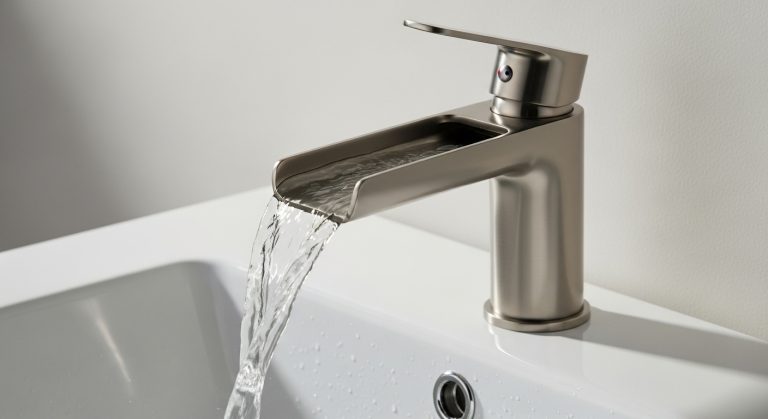
For most undermount bathroom sinks the best choice is a single-hole (single-handle) faucet, because undermount counters are almost always drilled with one faucet hole and a single-hole faucet gives you the cleanest look and the easiest cleaning around the base. Widespread is the upgrade pick if your counter already has three holes drilled at 8-inch spread.
The mount type isn’t really a preference — it’s dictated by how many holes are drilled in your countertop and how far apart they are. Here’s how the three common configurations map to undermount installs:
| Mount type | Holes needed | Hole spacing | Best for |
|---|---|---|---|
| Single-hole | 1 | N/A | Most undermount vanities; modern minimalist look; easiest to clean |
| Centerset | 3 (on a base plate) | 4 in center-to-center | Smaller counters with 4-inch pre-drilled holes; budget builds |
| Widespread | 3 (separate pieces) | 8 in (6–16 in adjustable) | Larger vanities; upscale look; two-handle temperature control |
| Wall-mount | 0 in counter | Roughed into wall | Floating vanities and very shallow undermount bowls |
A note on single-handle versus two-handle: a single-handle faucet lets you set temperature and flow with one motion and leaves fewer seams for grime — which is why it’s our default recommendation for busy family bathrooms. If you want the full case for that style, see our guide to choosing the best single handle faucet for a sink.
Which finish holds up best over an undermount sink?
Brushed nickel and brushed/matte black hold up best over an undermount bathroom sink, because their textured or low-gloss surfaces hide water spots and fingerprints far better than polished chrome — which is exactly what you want on a faucet that gets touched and splashed dozens of times a day.
Finish is part looks, part maintenance. Here’s the honest rundown for daily-use bathroom faucets:
- Brushed nickel — the safest all-rounder. Warm, neutral, hides spots, pairs with almost any sink color. Look for a PVD (physical vapor deposition) coating for scratch and tarnish resistance.
- Matte black — bold and modern, superb at hiding water spots, but shows hard-water mineral film and soap scum if you don’t wipe it. Great over a white undermount bowl.
- Polished chrome — cheapest and most durable surface, but shows every fingerprint and spot. Fine if you wipe daily.
- Brushed gold / champagne bronze — on-trend and forgiving of spots, but demands gentle cleaning to protect the finish. See our brushed gold faucet cleaning guide before you commit.
- Oil-rubbed bronze — traditional, dark, and great with classic bowls; a living finish that ages over time.
Whatever finish you pick, the underlying coating is what determines longevity. PVD finishes are bonded at the molecular level and resist the corrosion and flaking that plague cheap electroplated faucets — worth confirming on the spec sheet before you buy.
What’s the best bathroom faucet for an undermount sink at each budget?
Under $80 you want a solid single-hole faucet with a ceramic-disc cartridge; in the $80–$180 range you can step up to a widespread set with a PVD finish and a longer warranty; above $180 you’re paying for premium valves, designer styling, and lifetime parts coverage. Below is how the tiers actually compare.
| Budget tier | What you get | Cartridge / valve | Typical warranty | Best scenario |
|---|---|---|---|---|
| Under $80 | Single-hole, brushed nickel or chrome, basic aerator | Ceramic disc | Limited lifetime (drip), 1–5 yr finish | Rental, guest bath, quick refresh |
| $80–$180 | Widespread or premium single-hole, PVD finish, WaterSense aerator | Ceramic disc, brass body | Lifetime finish + function | Primary family bathroom |
| $180+ | Designer styling, solid-brass build, premium cartridge, optional touchless | Premium ceramic / sensor valve | Lifetime, often parts-included | Renovation, high-end vanity |
A few buying rules that apply at every price point:
- Insist on a ceramic-disc cartridge. It’s the single biggest predictor of whether a faucet drips in three years. Rubber-washer or cheap cartridge valves wear out fast.
- Favor a solid-brass body over zinc. Brass resists corrosion and gives the faucet a reassuring heft. If the listing dodges the question of body material, assume zinc.
- Confirm the shank length fits your counter. For quartz or granite over 1 inch thick, make sure the included mounting kit handles your deck thickness — this is the most common undermount install headache.
- Check for a WaterSense label if water bills or local code matter to you; it caps flow at 1.2 GPM without feeling weak.
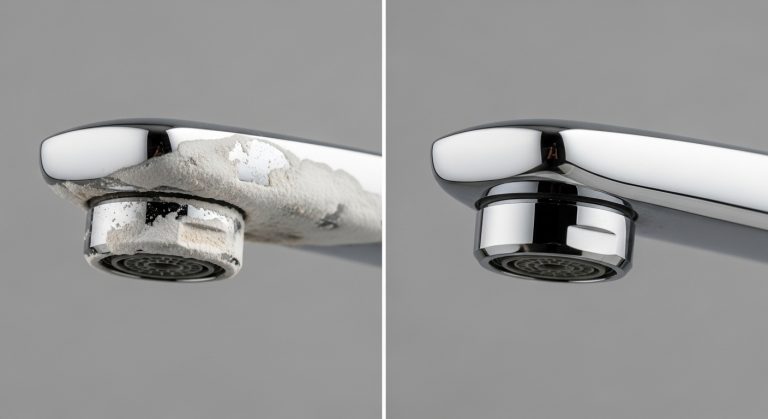
Worried about water quality wrecking a new faucet? If your home pushes discolored water through the lines, fix that first — our explainer on rusty water out of the faucet covers causes and fixes so mineral buildup doesn’t clog your shiny new aerator.
How do I install a deck-mount faucet on an undermount sink myself?
You can install a deck-mount faucet on an undermount sink in about 45–60 minutes with basic tools — the only undermount-specific step is making sure your mounting hardware clamps fully through the thick countertop. Here’s the process.
- Shut off the water at the two supply valves under the vanity and open the old faucet to relieve pressure.
- Disconnect and remove the old faucet. A basin wrench helps reach the mounting nuts in the tight space behind an undermount bowl.
- Clean the counter deck. Wipe away old caulk and mineral residue so the new base or gasket seals flat against the stone.
- Drop the new faucet through the hole(s). Use the supplied gasket or a thin bead of plumber’s putty/silicone under the base, depending on the maker’s instructions.
- Tighten from below. Hand-snug the mounting nut, confirm the faucet is square to the bowl, then wrench it down. On thick quartz, double-check the shank has enough thread engaged.
- Connect the supply lines, hand-tight plus a quarter turn — don’t over-torque the braided hoses.
- Turn the water back on slowly, check for leaks, then run the faucet for a minute and remove the aerator once to flush debris.
If your fixture ever drips after years of service, you usually don’t replace the whole faucet — you swap the cartridge. The same skills transfer; our walkthrough on faucet cartridge replacement shows how straightforward that repair is.
Common mistakes people make pairing a faucet with an undermount sink
The most common mistake is buying for looks alone and ignoring spout reach, which leaves water hitting the bowl wall or the front counter edge instead of the drain. A close second is buying a faucet whose mounting hardware is too short for a thick stone counter.
Watch for these specific traps:
- Too much reach. An oversized spout designed for a kitchen sink will overshoot a compact bathroom bowl and splash the back wall.
- Too little height on a deep bowl. A short spout over a deep undermount basin makes hand-washing cramped.
- Ignoring hole count. Buying a widespread set for a counter drilled with a single hole (or vice versa) means a return or an expensive re-drill of stone.
- Skipping the deck-thickness check on quartz and granite — the number-one reason an undermount faucet install stalls halfway.
FAQ
Does the faucet attach to the undermount sink or the countertop?
The countertop. With an undermount sink the bowl hangs below the counter, so the faucet mounts through hole(s) drilled in the stone or solid-surface deck. That’s why deck thickness and shank length are spec details you can’t ignore.
What spout reach is best for a standard bathroom undermount sink?
For a typical 16–18 inch bathroom undermount bowl, a spout reach of 4.5–5.5 inches lands water over the drain without splashing. Measure from your faucet hole to the drain center and subtract about an inch to find your ideal reach.
Is a single-handle or two-handle faucet better for an undermount sink?
For most undermount sinks a single-handle faucet is better — it needs only one drilled hole, sets temperature and flow in one motion, and has fewer seams to clean. Choose a two-handle widespread set only if your counter is already drilled for three pieces at an 8-inch spread or you want a more traditional look.
Can I use a kitchen faucet over a bathroom undermount sink?
You shouldn’t. Kitchen faucets have higher flow rates, taller arcs, and longer reach designed for large basins — over a small bathroom undermount bowl they splash and look oversized. Stick to a bathroom-rated faucet, ideally WaterSense-labeled at 1.2 GPM.
What finish is easiest to maintain over an undermount bathroom sink?
Brushed nickel and matte black are the easiest to maintain because their textured or low-gloss surfaces hide water spots and fingerprints. For longevity, look for a PVD-coated finish, which resists scratching and tarnishing far better than standard electroplating.
Do I need a plumber to install a faucet on an undermount sink?
Usually not. Most homeowners can swap a deck-mount bathroom faucet in under an hour with a basin wrench and an adjustable wrench. The only undermount-specific consideration is confirming the mounting hardware is long enough to clamp through a thick stone countertop.
About the author: This guide was written by the faucitta product team — specialists in faucets and bathroom fixtures who spend their days fitting, testing, and troubleshooting deck-mount and wall-mount faucets across every common sink configuration.
About faucitta: faucitta (faucitta.net) is a dedicated faucet and bathroom-fixture brand. Our recommendations are based on hands-on testing against industry standards — we look for ceramic-disc cartridges rated for hundreds of thousands of cycles, PVD finishes, lead-free brass bodies compliant with NSF/ANSI 61 and 372, WaterSense-labeled aerators, and manufacturer warranties (we favor faucets backed by limited lifetime coverage on finish and function). Always verify the specific model’s certifications and warranty on its spec sheet before purchase.