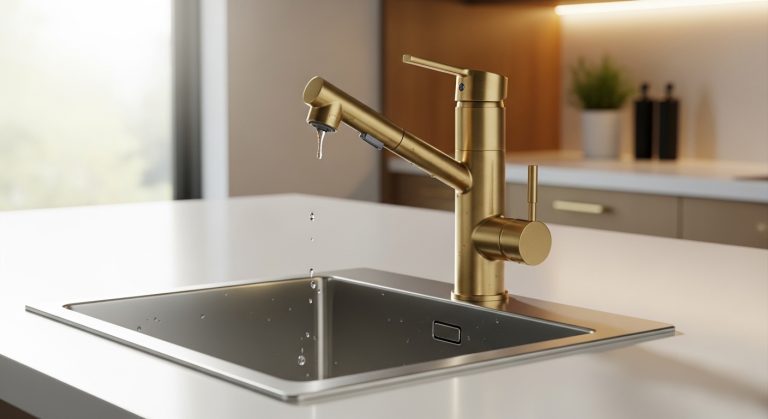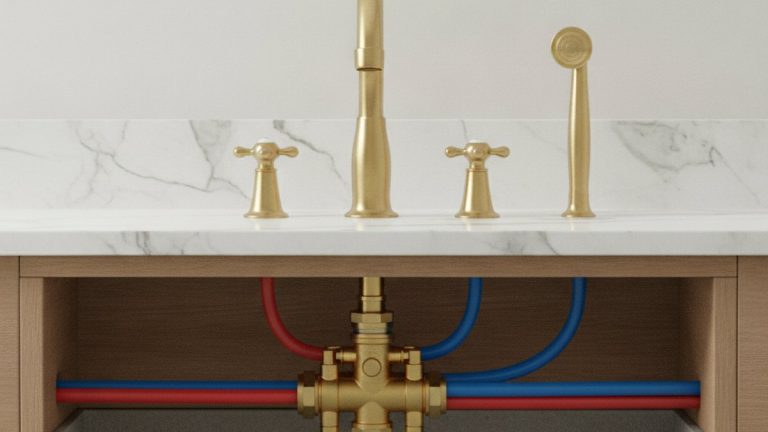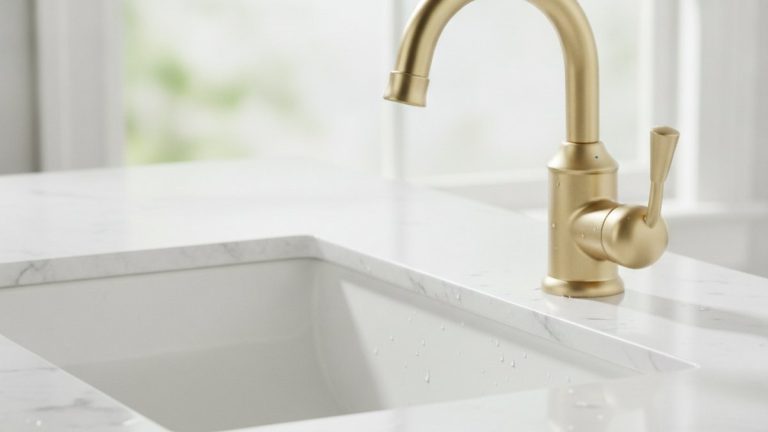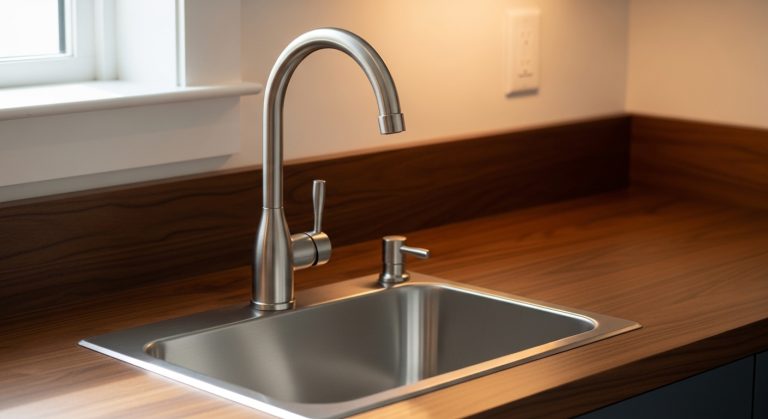
A brizo faucet soap dispenser is the deck-mounted pump that Brizo sells to match its kitchen faucet collections — Litze, Solna, Artesso, Odin, and Rook — so the soap pump, the faucet, and the sink accessories all wear the exact same finish (Luxe Gold, Matte Black, Brilliance Stainless, Chrome, and so on). It drops into a standard 1⅜-inch to 1½-inch accessory hole in your sink or countertop, holds roughly 13–16 oz of dish soap or hand soap, and — this is the part people actually care about — it refills from the top so you never have to crawl under the cabinet with a bottle again.
Below I’ll walk you through whether the genuine Brizo part is worth the money, how to pick the right finish and model, how it compares to a universal top-fill dispenser, and how to install one without calling a plumber. I’ve fitted and swapped a lot of these, so I’ll be honest about where Brizo earns its price and where it doesn’t.
What exactly is a Brizo faucet soap dispenser, and what do you get for the price?
It’s a finish-matched, top-fill soap pump designed to sit in the extra hole beside your faucet. What you get for $60–$120 is threefold: a solid-metal pump head (not plated plastic), a finish that is color-matched to Brizo’s faucet line so it won’t look “close but off,” and a large top-fill bottle that refills from above the counter.
Brizo is Delta Faucet Company’s premium design brand, so these dispensers are built to the same PVD (physical vapor deposition) finish standard as their faucets. PVD matters: it’s the coating process that makes Luxe Gold and Brilliance finishes highly resistant to scratching, tarnishing, and the acids in citrus dish soap. A cheap dispenser with electroplated brass will start flaking at the pump collar within a year of daily use; a PVD-finished pump generally won’t.
Here’s what’s inside the box of a typical Brizo dispenser (models like RP80674 for the round style or the Litze-matched versions):
- The pump head and spout — solid brass with the matching finish.
- A top-fill bottle — usually 13–16 oz, screws up from below onto the pump.
- A mounting nut and washer — to lock it to the deck from underneath.
- A finish-matched escutcheon collar — the visible ring that sits on the countertop.
What you do not get is anything electronic. Brizo’s soap dispensers are all manual push-pumps. If you specifically want a touchless, sensor-activated soap dispenser to match a touchless faucet, that’s a different product category — and worth reading up on the way you would for a touchless kitchen faucet before you buy.
Is a Brizo soap dispenser worth it, or should you buy a cheaper one?
Buy the genuine Brizo dispenser if you already own a Brizo faucet and you want a flawless finish match — that’s the one situation where the premium is clearly worth it. For everyone else, a well-made universal top-fill dispenser in the same finish family does the identical job for a quarter of the price.
The reason the finish match matters so much is that metallic finishes are surprisingly hard to fake across brands. “Champagne bronze,” “Luxe Gold,” and “brushed gold” from three different manufacturers can read as three slightly different colors under your kitchen lighting. When the soap pump sits four inches from a $600 faucet, a near-miss is more noticeable than no match at all. So if you own a Brizo faucet, matching within the Brizo line removes that risk entirely.
But be clear-eyed about the mechanics. The pump itself — the little plastic-and-spring mechanism that pushes soap up the tube — is not meaningfully better on a $90 Brizo than on a $25 alternative. They both eventually gum up if you let soap dry in the spout, and they’re both easy to clear. You’re paying for the finish and the badge, not a superior pump.
| Feature | Genuine Brizo dispenser | Quality universal top-fill | Cheap electroplated dispenser |
|---|---|---|---|
| Typical price | $60–$120 | $15–$40 | $8–$15 |
| Pump body material | Solid brass | Brass or stainless | Plated plastic/zinc |
| Finish durability | PVD, very high | PVD on better models | Electroplate, flakes |
| Exact Brizo finish match | Perfect | Close, family match | Rarely matches |
| Top-fill refill | Yes | Usually yes | Sometimes |
| Bottle capacity | 13–16 oz | 10–17 oz | 8–12 oz |
Which Brizo finish and model should you match to your faucet?
Match the finish name exactly to your faucet’s finish code, and match the pump style to your faucet’s design language — modern-industrial faucets like Litze pair with the angular pump, while curved collections like Solna pair with the rounded pump. The finish is the non-negotiable part; the shape is aesthetic preference.
Brizo uses consistent finish names across its whole catalog, which makes matching easy once you know your faucet’s finish. The most common ones you’ll be matching are:
- Luxe Gold — warm brushed gold, Brizo’s signature look.
- Matte Black — flat, non-reflective black.
- Brilliance Stainless / Luxe Steel — brushed steel tones.
- Polished Chrome — bright mirror silver.
- Luxe Nickel — brushed warm silver.
Find your faucet’s finish suffix on the original product page or the model number (Brizo puts a finish code at the end, like “-GL” for gold or “-BL” for black) and order the dispenser in the identical code. Don’t eyeball it from a website photo — screen color is unreliable, and “brushed gold” versus “Luxe Gold” can be genuinely different.
One practical note: gold and black finishes show water spots and dried soap residue faster than chrome or stainless. If your kitchen gets heavy use and you’re not a daily wiper, a brushed stainless pump hides fingerprints and spots better day to day.
How do you install a deck-mounted soap dispenser without a plumber?
You install it in about 15 minutes with no tools beyond your hands and maybe pliers: drop the pump through the sink’s accessory hole, tighten the mounting nut from underneath, and screw the bottle up onto the shank. There’s no water line and no plumbing involved — a soap dispenser is entirely self-contained.
The one thing that trips people up is the hole. Most kitchen sinks and countertops come with a pre-drilled accessory hole (often hidden under a chrome cover plate) sized 1⅜ to 1½ inches — the same size used for a side sprayer or an air gap. If yours is covered, pop the cover from underneath. If you have a solid countertop with no spare hole, drilling granite or quartz is a job for a pro with a diamond bit, not a DIY afternoon.
Step by step:
- Clear the hole. Remove any cover plate or old dispenser. Wipe the deck clean.
- Insert the pump shank. From above, push the threaded shank down through the hole so the finished collar sits flush on the deck.
- Secure from below. Slide the washer and mounting nut up the shank and hand-tighten, then give it a quarter turn with pliers. Don’t overtighten — you can crack the collar.
- Attach the bottle. Screw the top-fill bottle up onto the shank from underneath the cabinet.
- Prime the pump. Fill from the top, then pump 8–10 times to draw soap up the tube. First pumps will sputter air; that’s normal.
Because there’s no water connection, you never risk a leak or flood the way you might when you’re replacing bathtub faucet plumbing or swapping supply lines. The worst case here is a wobbly pump, which just means the nut needs another quarter turn.
What should you fill it with — and what will clog it?
Fill it with thin liquid hand soap or diluted dish soap; keep out anything thick, gritty, or with beads. The single most common reason a soap dispenser stops pumping is that someone filled it with concentrated dish soap or a heavy moisturizing hand wash that’s too viscous to climb the tube.
If you want dish soap in it, cut it roughly 1:1 with water. Thick, undiluted dish soap will pump for a while, then slow down, then jam. Exfoliating hand soaps with microbeads are the other killer — the beads settle and block the check valve at the base of the pump.
When a pump does clog, you rarely need a new dispenser. Unscrew the pump head, run hot water through it and back-flush the spout, soak the head in warm water for a few minutes to dissolve dried soap, and it almost always comes back to life. This is the same “fix the part, not the whole fixture” logic that saves you money on a pull-down kitchen faucet sprayer head replacement — the expensive component (the finish-matched body) is fine; only the cheap internal bit needs attention.
Does hard water damage a soap dispenser, and how do you protect the finish?
Hard water won’t damage the pump mechanism, but the mineral spots it leaves will dull and etch a gold or black finish over time if you let them dry on. The fix is boringly simple: wipe the pump down with a soft damp cloth when you wipe the faucet, and never use an abrasive or acidic cleaner on it.
If you’re on well water or a hard-water municipality, you already know the white crust that builds up on everything. It’s cosmetic on a soap dispenser — it won’t stop the pump — but it does the same slow dulling to your finish that it does to the whole faucet. Households fighting hard water usually make finish and scale-resistance a top buying criterion across every fixture, and it’s worth reading how that plays out for the whole sink when you shop for a bathroom faucet for hard water.
For cleaning, stick to: a soft cloth, warm water, and a drop of the mild soap that’s already in the dispenser. Avoid vinegar, lime scale removers, bleach, and anything with grit — those strip PVD and electroplate alike over time.
Brizo vs. matching your faucet brand: does the dispenser have to be the same brand?
No — the dispenser does not have to be the same brand as your faucet; it only has to match the finish. Because soap dispensers carry no water and connect to nothing, brand compatibility is irrelevant. A Delta, Kohler, or third-party pump in the same finish family works perfectly beside a Brizo faucet, and vice versa.
That’s genuinely freeing information, because it means your decision comes down to finish accuracy and build quality, not loyalty to a logo. If a Brizo faucet’s Luxe Gold and a well-made universal pump’s brushed gold are indistinguishable in your lighting, buy the cheaper one and spend the savings elsewhere. If you’re the kind of person who’ll notice a half-shade difference every single day, buy the genuine Brizo part and stop thinking about it.
This is one of those spots where knowing what actually differentiates a fixture — versus what’s just branding — saves real money. If you like thinking that way about your whole kitchen, it’s the same lens I’d use to figure out what makes a kitchen faucet unique and worth its price rather than paying for a name.
What are the real downsides of a Brizo soap dispenser?
The two honest downsides are price and the manual-only pump. At $60–$120 you’re paying a premium almost entirely for the finish match, and there’s no touchless or sensor option in the lineup if that’s what you were hoping for.
A few other things worth knowing before you commit:
- Bottle capacity is modest. A busy family kitchen refills a 14-oz bottle every couple of weeks. That’s fine — top-fill makes it painless — but it’s not a “fill once a season” reservoir.
- Gold and black show soap residue. Beautiful, but they reward regular wiping.
- Replacement pumps are proprietary-ish. If the pump head itself ever fails (rare), matching a genuine Brizo replacement head costs more than a whole generic dispenser.
None of these are dealbreakers. They’re just the trade-offs of buying a premium finish-matched accessory instead of a commodity one.
FAQ
Will a Brizo soap dispenser match my existing Brizo faucet?
Yes, as long as you order the same finish code. Brizo uses consistent finish names (Luxe Gold, Matte Black, Brilliance Stainless, and so on) across faucets and accessories, and applies the same PVD process, so a dispenser in your faucet’s finish will match exactly. Check the finish suffix on your faucet’s model number and order the identical one.
Can I use a non-Brizo soap dispenser with a Brizo faucet?
Absolutely. Soap dispensers carry no water and connect to no plumbing, so brand has zero effect on function. The only thing that matters is finding a pump in a finish that matches your faucet closely enough to satisfy you. Many people pair a quality universal dispenser with a Brizo faucet and can’t tell the difference.
How much soap does a Brizo dispenser hold, and how often do I refill it?
Most hold 13–16 oz. In an average kitchen that’s a refill every two to four weeks; in a heavy-use household, closer to every one to two weeks. Because it fills from the top, refilling takes about ten seconds and you never open the cabinet.
Why did my soap dispenser stop pumping, and can I fix it?
Almost always it’s clogged with soap that was too thick or dried in the spout. Unscrew the pump head, back-flush it with hot water, and soak it a few minutes to dissolve the dried soap. It usually revives completely. To prevent it, use thin liquid soap or dilute dish soap 1:1 with water, and skip anything with beads or grit.
Does a soap dispenser need its own hole in the sink or counter?
Yes, it needs a 1⅜–1½-inch accessory hole. Most kitchen sinks have a spare one (often hidden under a cover plate) originally meant for a side sprayer or air gap. If your countertop is solid stone with no extra hole, drilling one is a job for a professional with a diamond bit, not a DIY project.
Is a Brizo soap dispenser worth it if I don’t own a Brizo faucet?
Usually not. The main value of the genuine part is the perfect Brizo finish match. If your faucet is another brand, you’re better served buying a quality top-fill dispenser in the matching finish family for a fraction of the price — you get the same top-fill convenience and comparable durability without paying for the Brizo badge.
Author note: This guide was written by the faucitta fixtures team, who spec, install, and test kitchen and bath hardware for a living. We’ve mounted and serviced deck dispensers across dozens of finishes and sink configurations, so the advice here reflects what actually holds up at the sink — not spec sheets.
About faucitta: faucitta is a specialist retailer of faucets, sinks, and bathroom fixtures. We evaluate hardware against real durability standards — including the PVD finish and lifetime-warranty benchmarks that premium brands like Brizo and Delta build to under industry finish and flow standards (ASME/NSF) — so our buying guidance is grounded in how fixtures perform over years of daily use, not just how they look in a showroom photo.