Here is the complete, publish-ready HTML article:
If you’re staring at a big soaking tub and wondering whether to spend the extra money on a roman tub faucet with shower diverter, here’s the honest answer: it’s worth it when you actually rinse in the tub — long hair, dogs, small kids, or a tub you clean by hand — and it’s overkill if you only ever soak. The diverter is the small lever or knob that reroutes water from the tub spout up to a handheld sprayer, and that one part is the entire reason to buy this style instead of a plain deck-mount filler.
This guide walks you through what the diverter actually does, how many holes you need, the specs that matter (flow rate, valve type, finish), and the mistakes that cause the most returns. By the end you’ll know exactly which configuration fits your tub and your budget.
What exactly is a roman tub faucet with shower diverter, and how is it different from a regular tub filler?
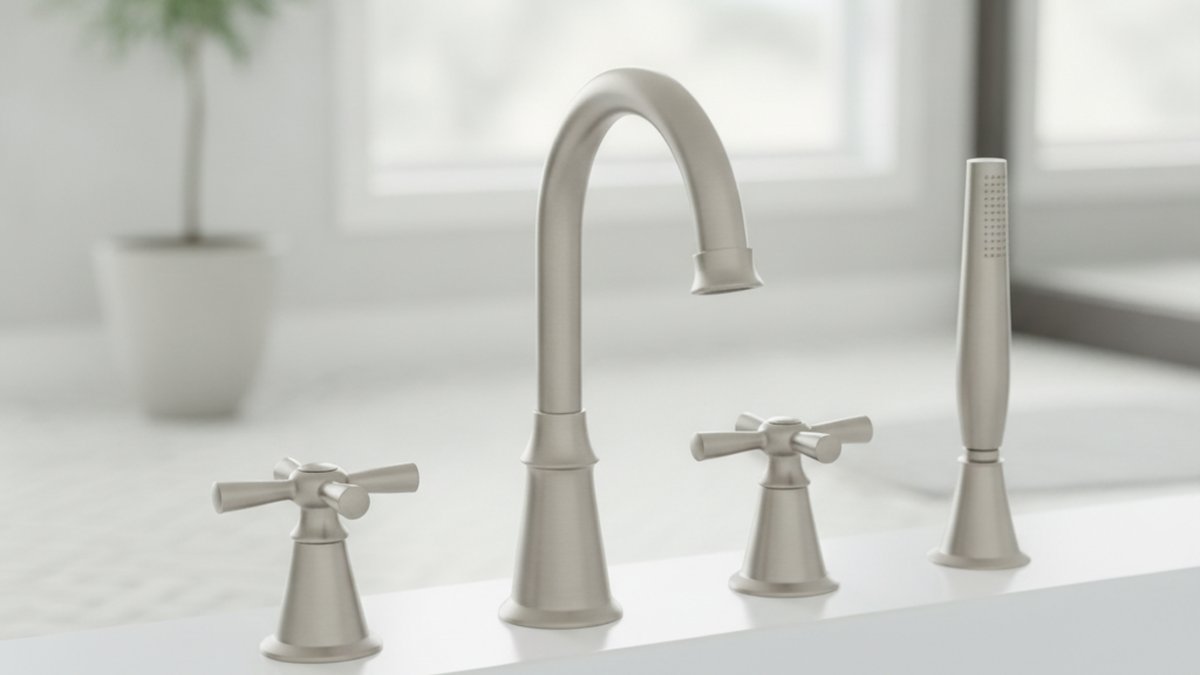
A roman tub faucet with shower diverter is a 4-piece, deck-mounted set — two handles, a spout, and a handheld sprayer — where a diverter valve inside the assembly switches water flow between the spout and the sprayer. A regular roman tub filler is usually 3 pieces (two handles and a spout) with no sprayer and no diverter. The “roman” part just means it mounts on the flat deck around the tub, not on the wall.
So the practical difference is one function: diversion. On a standard filler, water always comes out the spout. On a diverter model, you pull a small knob (often on top of the spout or on a separate fourth base) and the water jumps up to the handheld hose instead. Let go or push the knob back, and it returns to the spout. That’s it — but that single feature changes how the whole thing is plumbed and how many holes your tub deck needs.
People mix this up constantly with a tub-and-shower system that has a wall showerhead. A roman tub diverter does not send water to an overhead rain head or a wall arm. It only feeds the handheld sprayer sitting on the deck. If you want a real overhead shower, that’s a different (wall-mounted) valve entirely. This deck setup is for filling, rinsing, and cleaning — not for standing under a shower.
When is the shower diverter genuinely worth it?
The diverter earns its keep in a few very specific situations, and it’s dead weight in others. Buy it if you match one of these:
- You have long hair. Rinsing conditioner out over the tub edge with a handheld is far easier than cupping water from the spout.
- You bathe kids or pets. A handheld sprayer is the single most useful thing for washing a wiggly toddler or a muddy dog.
- You clean the tub by hand. Rinsing soap scum off a big soaker with a sprayer beats hauling a bucket every time.
- There’s no other shower in the room. The handheld becomes your quick rinse-off after a soak.
Skip it — and save $40–$120 — if the tub is purely for soaking, you already have a separate shower stall a step away, and nobody in the house has rinsing needs. In that case a clean 3-hole roman filler looks better and gives you one less part that can drip.
How many holes do I need in my tub deck for a roman faucet with a sprayer?
Most roman tub faucets with a shower diverter need 4 holes in the deck: one for each handle, one for the spout, and one for the handheld sprayer. Some designs combine the diverter into the spout base and still use 4 holes; a few compact sets use 3. Always match the faucet’s hole count and hole spacing to what your tub deck already has before you buy.
This is the number one cause of returns and headaches. Deck holes are typically drilled 8 inches apart on center for the handles and spout, but roman tub sets vary — some run wider. If your tub is pre-drilled (many acrylic and cast-iron tubs come with hole templates), you’re locked into that count and spacing. Adding a hole to an acrylic deck is doable with a hole saw; drilling one in cast iron or a solid-surface deck is a real project.
Here’s a quick way to figure out what you have and what you need:
- Count the existing holes in your tub deck and note whether they’re already drilled or just marked as knockouts.
- Measure center-to-center between the outer holes to get your spread (commonly 8″ but confirm yours).
- Measure the deck thickness — most faucet stems fit decks up to about 2 to 2.25 inches; a thick stone deck may need extension kits.
- Confirm you can reach the underside of the deck to tighten mounting nuts. Access is the hidden dealbreaker on drop-in tubs.
If you’re not sure whether you also need the underlying valve bodies, it’s worth understanding how the two pieces work together — our explainer on what a roman tub valve and trim kit is, and whether you need both covers exactly why some faucets ship as trim-only and won’t work without a matching rough-in valve underneath.
What is the rough-in valve, and do I need to buy it separately?
Yes, in many cases you buy the rough-in valve separately from the finished trim. The “rough-in” is the brass valve body that sits below the deck and connects to your hot and cold supply lines; the “trim” is the handles, spout, and sprayer you actually see. Big-name lines (Delta, Moen, Kohler) commonly split these so builders can rough-in the plumbing before choosing a finish.
Budget-friendly and imported sets often bundle everything in one box, which is simpler for a DIY swap but gives you fewer upgrade paths later. Before you check out, read the listing carefully: if it says “trim only” or “requires R-series rough valve,” you need the second component or nothing will fill your tub.
How do I install a roman tub faucet with shower diverter myself?
You can install one yourself in about 2 to 3 hours if the deck is already drilled and you have under-deck access. The core steps are: shut off the water, mount the valve bodies and spout from below, connect the handheld sprayer hose to the diverter port, hook up the supply lines, and test for leaks before the first real fill. The diverter model adds just one extra connection — the sprayer hose — versus a plain filler.
Here’s the realistic sequence:
- Shut off supplies at the fixture stops or the main, and open the old faucet to relieve pressure.
- Remove the old trim and valves from below. If your tub is old and the nuts are corroded, expect this to be the slowest part.
- Set the new valve bodies and spout into the deck holes with the supplied gaskets, and hand-tighten the mounting nuts from underneath.
- Install the sprayer holder in the fourth hole and drop the hose down through it, connecting it to the diverter outlet.
- Connect hot and cold supply lines to the correct valve bodies — hot on the left, cold on the right.
- Turn the water back on slowly, run the spout, then pull the diverter and run the sprayer, checking every joint for drips.
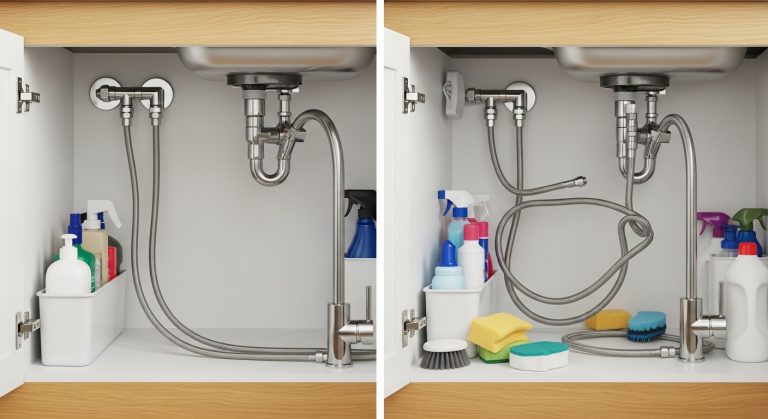
Two things trip people up. First, the sprayer hose needs slack to pull out fully but shouldn’t kink — leave a gentle loop under the deck. Second, corroded old hardware. If you’re replacing an aging setup, our guides on replacing bathtub faucet plumbing without flooding the bathroom and freeing rusted-solid mounting nuts will save you a lot of swearing under the tub.
Roman tub filler with diverter vs. other tub faucet styles — which fits my setup?
Choose based on where your holes are and whether you want a sprayer. If your tub deck is flat and drilled, a deck-mount roman filler (with or without diverter) is the match. If your tub stands alone in open floor, you need a floor-mount freestanding filler instead. If the plumbing comes out the wall, you’re looking at a wall-mount tub-and-shower valve. The table below lays out the trade-offs.
| Faucet type | Mounts on | Handheld sprayer? | Best for | Typical price |
|---|---|---|---|---|
| Roman tub filler with shower diverter | Tub deck (4 holes) | Yes, via diverter | Drop-in/soaking tubs where you rinse hair, kids, pets, or clean the tub | $90–$350 |
| Roman tub filler (no diverter) | Tub deck (3 holes) | No | Pure soaking tubs with a separate shower nearby | $60–$250 |
| Freestanding floor-mount filler | Floor next to tub | Often yes | Standalone tubs with no deck | $200–$800 |
| Wall-mount tub & shower valve | Wall | Via overhead/wall head | Tub-shower combos behind a wall | $150–$600 |
Notice the diverter model costs roughly $30 more than the same set without one. That premium is the sprayer, the extra valve, and the fourth hole. If any of the “best for” scenarios describe your bathroom, it’s money well spent. If you’re weighing a floor-mount option instead, our breakdown of the best freestanding tub faucet floor-mount Delta models is a good next read.
What flow rate should a roman tub filler have?
You want a high flow rate for the spout — ideally 10 to 20 gallons per minute — because a tub filler’s whole job is filling a big basin fast. This is the opposite of a kitchen or bathroom sink faucet, which is federally capped low for conservation. Tub fillers are generally exempt from the 2.2 GPM faucet rules precisely because a trickle would take forever to fill a soaker.
The handheld sprayer side, though, behaves more like a showerhead and is usually capped around 1.8 to 2.5 GPM. That’s fine — you don’t need a firehose to rinse hair. If fast filling matters to you, check the spout’s rated GPM before buying; a beautiful faucet that dribbles is a daily annoyance. For context on how tub filler flow compares to everyday taps, see our piece on the flow rate of standard kitchen faucet models and how much GPM you actually need.
Which finish holds up best, especially in hard water?
Brushed nickel and matte black hide water spots and fingerprints best, while polished chrome shows every drop but wipes clean easily. In a hard-water home, a brushed or living finish is the forgiving choice because mineral spotting practically disappears against the texture. Whatever you pick, match it to the tub drain and any other visible metal in the room so it reads as intentional.
A few finish realities worth knowing:
- Polished chrome — cheapest, most durable coating, but shows spots and needs frequent wiping.
- Brushed/satin nickel — warm, forgiving, hides water marks; the safest all-around pick.
- Matte black — modern and spot-hiding, but can show soap film and dried mineral crust in very hard water.
- Champagne bronze / brushed gold — trendy and warm, usually a PVD finish that resists tarnish.
If your water is genuinely hard, the finish is only half the battle — mineral buildup also clogs the sprayer’s spray face and can gum up the diverter over time. Our guide to the best bathroom faucet for hard water explains which valve materials and spray faces resist scaling. And if you want a deeper look at whether brushed nickel is the right modern choice, we compare it head-to-head in is a brushed nickel faucet a smart pick for a modern bathroom.
What should I actually look for on the spec sheet before buying?
Before you buy, verify five things: hole count and spacing, the valve/cartridge type, the spout GPM, whether the rough-in valve is included, and the deck-thickness range the stems will fit. Getting any one of these wrong is what turns a weekend upgrade into a return trip. Everything else — finish, spout curve, handle style — is preference.
On the valve type specifically, look for ceramic-disc cartridges. They outlast old rubber-washer or compression designs and are what keeps the faucet from developing a slow drip a year in. If yours ever does start dripping, it’s usually a cartridge or stem you can swap rather than a whole-faucet replacement — the same logic we cover in replacing a faucet stem when your tap keeps dripping.
Finally, check the warranty and the standards mark. Reputable tub fillers carry a lifetime finish-and-function warranty and meet cUPC/NSF certification, which means the valve was tested for pressure, durability cycles, and lead-free wetted surfaces. A no-name set with no listed certification and a 90-day warranty is a gamble on a fixture you expect to keep for a decade or more.
FAQ
Can I add a shower diverter to my existing roman tub filler?
Usually not without swapping the whole set. The diverter is built into the valve/spout assembly and needs its own port and, typically, a fourth deck hole for the sprayer. If your current filler wasn’t designed for a sprayer, you’d be drilling a new hole and replacing the internals — at which point you’re just buying a new diverter faucet anyway.
Does a roman tub diverter give me a real overhead shower?
No. A roman tub diverter only sends water to the deck-mounted handheld sprayer, not to an overhead or wall-mounted showerhead. If you want to stand and shower, you need a wall-mounted tub-and-shower valve, which is plumbed inside the wall rather than through the tub deck.
How many holes does a roman tub faucet with shower diverter need?
Most need four: two for the handles, one for the spout, and one for the handheld sprayer. A handful of compact designs combine functions into three holes. Always confirm the specific faucet’s hole count and center-to-center spacing against your actual tub deck before ordering.
Why does my tub take so long to fill with a new faucet?
Almost always low spout flow rate or restricted supply lines. Tub fillers should flow 10–20 GPM at the spout; if you accidentally bought a low-flow model or your shutoff valves aren’t fully open, filling drags. Check the spec sheet for the rated GPM and make sure the supply stops under the deck are open all the way.
Is a roman tub faucet with shower diverter hard to install for a DIYer?
It’s moderate — harder than a sink faucet, easier than moving plumbing. If your deck is pre-drilled and you can reach the underside, plan on 2–3 hours. The tricky parts are under-deck access, corroded old hardware, and routing the sprayer hose so it pulls freely without kinking. No drilling or plumbing relocation means most confident DIYers can handle it.
Will hard water damage the diverter or sprayer?
It can, over time. Mineral scale builds up on the sprayer’s spray face and inside the diverter mechanism, which can make the diverter stiff or cause the sprayer to spit unevenly. Choose a model with a ceramic-disc valve and a rubber-nub (self-cleaning) spray face, wipe the sprayer down regularly, and periodically soak it in a vinegar solution to keep flow and diversion smooth.
About the author: This guide was written by the faucitta fixtures team, who have specified, installed, and pressure-tested deck-mounted tub fillers across hundreds of bathroom builds and remodels. We test faucets on real tub decks — checking fill speed, diverter feel, and finish durability — rather than repeating manufacturer copy.
About faucitta: faucitta is a B2C faucet and bathroom-fixtures brand focused on plain-English buying guides and durable, standards-compliant fixtures. Every tub filler we recommend meets cUPC/NSF certification and carries a manufacturer warranty on finish and function, so you’re buying a fixture that was actually tested — not just photographed.