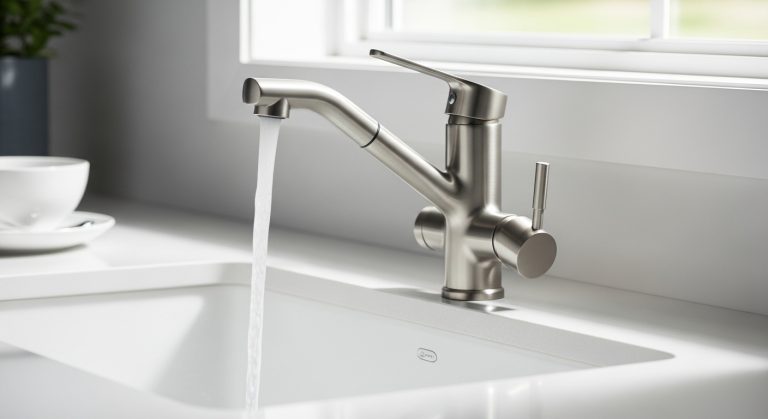
If you’ve been searching for a pull down kitchen faucet india shoppers can trust, here’s the honest version: the mechanism is simple, but the quality gap between a ₹1,800 marketplace special and a ₹9,000 brass unit is enormous — and it shows up within months, not years. A pull-down faucet has a spray head that pulls straight down into the sink on a flexible hose, which makes rinsing big pots, washing pressure-cooker vessels, and cleaning an Indian double-bowl sink far easier than a fixed spout. This guide walks you through what actually matters for Indian kitchens — hard water, low pressure, the ₹6,000–₹18,000 sweet spot — so you buy once instead of twice.
What exactly is a pull down kitchen faucet, and how is it different from a pull-out?
A pull down kitchen faucet has a tall, gooseneck-style spout, and the spray head detaches and pulls vertically down into the sink on a hidden hose. A pull-out faucet sits lower and the head pulls horizontally toward you. For most Indian kitchens with a deep single or double bowl, pull-down is the better match because the high arc clears tall stockpots, cooker bodies, and idli stands.
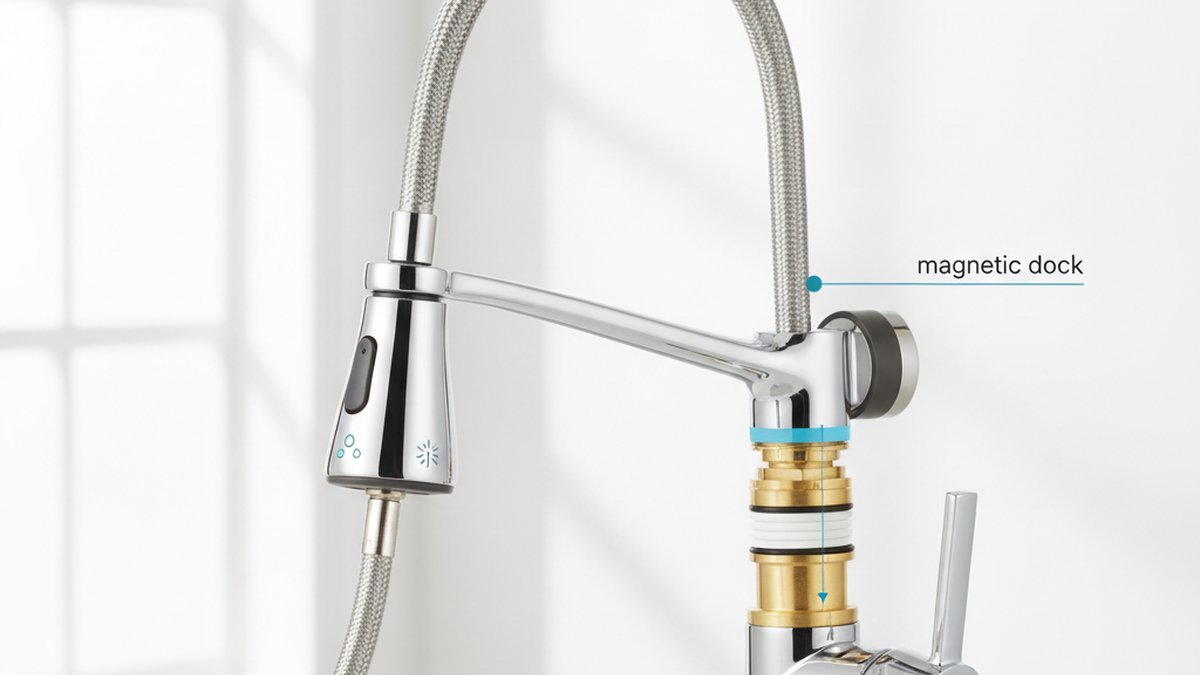
The core parts are the same across brands: a spout body, a spray head with a diverter, a weighted or magnetic dock that snaps the head back into place, and a braided hose that retracts. The two features that decide whether you’ll love or hate the faucet are the docking system (magnetic docks hold far better than old-style gravity weights over years of use) and the spray toggle (a button that switches between a soft aerated stream for filling and a hard spray for scrubbing).
How much should a good pull down kitchen faucet cost in India?
Budget ₹6,000–₹18,000 for a pull-down faucet that will genuinely last in an Indian kitchen. Below roughly ₹4,000 you’re almost always getting a zinc-alloy or plastic body with a rubber hose and a cheap cartridge — it looks fine on day one and starts dripping or losing spray tension within a year. The ₹6,000–₹18,000 range is where you find full brass bodies, ceramic-disc cartridges, and stainless braided hoses.
| Price band (₹) | What you typically get | Realistic lifespan | Best for |
|---|---|---|---|
| 1,500–3,999 | Zinc/plastic body, rubber hose, basic cartridge, often no spray toggle | 6 months–2 years | Rental or short-term use only |
| 4,000–5,999 | Part-brass or coated body, nylon hose, single-spray head | 2–4 years | Tight budgets, low-use kitchens |
| 6,000–11,999 | Full brass body, ceramic disc cartridge, braided hose, magnetic dock, dual spray | 7–12 years | Most Indian family kitchens |
| 12,000–25,000+ | Premium brass, PVD finish, high-flow, sometimes touchless/pull-down combo | 10–15+ years | Heavy cooks, premium remodels |
The takeaway: you don’t need to spend ₹20,000, but paying below ₹6,000 usually means paying twice. If a listing hides the body material or just says “SUS304-look” without confirming solid brass or genuine 304 stainless, treat that as a red flag.
Will a pull down faucet survive Indian hard water and low pressure?
Yes — if you pick the right internals. Hard water (high calcium and magnesium, common across much of India) is the number one killer of kitchen faucets, and it attacks three points: the aerator, the spray head nozzles, and the cartridge. The fix is choosing a faucet designed to shrug off scale.
- Silicone/rubber spray nozzles: These “anti-lime” nozzles let you wipe scale off with a thumb. Faucets with metal-only nozzles clog and spray sideways within months in hard-water areas.
- Ceramic-disc cartridge: More resistant to grit and scale than rubber-washer valves, and it gives you that smooth quarter-turn feel that doesn’t get stiff.
- Removable aerator: You’ll unscrew and soak it in diluted vinegar or citric acid every few months — make sure it’s a standard, replaceable size.
- Pressure-tolerant design: Many Indian homes run on overhead tanks with gravity-fed pressure as low as 0.5–1.0 bar. Check that the faucet is rated to work at low pressure; some imported models assume 2–3 bar mains pressure and dribble on a tank supply.
If your kitchen runs on tank pressure and the flow feels weak, that’s usually the aerator or supply lines — not a faulty faucet. The same low-pressure logic that trips up touchless models applies here; our breakdown of why a faucet shows low water pressure and how to fix it walks through diagnosing whether the culprit is scale, the cartridge, or your supply lines.
Single-hole or three-hole? What sink setup do you actually need?
Most pull-down faucets are single-hole, so you need a sink or countertop with one mounting hole of about 35mm. That’s the direct, practical answer — before you buy, count your existing holes. If your granite counter or sink already has three holes (a common older Indian layout with separate spout and handles), you have two options: use a deck plate (escutcheon) to cover the extra holes, or get the counter re-drilled/plugged.
A few real-world checks before you commit:
- Hole diameter: Standard is ~35mm. Granite counters sometimes have narrower or wider bores — measure before ordering.
- Counter thickness: Thick granite (25–40mm) needs a faucet with long enough threaded studs and a proper mounting nut; some slim imported faucets don’t clamp thick stone well.
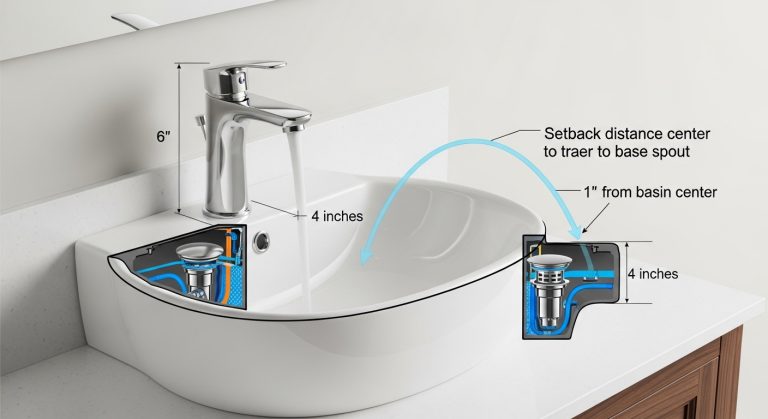
- Spout reach and height: Measure from the faucet hole to the center of the bowl. The spout should drop water into the bowl, not behind it, and the arc should clear a tall pressure cooker.
- Wall clearance: A high gooseneck needs room to swing; check it won’t hit a window sill or backsplash shelf.
If you’re replacing an old tap and dreading corroded mounting nuts under the sink, that job is a guide of its own — see how to remove a very old kitchen faucet when the nuts are rusted solid before you start, because a stuck basin nut is where most DIY installs stall.
Brass, stainless, or coated zinc — which body material lasts?
Buy solid brass or genuine 304 stainless steel, and skip zinc alloy for anything you plan to keep. Brass is the traditional gold standard: it resists corrosion, handles Indian water chemistry well, and threads hold up to repeated servicing. Genuine 304 stainless is lighter, lead-free by nature, and also excellent. Zinc alloy (sometimes marketed vaguely as “metal body”) is cheaper and heavier-feeling but corrodes from the inside and cracks at threaded joints over time.
Finish matters for looks and cleaning, not just style:
| Finish | Look | Fingerprints / water spots | Best for |
|---|---|---|---|
| Chrome | Bright, mirror-like | Shows spots and marks readily | Budget-friendly, easy to find |
| Brushed / Stainless | Matte silver, warm | Hides spots and lime well | Hard-water kitchens, everyday use |
| Matte Black | Bold, modern | Hides fingerprints, shows dried water scale (white) | Contemporary modular kitchens |
| Gunmetal / PVD Gold | Premium, designer | PVD is very durable, low maintenance | Premium remodels, statement sinks |
For hard-water Indian kitchens, brushed/stainless is the most forgiving day to day — it hides both fingerprints and the white lime spotting that plagues chrome. Matte black looks stunning but shows dried mineral spots, so keep a microfiber cloth handy. Whatever you choose, insist the finish is PVD or electroplated over brass/stainless, not painted over zinc.
What features are worth paying for, and which are just marketing?
Worth it: a magnetic dock, a dual-function spray head, a braided hose, and a ceramic cartridge. Skip-if-budget-tight: touchless sensors, LED temperature lights, and “spot-resist” gimmicks that don’t beat a good brushed finish. Here’s the plain-English breakdown.
- Magnetic dock (worth it): Keeps the spray head snapped tight for years. Old gravity-weight docks sag over time, leaving the head drooping.
- Dual spray toggle (worth it): Aerated stream for filling pots and washing rice; concentrated spray for blasting stuck dal off vessels. This is the single most-used feature in a real kitchen.
- 360° swivel (worth it): Essential for double-bowl sinks so you can reach both basins.
- Braided stainless hose (worth it): Outlasts rubber and resists kinking as it retracts.
- Touchless / motion sensor (nice, not essential): Genuinely hygienic when your hands are covered in atta or raw chicken, but it adds ₹4,000–₹10,000, needs batteries or power, and is one more thing to fail.
- Pull-down + pot filler combo, LED lights (mostly marketing): Fun, rarely necessary. Don’t let them drive the purchase.
One underrated point: the spray head itself is a wear part. Nozzles clog, buttons stick, and the diverter eventually tires. The good news is you often don’t need a whole new faucet — many brands sell just the head. If yours ever fails, our guide to a pull down kitchen faucet sprayer head replacement shows how to swap it in minutes and save the cost of a full unit, which is exactly why buying a brand with available spare parts matters in India.
Which brands and where do you buy safely in India?
Stick to brands that publish their body material, offer a real warranty (5–10 years on the cartridge is a good sign), and — crucially in India — sell spare cartridges, aerators, and spray heads locally. A faucet you can’t service is a faucet you’ll throw away. Well-known names in the Indian market span established plumbing brands and newer specialist faucet makers; the more important filter than the logo is the spec sheet and after-sales support.
When you’re comparing lesser-known or online-first brands, read past the star rating to what buyers say about longevity and spares. We’ve done that legwork for a couple of popular budget-to-mid options — our Huaake kitchen faucet review and our Mirozza kitchen faucet review both dig into build quality, hose durability, and whether the value holds up. Use those as a template for vetting any brand you find on a marketplace.
Buying tips specific to India:
- Prefer official brand stores or authorized sellers so warranty claims are honored — grey-market imports often can’t be serviced here.
- Confirm the box includes supply hoses, mounting hardware, and a deck plate if you need one; missing parts are a common marketplace complaint.
- Check the warranty terms: lifetime on the finish is nice, but the number that matters is cartridge and hose coverage.
- Ask about spare-part availability before buying — a cartridge and spray head should be orderable in India, not only from overseas.
If you’re still weighing whether to go pull-down at all versus other styles, it helps to see how the category fits into the broader market; our overview of the best faucet brands for 2026 gives context on who does what well across bathroom and kitchen lines.
How do you install and maintain a pull-down faucet so it lasts?
Installation is a genuine DIY job for most single-hole setups — budget 45–90 minutes and a few basin tools. Maintenance is even simpler: descale the aerator and nozzles every couple of months, and the faucet will run like new for a decade.
- Shut off the water at the angle valves under the sink and open the faucet to release pressure.
- Remove the old faucet — disconnect supply lines and loosen the basin nut (if it’s rusted, don’t force it; penetrating oil first).
- Drop the new faucet in through the 35mm hole, feed the pull-down hose and supply lines down, and tighten the mounting nut from below.
- Connect supply hoses to the angle valves, hand-tight plus a quarter turn with a wrench — don’t overtighten and crack the fitting.
- Attach the hose weight/dock per the manual, then run water and check every joint for leaks before you walk away.
For maintenance: soak the removable aerator and spray head in a 1:1 white vinegar and water solution (or a citric-acid solution) monthly in hard-water areas, wipe the silicone nozzles with your thumb, and keep the finish clean with a soft damp cloth — never abrasive scrubbers, which scratch the coating. If the flow ever drops suddenly, the aerator is the first suspect, then the spray head, then the cartridge.
FAQ
Is a pull down kitchen faucet good for Indian kitchens with hard water?
Yes, as long as you choose one with silicone anti-lime spray nozzles, a ceramic-disc cartridge, and a removable aerator. Those three features let you wipe and soak away scale in minutes. Avoid faucets with sealed, metal-only nozzles — they clog and spray unevenly within months in high-hardness water.
What is the difference between a pull-down and a pull-out faucet?
A pull-down faucet has a tall gooseneck spout and the spray head pulls straight down into the sink; a pull-out faucet is lower and the head pulls horizontally toward you. Pull-down suits deep Indian sinks and tall pots better, while pull-out works well in kitchens with a low window or shelf directly above the faucet.
How much does a decent pull-down kitchen faucet cost in India?
Plan for ₹6,000–₹18,000 for a solid-brass or 304-stainless faucet with a ceramic cartridge and braided hose that lasts 7–12 years. Below ₹4,000 you usually get zinc or plastic bodies that fail within a year or two, so the cheaper option often ends up costing more.
Can I install a pull-down faucet myself, or do I need a plumber?
Most single-hole pull-down faucets are a DIY job of 45–90 minutes with basic tools — shut off the angle valves, remove the old tap, drop in the new one, tighten the basin nut, and connect the supply hoses. Call a plumber only if your counter needs re-drilling, the old mounting nuts are seized solid, or you’re moving from a three-hole to a single-hole layout.
How long does a pull-down kitchen faucet last, and what usually breaks first?
A quality brass pull-down faucet lasts 7–15 years. The first parts to wear are the spray head nozzles and the cartridge — both are replaceable, so you rarely need a whole new faucet. That’s why buying a brand with locally available spare parts and a 5–10 year cartridge warranty matters more than the sticker design.
Author note: This guide was written by the faucitta fixtures team, who spec, install, and pressure-test kitchen and bathroom faucets for Indian water conditions — including gravity-fed tank pressure and high-hardness supply. Our recommendations follow standard plumbing practice for ceramic-disc cartridges, lead-safe brass, and manufacturer warranty terms; we cross-check flow behavior at low pressure (0.5–1.0 bar) rather than assuming high mains pressure. faucitta.net covers faucets, showers, and bathroom fixtures with practical, tested, no-hype advice, and we recommend choosing faucets that carry a genuine cartridge warranty and locally stocked spare parts so your purchase is serviceable for its full lifespan.