An outdoor faucet hose connector is the small threaded fitting that links your garden hose (or a splitter, timer, or quick-connect) to the outdoor spigot on the side of your house. It sounds trivial until it starts spraying water sideways every time you turn on the tap. Ninety percent of “my outdoor faucet leaks at the hose” problems aren’t the faucet at all — they’re the connector, the washer inside it, or a thread mismatch. Get the connector right and the leak disappears. Below, I’ll walk you through exactly which type to buy, how to match the threads, and how to avoid the three mistakes that send people back to the hardware store twice in one weekend.
What exactly is an outdoor faucet hose connector, and what does it do?
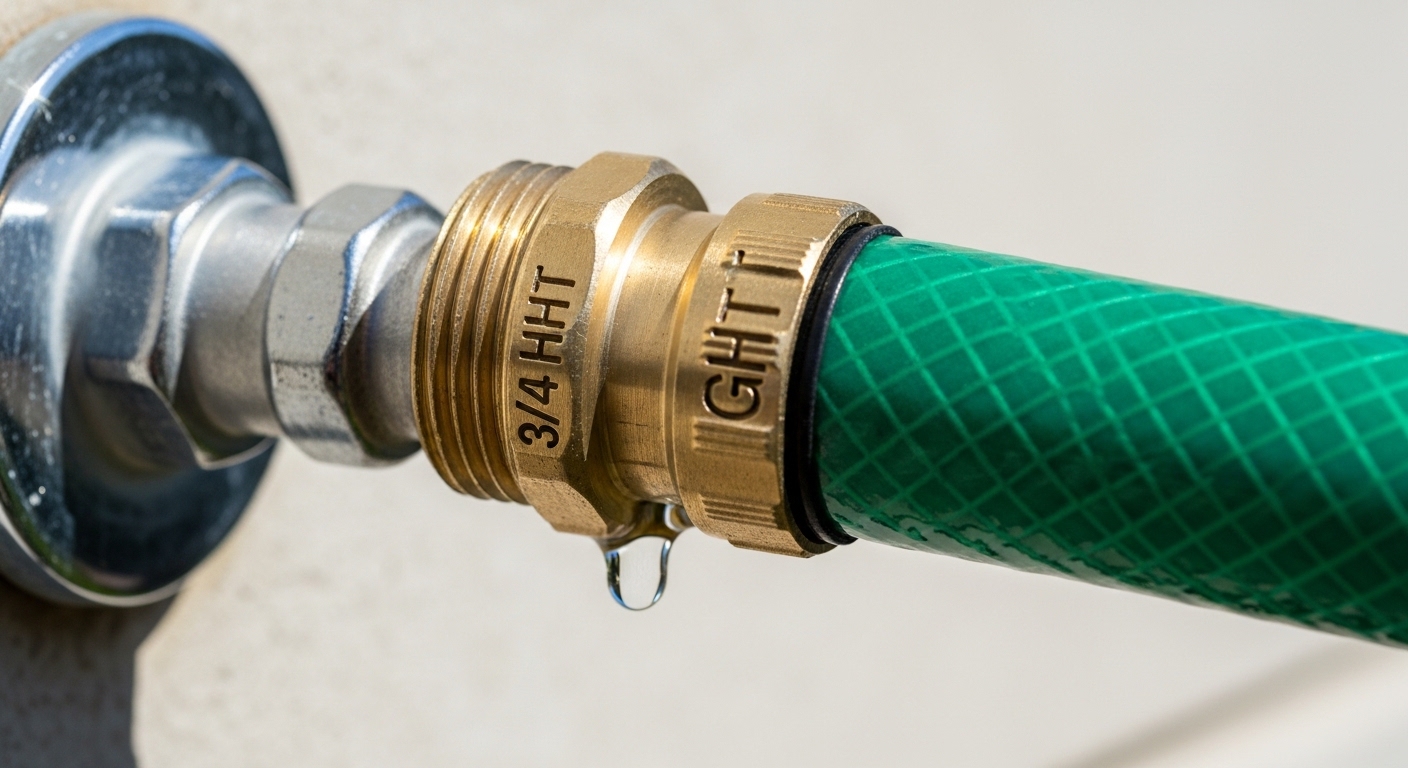
It’s the fitting that creates a watertight seal between your spigot and whatever you’re attaching — a hose, a splitter, a hose timer, or a pressure washer line. The connector threads onto the spigot’s male hose thread and clamps down on a rubber washer that does the actual sealing. The metal just holds everything in compression.
Here’s the part most people miss: the threads on a standard U.S. outdoor faucet are 3/4″ GHT (Garden Hose Thread), which is a specific 11.5 threads-per-inch standard — not the same as 3/4″ NPT (National Pipe Thread) used in plumbing. They look almost identical and will start to thread together, then bind, cross-thread, and leak forever. If you’ve ever forced a connector on and it still dripped, a GHT-vs-NPT mismatch is the usual culprit. When in doubt, buy something labeled “garden hose thread” or “GHT,” and you’re matching the vast majority of American residential spigots.
Which type of outdoor faucet hose connector should I buy?
For a typical homeowner attaching a garden hose, buy a solid brass 3/4″ GHT quick-connect set or a simple brass threaded coupler. Brass survives freezing temperatures, resists corrosion, and won’t crack like plastic. Here are the main types and who each one is for:
- Threaded coupler / mender: The simplest fix. Screws directly onto the spigot and the hose screws onto it. Cheapest and most reliable if you rarely disconnect the hose.
- Quick-connect (push-fit) set: A base piece stays on the spigot; the hose gets a mating tip. Snap on and off in one second. Best if you swap hoses, sprayers, or a pressure washer often.
- Y-splitter / 2-way or 4-way manifold: Turns one spigot into two-plus outlets with individual shut-off valves. Great for running a soaker hose and a sprinkler at once.
- Swivel connector: Rotates so the hose doesn’t kink or torque the spigot when you move around the yard.
- Vacuum breaker / anti-siphon adapter: Adds backflow protection between spigot and hose. Some local codes require it — it stops contaminated water from being siphoned back into your drinking supply.
Brass vs. stainless steel vs. plastic: what’s the real difference?
Brass is the default best choice for outdoor hose connectors because it handles freeze-thaw cycles, resists corrosion, and grips threads tightly without cracking. Plastic (usually nylon or ABS) is cheaper and lighter but becomes brittle in cold weather and strips easily. Stainless steel is the most corrosion-proof and strongest for the connector body, but it’s overkill and pricier for most yards. Here’s how they actually stack up:
| Material | Typical price | Freeze resistance | Corrosion resistance | Best for |
|---|---|---|---|---|
| Solid brass | $6–$18 | Excellent | Very good (may patina) | Almost everyone — the reliable default |
| Stainless steel | $12–$30 | Excellent | Excellent | Coastal / hard-water / heavy commercial use |
| Zinc alloy (die-cast) | $4–$10 | Good | Fair — corrodes over time | Light seasonal use, budget buyers |
| Plastic / nylon | $2–$7 | Poor (cracks) | Good chemically, weak physically | Temporary or indoor use only |
One caution on brass: cheap “brass-colored” connectors are often zinc alloy with a thin plating. Real brass feels heavier and is usually stamped or described as “solid brass” or “lead-free brass.” If you’re on a well or you drink from the outdoor tap (filling water bottles, kids’ pools, pet bowls), specifically choose a lead-free brass connector that meets the NSF/ANSI 372 low-lead standard.
How do I stop my outdoor faucet from leaking where the hose connects?
Nine times out of ten, replace the little rubber washer inside the connector — it’s a 50-cent fix, not a new-faucet job. The washer compresses each time you tighten a hose, and after a couple of seasons it hardens, splits, or falls out. If the seal is gone, water sprays from the joint no matter how hard you crank it.
Walk through it in this order before you buy anything new:
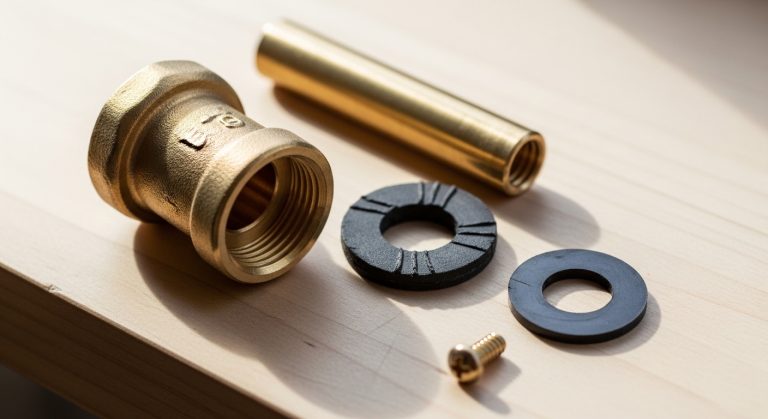
- Check the washer. Unscrew the hose and look inside the coupling. If the rubber ring is missing, flattened, cracked, or dry, pop in a fresh one. A pack of assorted garden-hose washers costs a couple of dollars. This is the same logic behind fixing a dripping spigot — if you’re chasing drips at the tap itself, our guide to the outdoor faucet washer covers which size stops the drip.
- Don’t over-tighten. Hand-tight plus a quarter turn is plenty. Cranking with pliers deforms the washer and makes leaks worse, not better.
- Add thread-seal tape only on pipe-thread connections. PTFE (plumber’s) tape belongs on tapered NPT threads, not on the garden-hose-thread face that seals with a washer. Wrapping GHT threads usually does nothing.
- Inspect the threads. If the spigot threads are chewed up, corroded, or cross-threaded, a swivel connector or a new hose-bib repair may be needed.
- Rule out a mineral-clogged or seized valve. Hard-water scale builds up on threads and inside valves. If the whole faucet is stiff or crusted, that’s a different problem — our piece on a stuck faucet valve explains how mineral buildup seizes fittings and how to free them.
Does hard water ruin outdoor hose connectors faster?
Yes — hard water is the top reason connectors seize, corrode, and leak early. Dissolved calcium and magnesium leave scale on the threads and inside the connector, which grinds down washers, glues fittings so they won’t unscrew, and eats away at cheaper zinc alloys. If you’re in a hard-water region (much of the American Southwest, Midwest, and Texas), that white crust on your spigot is the warning sign.
A few habits extend the life of any connector in hard water: choose solid brass or stainless over zinc, disconnect the hose over winter so scale doesn’t lock the threads, and give the threads a soak in white vinegar once a season to dissolve buildup. The same mineral chemistry that clogs indoor fixtures is at work here — if hard water is a whole-home issue for you, it’s worth reading how the right fixture materials fight scale in our guide to the best bathroom faucet for hard water. The material lessons carry straight over to your outdoor spigot.
How do I know what size and thread my spigot needs?
Measure the outside diameter of the spigot’s male threads: about 1 1/16″ across means it’s the standard 3/4″ GHT that fits virtually all U.S. garden hoses and connectors. If the threads measure smaller — around 5/8″ or 1/2″ — you likely have a European or specialty spigot and need an adapter. Here’s the quick decision guide:
- ~1 1/16″ outer diameter, 11.5 TPI: Standard 3/4″ GHT. Buy any garden-hose-labeled connector — you’re set.
- Threads start but bind and leak: Likely NPT pipe thread, not GHT. You need a GHT-to-NPT adapter, not more force.
- Metric or oddball threads (common on some laundry taps, imported fixtures): Use a dedicated thread adapter. The same idea as adding a threaded extender to any tap — see how adapters solve fit problems in our tap extender guide.
- Worn or stripped spigot threads: A swivel or repair-style connector can bite fresh, but a badly damaged hose bib may need replacing.
When you’re unsure, bring your old connector — or a photo and a caliper measurement — to the store, or just default to solid brass 3/4″ GHT, which fits the overwhelming majority of homes.
Quick-connect vs. threaded: which is better for everyday use?
Quick-connects win if you attach and detach often; threaded couplers win if you set it and forget it. A quick-connect lets you snap a hose, nozzle, sprinkler, or pressure washer on and off in a second without twisting — a real convenience if you’re constantly swapping tools. The trade-off is more moving parts and O-rings that can eventually leak or lose grip.
A plain threaded coupler has almost nothing to fail: metal, one washer, done. If your hose lives on the same spigot all summer, threaded is more foolproof and cheaper. Many people run both — a quick-connect base on the spigot for flexibility, plus quick-connect tips on their most-used hoses and nozzles.
How do I install an outdoor faucet hose connector correctly?
Thread it on by hand, snug it a quarter turn past hand-tight, and test under full pressure — no tools, no thread tape on the washer face. Rushing or over-torquing is what causes callbacks. Here’s the clean way to do it:
- Turn off the spigot fully and remove the old connector or hose.
- Wipe the spigot threads clean; scrape off any mineral crust or old tape.
- Check that a fresh rubber washer is seated flat inside the connector.
- Thread the connector on straight — if it resists in the first turn, back off and realign; never force it (that’s how threads cross).
- Hand-tighten, then add roughly a quarter turn with light grip.
- Turn the water on full and watch the joint for 30 seconds. A dry joint means you’re done; a drip means re-seat the washer, not more muscle.
How much should I spend, and when is cheap a false economy?
Spend $8–$18 on solid brass for anything you’ll use regularly; a $2 plastic connector is fine only for a one-off temporary job. The math is simple: a plastic connector that cracks in the first frost and floods your hose bib costs you far more in wasted water and a replacement than the few dollars you saved. For a splitter or timer that stays outside all season, brass or stainless is worth every penny.
Where cheap is fine: rubber washers (buy a whole assorted pack for a couple of dollars) and a spare threaded mender to keep in the garage. Where cheap bites back: the main connector body, quick-connect sets, and anything with a shut-off valve you’ll open and close hundreds of times.
Author note & why you can trust this
This guide was written by the faucitta fixtures team — plumbing-product specialists who spec, pressure-test, and field-service faucets and connectors across residential and light-commercial installs. We bench-test brass and stainless connectors for thread tolerance and seal integrity, and we base our recommendations on the same GHT and NSF/ANSI 372 low-lead standards that govern U.S. residential water fittings. faucitta sells outdoor and indoor fixtures at faucitta.net, and our brass hose connectors are backed by a manufacturer warranty against defects. We recommend by fit and durability first — not by price tag — because a connector that leaks is worse than no connector at all.
FAQ
What size hose connector fits a standard outdoor faucet?
A standard U.S. outdoor faucet uses 3/4″ GHT (garden hose thread), which measures about 1 1/16″ across the outside of the male threads. Any connector labeled “garden hose thread” or “3/4 GHT” will fit. If threads bind or leak, you likely have NPT pipe thread instead and need a GHT-to-NPT adapter.
Why does my outdoor faucet leak where the hose screws on?
It’s almost always a worn, hardened, or missing rubber washer inside the connector. Replace the washer, hand-tighten plus a quarter turn, and don’t over-crank. If it still leaks, check for cross-threaded or corroded threads and consider a swivel or repair connector.
Are brass hose connectors better than plastic?
Yes, for almost every use. Brass resists freezing, corrosion, and thread stripping, while plastic becomes brittle in cold and strips easily. Plastic is acceptable only for temporary or indoor jobs. For anything used regularly outdoors, solid brass (or stainless in harsh conditions) lasts far longer.
Do I need a vacuum breaker on my outdoor hose connector?
Many local plumbing codes require a vacuum breaker (anti-siphon device) on outdoor spigots to prevent contaminated water from being siphoned back into your drinking supply. If your spigot doesn’t have one built in, a screw-on vacuum breaker adapter is an inexpensive, code-friendly upgrade — especially if you use fertilizer sprayers or fill pools.
Should I use plumber’s tape on a hose connector?
Not on the garden-hose-thread joint — that connection seals with a rubber washer, not the threads, so tape does nothing there and can even interfere. Use PTFE thread tape only on tapered NPT pipe-thread connections, such as where a spigot screws into a pipe.
Can I leave the hose connector on the spigot over winter?
It’s best to disconnect it. Leaving a hose or connector attached traps water that can freeze, expand, and crack the spigot or split the connector. Disconnect the hose, drain the spigot, and store brass connectors somewhere they won’t seize with mineral scale until spring.