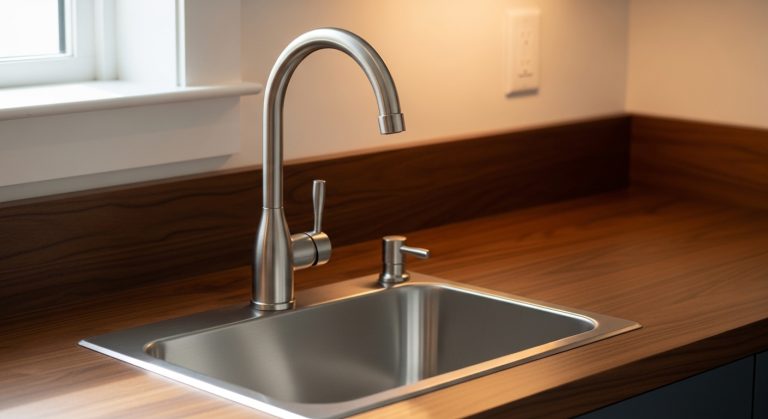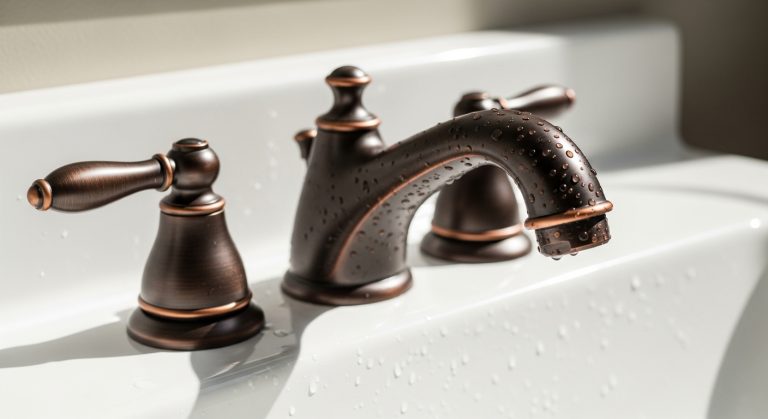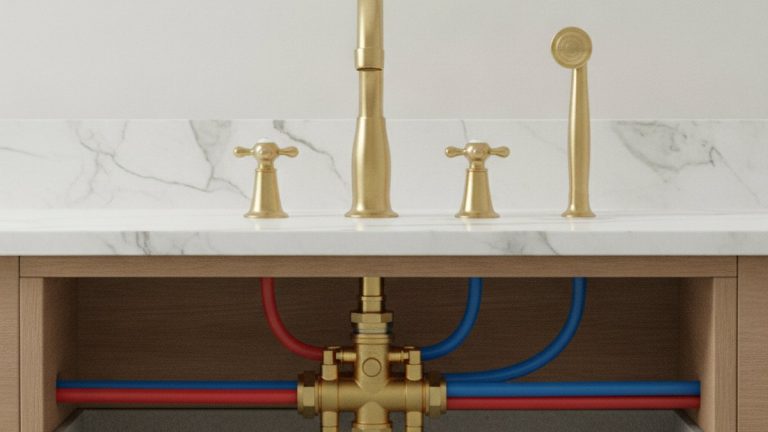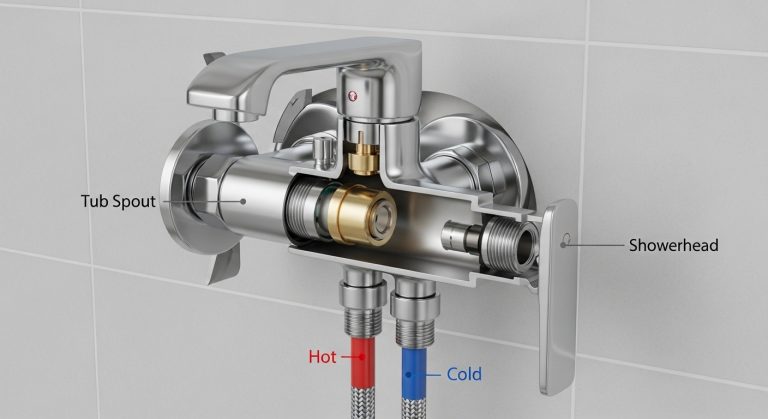
A pot filler and faucet set is a coordinated pair — a wall-mounted (or occasionally deck-mounted) pot filler that swings out over your cooktop, plus a main kitchen sink faucet, both designed by the same manufacturer in an identical finish and design language. People search for this because they’ve learned the hard way that “brushed gold” from one company almost never matches “champagne bronze” from another. Buying the two as a set solves the matching problem in one purchase and usually puts both fixtures under one warranty. Below, we’ll answer the real questions shoppers ask before spending $300–$900 on one.
What exactly is a pot filler, and why do people buy it as a set with the sink faucet?
A pot filler is a long, jointed cold-water faucet mounted on the wall behind your stove so you can fill a big stockpot right on the burner instead of hauling it, full and heavy, from the sink. That’s the whole point: a full 12-quart pot of water weighs about 25 pounds, and carrying it across the kitchen is how people burn themselves and wreck their backs. The pot filler brings the water to the pot.
People buy it as a set with the sink faucet for one honest reason — finish matching. Kitchen finishes like matte black, brushed nickel, champagne bronze, and stainless are not standardized across brands. One company’s “brushed gold” reads warmer or cooler than another’s, and once both fixtures are lit under the same kitchen lights, a slight mismatch is glaringly obvious. A pot filler and faucet set from a single maker guarantees the two pieces were finished in the same process, so they read as one intentional design rather than two near-misses.
- Guaranteed finish match — same plating batch, same sheen, same undertone.
- One warranty, one point of contact — no finger-pointing between two brands if a finish flakes.
- Coordinated design language — matching spout curves, lever styles, and joint hardware.
- Often a small bundle discount versus buying two premium fixtures à la carte.
Is a matching pot filler and faucet set actually worth it, or is it a waste of money?
It’s worth it if (a) you cook enough to justify a pot filler at all, and (b) you care about the two fixtures matching perfectly. If either of those isn’t true, a set is a waste of money. A pot filler is a convenience fixture, not a necessity — you can live without one forever. But if you’re already renovating, already running a water line to the wall behind the range, and you want a showpiece kitchen, buying the pair together is the low-effort way to get a coordinated look.
Here’s the honest counterpoint: if you already own a kitchen faucet you’re happy with, forcing a full set on yourself just to “match” is backwards. In that case, buy a standalone pot filler in the closest available finish. The set only makes financial sense when you’re replacing both fixtures anyway, or building new. If you’re mid-renovation and pulling out an old faucet first, our guide on how to remove a very old kitchen faucet when the nuts are rusted solid will save you an afternoon of frustration before the new set goes in.
How much does a pot filler and faucet set cost in 2026?
Expect to spend roughly $250 to $900 for the pair, depending on finish, valve quality, and brand tier. Budget sets run $250–$400, mid-range (the sweet spot for most homeowners) lands at $400–$650, and premium designer sets climb past $700. The single biggest price driver isn’t the sink faucet — it’s the pot filler’s valve count and joint quality.
| Tier | Price (pair) | What you get | Best for |
|---|---|---|---|
| Budget | $250–$400 | Single-joint pot filler, standard ceramic-disc faucet, basic finish (chrome, brushed nickel) | Rentals, secondary kitchens, tight budgets |
| Mid-range | $400–$650 | Double-jointed articulating pot filler, pull-down sink faucet, matte black or champagne bronze, dual shut-off valves | Most homeowners — best value |
| Premium | $650–$900+ | Solid-brass body, PVD finish, magnetic-dock sprayer, designer styling, lifetime warranty | Chef’s kitchens, high-end remodels |
What should I look for when buying a pot filler and faucet set?
Look for two shut-off valves on the pot filler, a solid-brass body, a genuine PVD or physical-vapor-deposition finish, and a reach that actually clears your largest burner. Those four things separate a set you’ll love for 15 years from one that drips and tarnishes in two. Here’s what each one means in plain terms:
- Double valve on the pot filler. The best pot fillers have two independent shut-off valves — one at the wall and one at the spout. Redundancy matters because this faucet sits over an open flame; if one valve ever fails, the second stops the leak instead of dripping onto your cooktop.
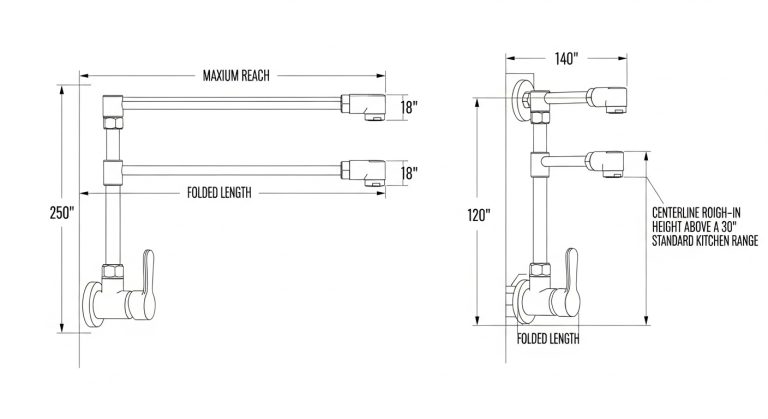
- Reach and joints. Measure from the wall to the center of your farthest burner. A double-jointed (“articulating”) pot filler typically extends 20–24 inches and folds flat against the wall when not in use. Single-joint models are cheaper but may not reach a back burner on a 36-inch range.
- Solid brass, not zinc. A brass body resists corrosion and holds a finish far better than pot-metal zinc alloy. It’s heavier in the hand — that heft is a good sign.
- Real PVD finish. PVD-coated matte black and brushed gold resist scratching and won’t fade. Cheaper electroplated finishes chip, especially in the steam-and-grease zone above a stove.
- Faucet spout height and sprayer type. Match the sink faucet to your basin depth. A high-arc pull-down is the most versatile; if your set offers a magnetic dock, it keeps the sprayer head from sagging over time.
Because the sink faucet in the set is the fixture you’ll actually touch a hundred times a day, don’t let the pot filler distract you from vetting it. If you’re weighing pull-down sprayer designs and dock quality, our breakdown of real-world kitchen faucet reviews and which models hold up covers the failure points to check before you commit.
Do I need a plumber, or can I install a pot filler and faucet set myself?
The sink faucet half of the set is a confident-DIYer job; the pot filler half almost always needs a plumber unless you’re doing it during open-wall construction. The reason is simple: a pot filler requires a new cold-water supply line run inside the wall behind your range, plus a recessed valve box and blocking to anchor it. That means opening drywall, running pipe, and pressure-testing the connection — work most homeowners shouldn’t improvise.
If your wall is already open during a remodel, the rough-in is straightforward for a handy person: mount the valve box at the right height (typically 18–20 inches above the cooktop surface, centered over the burners), run half-inch line, and cap it for testing before the drywall goes back. The sink faucet, by contrast, connects to existing supply lines under the sink — a job you can knock out with a basin wrench and an hour. When you plumb the pot filler, use quality supply lines; our guide to choosing a copper faucet supply line explains why the connection behind a stove is not the place to cut corners.
Where should the pot filler go, and how high above the stove?
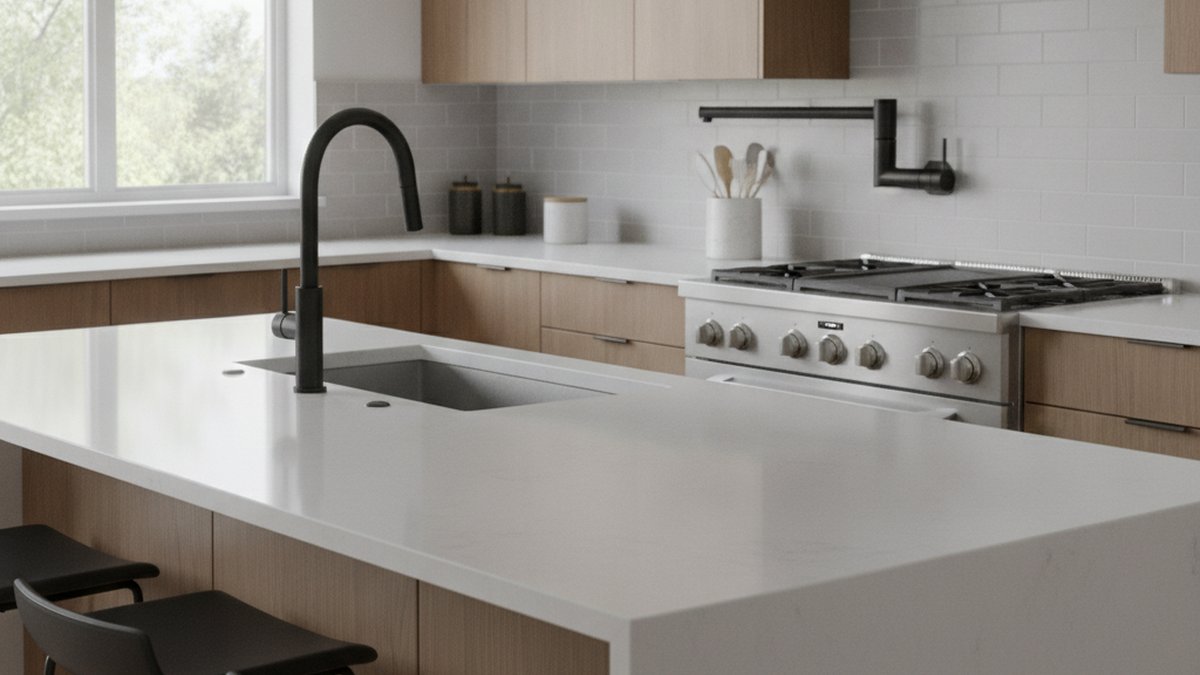
Mount the pot filler so the spout sits about 18 to 20 inches above the cooktop surface and centered left-to-right over your burners, with enough clearance that the folded arm doesn’t hit your tallest stockpot. Too low and a big pot won’t fit under it; too high and water splashes when it hits the pot. The center of the spout should line up roughly with the middle of the cooking surface so it can swing to reach front and back burners alike.
Confirm two clearances before you commit to a location: vertical (spout height above the tallest pot you use) and horizontal (arm reach to the farthest burner). If you have a pot-filler-friendly range hood or a tile backsplash pattern, plan the valve-box location before tiling so the escutcheon lands cleanly on a grout line or tile center, not awkwardly across a seam.
What finishes work best for a pot filler and faucet set?
Matte black and champagne bronze are the two most popular finishes for coordinated sets in 2026 because they read as intentional design statements and hide water spots well; brushed nickel and stainless remain the safe, timeless picks. The finish you choose should tie into your cabinet hardware and appliances, not fight them. Since the pot filler lives in a steam-and-grease zone, finish durability matters more here than anywhere else in the kitchen.
| Finish | Look | Spot & fingerprint resistance | Best paired with |
|---|---|---|---|
| Matte Black | Bold, modern | Excellent (hides spots) | White or wood cabinets, brass accents |
| Champagne Bronze | Warm, upscale | Very good | Navy, green, or cream cabinetry |
| Brushed Nickel | Neutral, timeless | Good (softens spots) | Almost anything — safest choice |
| Polished Chrome | Bright, classic | Fair (shows spots) | Traditional and transitional kitchens |
| Stainless / Steel | Utilitarian, clean | Good | Stainless appliance packages |
One practical note: if your appliances are stainless, a stainless or brushed-nickel set blends seamlessly, while matte black creates a deliberate contrast. There’s no wrong answer — just decide whether you want the fixtures to disappear or to stand out. If you’re still choosing an overall fixture brand and finish direction for the whole home, our roundup of the best fixture brands for consistent finishes is a useful sanity check before you buy.
FAQ
Does a pot filler need hot water?
No. A pot filler is cold-water only by design. You bring the water to a boil on the burner anyway, so there’s no reason to run a hot line — and a single cold line keeps the in-wall plumbing simpler and cheaper. If a “set” advertises hot and cold to the pot filler, you’re paying for plumbing you don’t need.
Will a pot filler leak onto my stove?
A quality pot filler with two shut-off valves is very unlikely to leak, which is exactly why the dual-valve design exists. Cheap single-valve units are the ones that eventually drip. Always close both valves after use, and buy a set with solid-brass valve internals rather than plastic. This is the one spec worth spending extra on given the fixture sits over your cooktop.
Can I add a pot filler to an existing kitchen without gutting the wall?
Sometimes, but it’s messy. Adding a pot filler after the fact means opening the backsplash wall to run a new cold-water line and set a valve box, then patching and re-tiling. It’s far cheaper and cleaner to do it during a remodel when the wall is already open. Retrofitting is possible but plan for drywall and tile repair.
Do the pot filler and sink faucet have to be from the same brand to match?
To match perfectly, yes — that’s the entire value of buying a set. Finish names are not standardized, so one brand’s matte black or champagne bronze rarely matches another’s exactly under kitchen lighting. If you insist on mixing brands, buy in person or order samples and compare them side by side before committing.
What size supply line does a pot filler use?
Most pot fillers connect to a standard 1/2-inch cold-water supply line run inside the wall, terminating at a recessed valve box. The flexible connector at the sink faucet is typically a 3/8-inch compression fitting to the existing shut-off valves. Confirm the exact fitting sizes in your set’s spec sheet before your plumber roughs in the line.
Is a deck-mounted pot filler a good alternative to a wall-mounted one?
A deck-mounted pot filler — installed on the countertop beside the cooktop instead of on the wall — is a solid option when you can’t run a line inside the wall. It draws from the counter’s plumbing area rather than the backsplash, which simplifies retrofits. The trade-off is that it takes up counter space and doesn’t fold flat against the wall the way an articulating wall-mount does.
Author note: This guide was written by the faucitta fixture team, who spend their days specifying, installing, and stress-testing kitchen and bath fixtures. We’ve mounted pot fillers over gas, induction, and electric cooktops and seen firsthand which valve designs last and which drip.
About faucitta: faucitta (faucitta.net) is a specialist faucet and bathroom-fixtures brand focused exclusively on faucets, showers, tubs, sinks, and the parts that keep them running. Every fixture we recommend is evaluated against real installation and durability criteria — not spec-sheet marketing.
On testing and standards: When comparing sets, favor fixtures that meet recognized North American plumbing standards (such as ASME A112.18.1 / CSA B125.1) and lead-free compliance (NSF/ANSI 372). A genuine manufacturer warranty on both the finish and the valve — ideally a limited lifetime warranty on the pair — is the clearest signal a brand stands behind the set. Register your set after install so the warranty on both fixtures stays valid.