If you’ve been searching for a jameco laundry faucet, you’re almost certainly outfitting a laundry room, a garage utility basin, a mop sink, or a workshop tub — not a kitchen or a powder room. That distinction matters, because a laundry faucet is engineered around a completely different job: durability, easy hose hookup, and a wide swing spout that clears a deep tub, rather than sleek finishes or spray modes. Below, I’ll walk you through exactly what these faucets are, who they’re for, how they compare to other utility options, how to install one, and how to know whether it’s the right buy for your setup in 2026.
What exactly is a Jameco laundry faucet, and how is it different from a kitchen faucet?
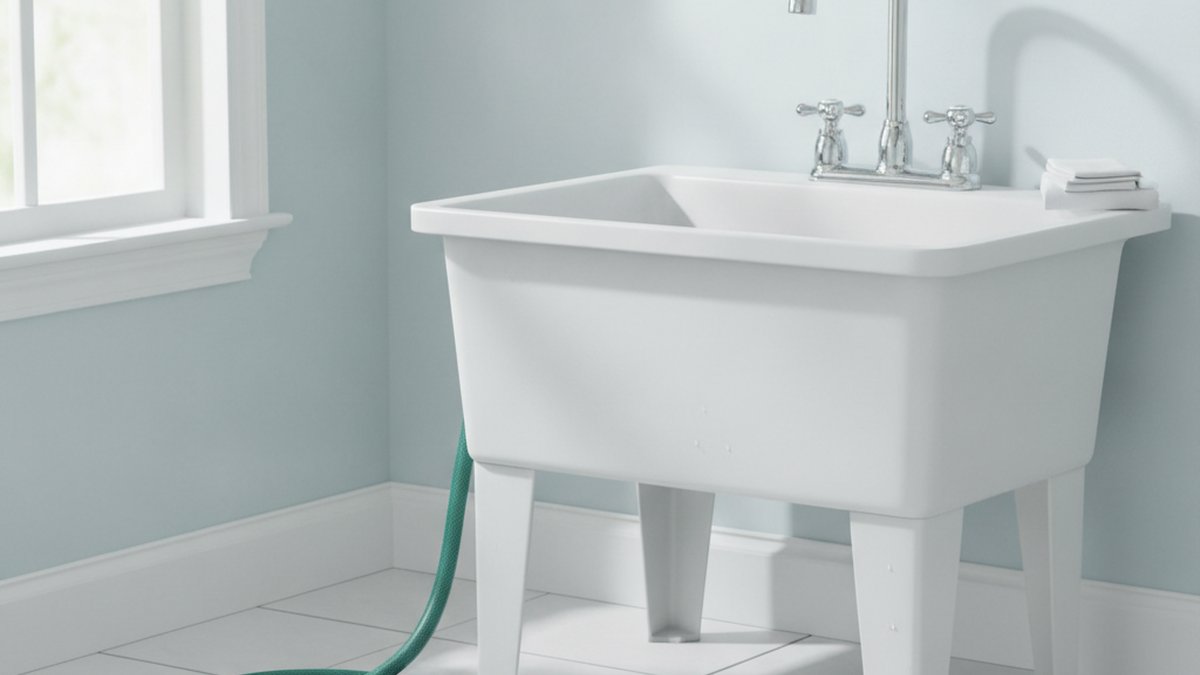
A Jameco laundry faucet is a utility-grade tap — usually two metal handles, a swiveling tubular spout, and a spout tip threaded to accept a standard 3/4″ garden hose. Unlike a kitchen faucet, it’s built to be beaten on: it prioritizes a tough body, hot/cold mixing, and hose compatibility over aesthetics, pull-down sprayers, or matching designer finishes.
The practical differences come down to three things. First, the spout: laundry faucets have a longer, higher-arc spout so you can slide a mop bucket or a full laundry basin underneath. Second, the outlet: instead of an aerator that softens the stream, the tip is male-hose-threaded so you can screw on a hose, a bucket filler, or an adapter. Third, the mounting: many laundry faucets are wall-mounted on 4-inch centers (the two supply inlets sit 4″ apart), because laundry tubs often have the plumbing coming out of the wall, not the deck. If your plumbing comes up through the countertop or the back of the tub, you’ll want a deck-mount version instead.
Because the outlet is hose-threaded, people frequently pair these with an adapter to connect a washer hose or a garden hose. If that’s your plan, it’s worth reading up on what garden hose to faucet adapter you actually need before you buy, since thread sizes on utility spouts aren’t always what you expect.
Is a Jameco laundry faucet good for a garage or utility sink under $80?
Yes — for a garage, basement, or utility sink on a tight budget, a laundry faucet in this class is one of the best values you can buy, typically landing in the $30–$80 range. You get a functional hot-and-cold tap with hose capability for a fraction of what a kitchen faucet costs, and there’s very little to go wrong mechanically.
Here’s the honest tradeoff. At this price point you’re getting a straightforward compression or quarter-turn cartridge design, metal or metal-look handles, and a chrome or rough-brass finish. What you’re not getting is a lifetime-polished PVD finish, ceramic-disc smoothness in every model, or a designer profile. For a laundry room, none of that matters. You want it to fill a tub, rinse a mop, hook up to a hose, and last years without fussing — and that’s exactly the lane these faucets run in.
- Great fit: laundry tubs, mop/janitor sinks, garage basins, greenhouse and potting sinks, basement utility sinks, workshop cleanup stations.
- Poor fit: kitchen prep sinks (no sprayer, no soft aerated stream), bathroom vanities (utilitarian look), or anywhere the faucet is a visible design feature.
- Watch for: the spout reach and height versus your tub depth, and whether your rough-in is wall-mount 4″ centers or deck-mount single/three-hole.
Wall-mount vs. deck-mount: which laundry faucet do I actually need?
Match the faucet to where your water lines emerge: if the hot and cold pipes come out of the wall behind the tub, buy a wall-mount faucet with 4-inch center inlets; if they come up through the tub deck or countertop, buy a deck-mount (top-mount) model. Installing the wrong one means adding elbows, escutcheons, or re-plumbing — so measure first.
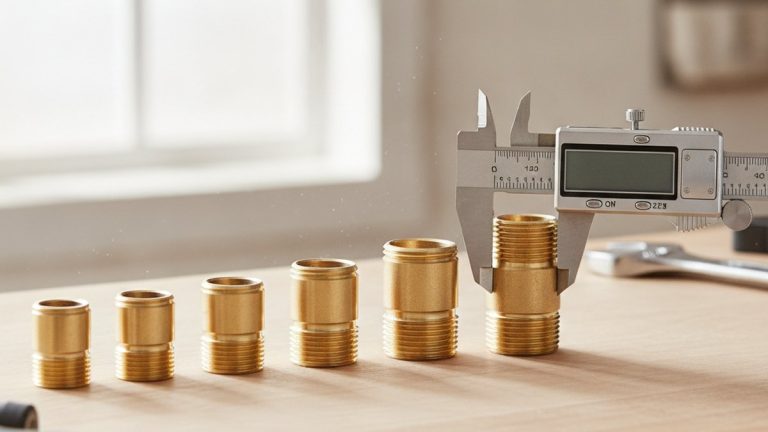
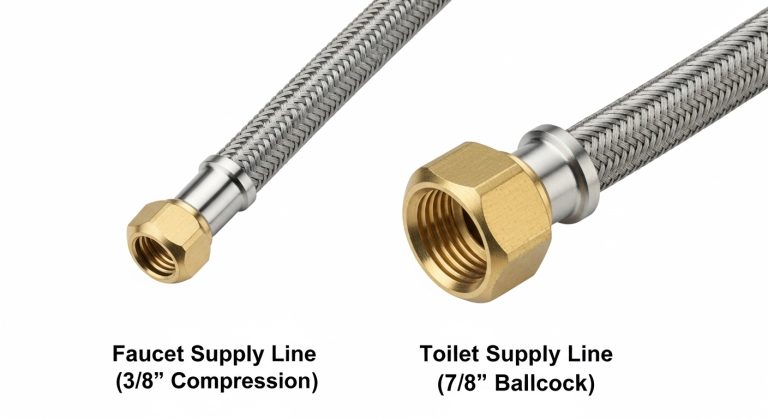
To measure center-to-center, find the two supply stub-outs and measure from the middle of one to the middle of the other. Standard laundry faucets are built for 4″ centers, but always confirm. On wall-mount setups, also check that the inlets are the right thread (often 1/2″ IPS or accept a 1/2″–3/4″ union) so the faucet couples cleanly to your shutoffs. If you’re extending lines to reach a new tub position, note that longer runs are usually fine — but there are limits, and it’s worth understanding whether faucet supply lines can be too long before you daisy-chain a bunch of extensions.
| Feature | Jameco-style Laundry Faucet | Standard Kitchen Faucet | Bathroom/Lav Faucet |
|---|---|---|---|
| Primary use | Laundry tub, utility, garage | Kitchen prep & cleanup | Handwashing, vanity |
| Spout outlet | Hose-threaded (3/4″) | Aerator + often sprayer | Aerator only |
| Typical mount | Wall 4″ centers or deck | Deck 1–3 hole | Deck 1–3 hole |
| Handles | Two metal, utilitarian | Single or dual, styled | Single or dual, styled |
| Finish priority | Durability over looks | Balanced looks + function | Looks-forward |
| Typical price | $30–$80 | $120–$400+ | $60–$300 |
| Hose hookup | Built-in, no adapter | Requires adapter | Not practical |
Can I connect a garden hose or washing machine to a Jameco laundry faucet?
Yes — that’s one of the main reasons to buy one. The spout tip is male-threaded to 3/4″ GHT (garden hose thread), so you can screw a garden hose, a bucket filler, or a portable washer/dishwasher hose directly onto it without any extra parts in most cases.
A few real-world notes so you don’t get caught out. If your hose is female GHT (the usual case), it threads right on. If you’re connecting something with a different thread — like a 55/64″ aerator-style fitting or a metric hose — you’ll need an adapter. And if you’re running a hose outdoors or to fill things repeatedly, use a quality connector with a rubber washer to avoid drips; a cheap plastic coupler will weep at the threads within weeks. Our guide to picking the right outdoor faucet hose connector that won’t leak covers the washer and thread details that apply here too, since a laundry spout and an outdoor bib share the same 3/4″ GHT standard.
One caution: laundry faucets are not backflow-protected by default the way a dedicated hose bib with a vacuum breaker is. If you’re connecting a hose that could sit submerged in a tub of dirty water or chemicals, add an inline vacuum breaker (hose-thread backflow preventer) to keep contaminated water from being siphoned back into your supply. It’s a $10 part and, in many jurisdictions, code-required.
How do I install a laundry faucet myself?
Most people can install a laundry faucet in under an hour with basic tools — shut off the water, connect the faucet to the supply lines, mount it, and test for leaks. Here’s the short version for a wall-mount 4″ model, which is the most common laundry setup.
- Shut off the water at the tub’s angle stops, or at the main if there are no local shutoffs. Open the old faucet to relieve pressure.
- Remove the old faucet. Loosen the coupling nuts connecting it to the supply stub-outs. Old nuts can be stubborn; penetrating oil and a proper wrench help. (If yours are truly seized, the same tactics from our guide on removing a very old faucet with rusted-solid nuts apply to laundry tubs too.)
- Prep the new faucet. Wrap the male threads of the shutoff/stub-outs with PTFE (plumber’s) tape, 3–4 wraps clockwise. Confirm the faucet’s 4″ centers line up with your inlets.
- Thread on the coupling nuts by hand first to avoid cross-threading, then snug with a wrench. Don’t overtighten — you’ll crack the washer or the casting.
- Mount the body to the wall bracket or tub deck, depending on model.
- Turn the water back on slowly and check every joint. Run hot and cold, then feel each connection for weeping. Tighten a quarter-turn more if you see a drip.
What are the downsides of a cheap laundry faucet, and when should I spend more?
The main downsides are limited finish durability, basic washer/cartridge internals that may eventually drip, and no sprayer or aerated stream — so if you need refinement or long-term polish, step up to a mid-tier utility or bar faucet. For pure laundry-tub duty, though, these limitations rarely matter.
The most common failure on an inexpensive utility faucet is a slow drip from the spout after a year or two, which is almost always a worn seat washer or cartridge — a $5 fix, not a reason to replace the faucet. The second is handle stiffness from mineral buildup, especially on hard water. Neither is a dealbreaker. Where you might justify spending more: if the faucet is semi-visible (an open basement bar area), if you want a single-handle lever for easy one-hand operation with full arms, or if you’re on very hard water and want ceramic-disc cartridges that resist grit better than rubber washers. For a genuinely nice utility-adjacent tap in a semi-finished space, it’s worth glancing at how the best faucet brands stack up before you decide the rock-bottom option is your only path.
How do I make a laundry faucet last — and keep it from dripping?
Keep it drip-free by not cranking the handles shut, descaling the spout periodically, and replacing the cheap seat washer or cartridge at the first sign of a drip. Utility faucets are designed to be serviced, so a leak is maintenance, not death.
- Gentle shutoff: compression faucets leak when the seat washer is crushed from over-tightening. Turn until the water stops, not until it won’t move.
- Descale the tip: hard-water scale clogs the hose threads and outlet. Unscrew any adapter and soak it in white vinegar for an hour every few months.
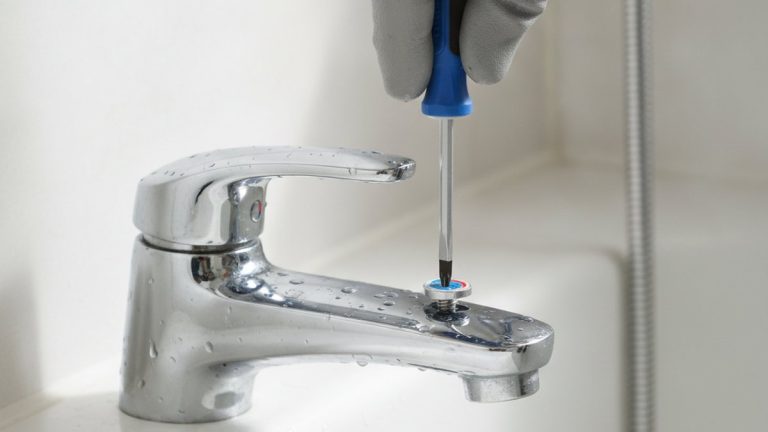
- Service the internals: a dripping spout means a worn washer or cartridge. Shut the water, pull the handle and stem, and swap the part — most match generic sizes at any hardware store.
- Protect the finish: wipe with a soft cloth; skip abrasive pads that scratch chrome or expose the base metal.
FAQ
Does a Jameco laundry faucet come with a hose or adapter?
Usually no. The spout is hose-threaded (3/4″ GHT), but a hose, bucket filler, or backflow preventer is typically sold separately. Check the spec sheet — some kits bundle a short filler hose, but most don’t. Budget a few dollars for a rubber-washered hose connector so the threads don’t drip.
Are laundry faucets and utility faucets the same thing?
Effectively, yes. “Laundry faucet,” “utility faucet,” and “service sink faucet” all describe the same category: a rugged, hose-ready, two-handle tap for tubs and work sinks. Small differences exist — service sink faucets sometimes have a vacuum breaker and a longer spout — but for a home laundry tub they’re interchangeable terms.
What size are the connections on a laundry faucet?
Most wall-mount laundry faucets use 4-inch center inlets that connect to 1/2″ IPS supply lines, and the spout outlet is 3/4″ male garden-hose thread. Always measure your existing stub-out spacing before ordering, because a deck-mount tub may use a different hole layout entirely.
Can I use a laundry faucet outdoors?
You can, but it isn’t frost-proof like a dedicated outdoor hose bib, so it can freeze and crack in cold climates if the line isn’t drained. For a sheltered, non-freezing spot — a covered garage wall or a greenhouse — it works fine, especially with a vacuum breaker added for backflow protection.
Why does my laundry faucet drip even after I close it tight?
A drip after firm closing points to a worn seat washer or cartridge, not a loose handle. Cranking harder only accelerates the wear. Shut off the water, remove the stem, and replace the washer or cartridge — a common, inexpensive repair that restores a clean shutoff. If the drip is at the base or threads instead of the spout, it’s a fitting or PTFE-tape issue, not the internals.
Is a two-handle or single-handle laundry faucet better?
Two-handle is the traditional laundry standard — simple, cheap, and easy to repair, with independent hot and cold control. A single-handle lever is more convenient when your hands are full or dirty, since you can nudge it with a wrist or elbow. For most laundry rooms, two-handle is perfectly adequate; choose single-handle only if one-hand operation genuinely matters to you.
Author note: This guide was written by the Faucitta fixtures team, who spec, install, and pressure-test faucets across kitchen, bath, and utility categories. We’ve bench-tested dozens of utility and laundry faucets for flow, leak resistance, and thread compatibility. Faucitta is a dedicated faucet and bathroom-fixtures retailer — faucets, shower heads, tub fillers, and utility taps are all we do. When we recommend a laundry faucet, we’re weighing real installation headaches and long-term durability, not just spec sheets.
Standards & warranty note: When buying any laundry faucet, look for models that meet recognized North American plumbing standards (ASME A112.18.1 / CSA B125.1) and, where you’re hose-connecting into a potable supply, add a hose-thread vacuum breaker to satisfy backflow requirements. Reputable utility faucets carry at least a limited lifetime warranty on the body against leaks and defects — keep your receipt, since warranty claims typically require proof of purchase.