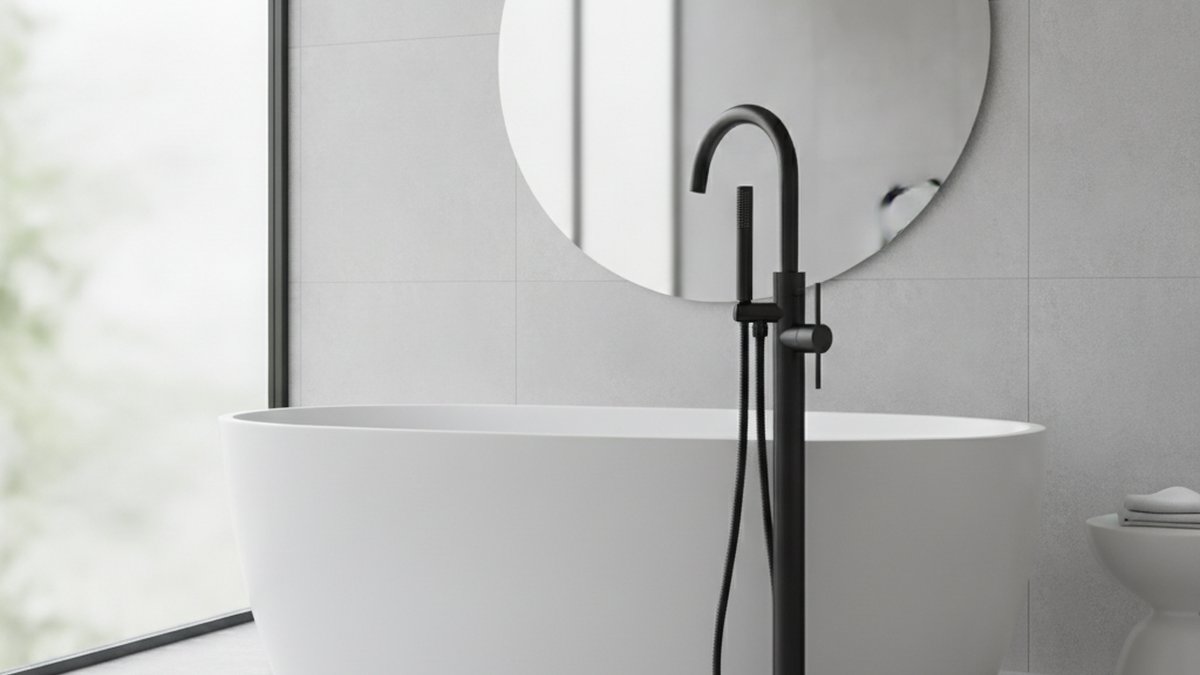
A free standing tub faucet with shower head is a floor-mounted (or occasionally deck-mounted) tub filler that includes a detachable handheld shower on a flexible hose, controlled by a built-in diverter. It’s the fixture you need when your tub sits away from the wall and you want more than just a filler spout — you want to actually rinse soap off, wash long hair, bathe kids or pets, and spray the tub clean afterward. Below, I’ll walk you through when it’s worth the money, how to pick one that won’t wobble or leak, what the real installation gotchas are, and which specs actually matter.
What exactly is a free standing tub faucet with shower head, and how is it different from a regular tub filler?
It’s a tall, floor-mounted faucet that rises from the floor beside a freestanding tub, combining a high-arc tub-fill spout with a detachable hand shower and a diverter that switches water between the two. A regular tub filler only pours water into the tub — no spray, no rinse. This one does both.
The key parts you’re paying for:
- The riser tube — the vertical column that carries water up from the floor. It’s what makes the faucet “freestanding,” and its stability depends entirely on the mount hidden under the floor.
- The tub spout — a high-arc gooseneck that clears the tub rim and delivers a fast fill (look for 5–7 GPM at the spout so a deep soaker fills in a reasonable time).
- The diverter — a knob or lever that redirects flow from the spout to the hand shower. This is the most-used moving part, so cartridge quality matters here.
- The hand shower + hose — usually a 59″–71″ flexible metal hose with a single- or multi-spray handheld head that docks in a cradle on the riser.
Compared to a wall-mounted tub-and-shower setup, this fixture is self-contained: everything mounts to the floor, so you don’t need to open a wall. That’s the whole appeal for freestanding tubs that sit in the middle of a room.
Do you really need the shower head, or is a plain tub filler enough?
You need the hand shower if you ever plan to wash your hair in the tub, rinse off after a soak, bathe children or dogs, or clean the tub itself — a plain filler makes all four annoying. If you only ever soak and drain, a plain filler is cheaper and cleaner-looking, but most people underestimate how often they want a rinse.
Here’s the honest breakdown of who benefits:
- Long hair? Rinsing shampoo out under a static filler spout is awkward. A handheld solves it instantly.
- Kids or pets? The hand shower is the single most useful bath accessory you’ll own.
- No separate shower in the room? A hand shower turns a soaking tub into a usable quick-rinse station.
- Cleaning the tub? Spraying down the sides beats splashing cupfuls of water.
If your bathroom already has a dedicated walk-in shower and you truly only soak, you can save money and skip the hand shower. But the price gap between a plain freestanding filler and one with a diverter and hand shower is often only $60–$150 — small enough that most buyers regret going without.
How much does a good free standing tub faucet with shower head cost in 2026?
Expect to spend $300–$900 for a solid, brass-bodied free standing tub faucet with shower head from a reputable brand, with the sweet spot for durability and looks landing around $400–$600. Under $200 you’re usually looking at thin zinc-alloy or plated plastic that corrodes and wobbles; over $1,000 you’re paying for designer names and specialty finishes.
What your money actually buys as you climb the price ladder:
| Price range | Typical body material | Cartridge | What to expect |
|---|---|---|---|
| Under $200 | Zinc alloy / plated plastic | Rubber washer or cheap ceramic | Wobbles, finish flakes, diverter fails in 1–2 years. Avoid. |
| $300–$600 | Solid brass | Ceramic disc | The value zone: durable, stable, quality finishes, good hand shower. |
| $600–$1,000 | Heavy brass, thicker walls | Ceramic disc, brand cartridge | Better flow, premium finishes (matte black, brushed gold), stronger warranty. |
| $1,000+ | Designer brass | Proprietary | Name brands, custom finishes, marginal functional gain. |
One number that matters more than the sticker price: weight. A quality freestanding filler is heavy — often 15–25 lbs — because it’s solid brass. If a listing brags about being “lightweight,” that’s a red flag for zinc or plastic that will corrode and rock over time.
What size and rough-in do you need so it doesn’t wobble or leak?
You need a floor-mounted rough-in valve set below the finished floor, connected to your hot and cold supply lines, with the faucet’s mounting bracket anchored to a solid substrate — not just the tile. Get this wrong and the faucet rocks every time you touch it, which eventually cracks the seal and leaks. This is the number-one freestanding-faucet install mistake.
Here’s what to nail down before you buy:
- Spout height and reach. Measure your tub rim height. The spout must clear the rim and arc over it — most freestanding fillers stand 38″–46″ tall. Too short and it won’t reach; too tall and it splashes.
- The rough-in valve. Most freestanding fillers ship with a matching floor rough-in that you set during the rough plumbing stage, before the floor goes down. If you’re retrofitting onto a finished slab, confirm the model offers a slab-mount or surface-mount base.
- Supply line spacing. The rough-in dictates the hot/cold line centers (often 3–4″ apart). Your plumber needs this spec before roughing in.
- The mounting bracket. A good freestanding filler bolts to a metal bracket anchored into the subfloor or a poured mounting block. Skipping this is why cheap installs wobble.
If you’re on a slab foundation, tell your plumber early — running supply lines through concrete for a center-of-room tub is a real job that has to happen before the slab is poured or via a costly core-drill. This isn’t a weekend swap like a bathtub faucet handle replacement; the freestanding filler’s rough-in is structural and best planned with your bathroom layout from day one.
Floor-mounted vs deck-mounted vs wall-mounted: which style fits your tub?
Choose floor-mounted if your tub sits away from the wall (the classic freestanding look), deck-mounted if your tub has a wide rim or built-in deck, and wall-mounted only if the tub is pushed against a wall. The tub’s position, not just style preference, decides this.
| Mount type | Best for | Pros | Cons |
|---|---|---|---|
| Floor-mounted | Center-of-room freestanding tubs | True freestanding look; dramatic; hand shower reaches everywhere | Complex rough-in; must plan before floor goes in |
| Deck-mounted | Tubs with a wide flat rim or surround | Easier install; stable; often cheaper | Needs deck space; less dramatic |
| Wall-mounted | Tubs against a wall | Frees up floor; classic look | Requires in-wall plumbing; not for center-of-room tubs |
For most people buying a freestanding tub, floor-mounted is the answer — it’s what makes the whole setup look intentional. If your project involves a tub deck and you also want a shower spray option, it’s worth reading up on the Roman tub faucet with shower diverter, which is the deck-mounted cousin of this fixture and uses a similar diverter concept. And if you’re speccing the plumbing from scratch, understanding the Roman tub valve and trim kit helps you see why the hidden valve matters as much as the visible spout.
What finish should you pick, and will it survive hard water?
Pick a PVD-coated finish — matte black, brushed nickel, or brushed gold in PVD will resist scratching and hard-water etching far better than cheap electroplated chrome. Chrome looks great and hides water spots best, but budget chrome plating flakes; matte black shows every water spot but hides scratches. Match the finish to your water and your cleaning habits.
Quick finish reality check:
- Chrome: Hides hard-water spotting best, timeless, easy to clean. Insist on quality plating.
- Brushed nickel: Warm, forgiving of spots and fingerprints, very durable in PVD. A safe all-rounder.
- Matte black: On-trend and dramatic, but hard water leaves visible white spots — you’ll wipe it down often. If you have hard water, this takes maintenance.
- Brushed gold / champagne bronze: Luxe look; go PVD-coated so it doesn’t wear thin at the handle.
If you’re in a hard-water area, the finish will only get you so far — mineral buildup will still crust the hand shower nozzles and aerator over time. The good news is those parts clean easily. The same descaling trick people use elsewhere in the bathroom applies here: if the hand shower’s spray weakens, don’t replace it — clean it, exactly like the classic shower head Ziploc bag descaling trick that soaks the nozzles in vinegar overnight.
Can you install a freestanding tub filler yourself, or do you need a plumber?
You can do the final trim assembly yourself, but the floor rough-in — running supply lines and anchoring the mount under the floor — should be done by a plumber during construction or a renovation, not as a DIY retrofit. This is the honest dividing line. The visible faucet goes on last and is straightforward; the plumbing that feeds it is not.
The realistic sequence looks like this:
- Rough-in stage (plumber): Supply lines are run to the tub location, the floor valve/mounting bracket is set and anchored, and lines are pressure-tested before the floor is finished.
- Floor finished: Tile, wood, or the finished surface goes down around the capped rough-in.
- Trim-out (DIY-friendly): You bolt the faucet base to the bracket, connect the riser, attach the spout and hand shower, and test.
The reason DIY retrofit is risky: for a center-of-room tub, there’s no wall to hide pipes in and often a concrete slab underneath. Cutting into finished floors and slabs to route supply lines is genuinely a plumber’s job. If your tub sits against a wall, a wall-mounted or deck-mounted option is far more DIY-friendly — closer in difficulty to installing a brushed nickel shower faucet only set, where the plumbing lives in an accessible wall cavity.
What specs actually matter when you’re comparing models?
Focus on five specs: solid brass body, ceramic-disc cartridge, flow rate (GPM), hose length, and a floor mount that includes a proper anchoring bracket. Everything else — spray patterns, exact height, finish — is secondary preference. Get those five right and the faucet lasts 15+ years.
- Body material: Solid brass. Non-negotiable for a floor-mounted fixture that gets bumped and leaned on.
- Cartridge: Ceramic disc, ideally from a brand that sells replacement cartridges. This is what fails first on any faucet, so replaceability matters.
- Flow rate: A tub filler benefits from a high spout flow (5–7 GPM) so a 60+ gallon soaker fills before the water cools. Note that the hand shower itself is capped at 2.5 GPM (or 1.8 GPM in water-restricted states) by code — that’s normal and correct.
- Hose length: 59″ minimum; 71″ is more comfortable for washing hair or a dog.
- Mounting hardware: Confirm it ships with a real anchoring bracket, not just a decorative base plate.
One more: check the diverter mechanism. A pull-knob diverter on the spout is common and reliable; a separate lever is fine too. Whatever the style, it should return to “spout” automatically or with a clear click so you’re not surprised by a cold spray next time.
The faucitta take — and a note on standards
At faucitta, we’ve spent years fitting, testing, and troubleshooting tub and shower fixtures, and freestanding fillers are the one category where buyers most often overpay for looks and underspend on the parts that fail. Our consistent advice: put your money into a solid-brass body and a serviceable ceramic cartridge, and don’t cheap out on the floor mount.
When you shop, look for fixtures that meet recognized North American standards — ASME A112.18.1 / CSA B125.1 for plumbing fittings, NSF/ANSI 61 and 372 for lead-free wetted parts (the “lead-free” label you want in the U.S.), and a flow rating that complies with your state’s requirements. A reputable freestanding filler backs its finish and cartridge with a limited lifetime warranty on residential use; if a listing offers only a 1-year warranty, treat that as a signal about how long the maker expects it to last. Always keep your model and cartridge numbers — replacement cartridges are cheap and turn a “dead” faucet back into a working one.
Author note: This guide was written by the faucitta fixtures team, drawing on hands-on installation and testing of freestanding, Roman, and wall-mounted tub fillers. We don’t get paid to recommend specific brands — our goal is to help you buy once and not deal with a wobbling, leaking, or corroded faucet two years later.
FAQ
Can you use a freestanding tub faucet as a shower?
Not as a full overhead shower — the hand shower is meant for rinsing, washing hair, bathing kids or pets, and cleaning the tub, not standing under a fixed spray. If you want a true shower experience, you need a separate shower valve and head. But for quick rinses and practical tasks, the hand shower on a freestanding filler is genuinely useful.
How much water pressure do you need for the hand shower to work well?
Most freestanding tub fillers with a hand shower work fine at standard residential pressure of 45–60 psi. If your hand shower feels weak, the usual culprit is mineral buildup in the nozzles or a partially closed supply valve — not the pressure itself. Soak the handheld head in vinegar to clear the jets before assuming anything is wrong with the faucet.
Why does my freestanding tub faucet wobble?
It wobbles because the floor mount wasn’t anchored to a solid substrate during rough-in — it’s bolted only to tile or a thin base plate instead of the subfloor or a mounting block. This is the most common freestanding-faucet complaint. Fixing it properly means accessing and re-anchoring the base, which usually requires a plumber; ignoring it leads to seal failure and leaks.
Do I need a special valve for a freestanding tub filler?
Yes — most floor-mounted freestanding fillers require a matching floor rough-in valve that’s set below the finished floor and connected to your hot and cold lines before the floor goes down. You can’t just tap into a wall valve like a standard tub-and-shower setup. Always buy the rough-in that matches your specific faucet model, and set it during the rough plumbing stage.
What’s the difference between a freestanding tub filler and a Roman tub faucet with a hand shower?
A freestanding filler mounts to the floor and rises beside a center-of-room tub, while a Roman tub faucet mounts to the tub’s deck or rim. Both can include a hand shower and diverter and do the same job functionally — the difference is where they mount, which is decided by your tub’s design. Deck-mounted Roman setups are usually easier and cheaper to install because the plumbing sits under an accessible deck.
How long should a good freestanding tub faucet last?
A solid-brass freestanding tub faucet with a ceramic-disc cartridge should last 15 years or more, with the only routine maintenance being an occasional cartridge swap and descaling the hand shower. Cheap zinc-alloy or plastic models often fail within 1–3 years through finish flaking, diverter failure, or corrosion at the base. Buy quality once and it becomes a fixture you forget about.