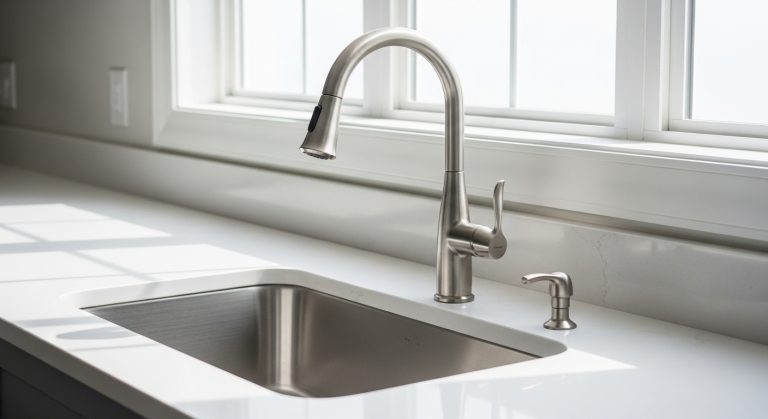
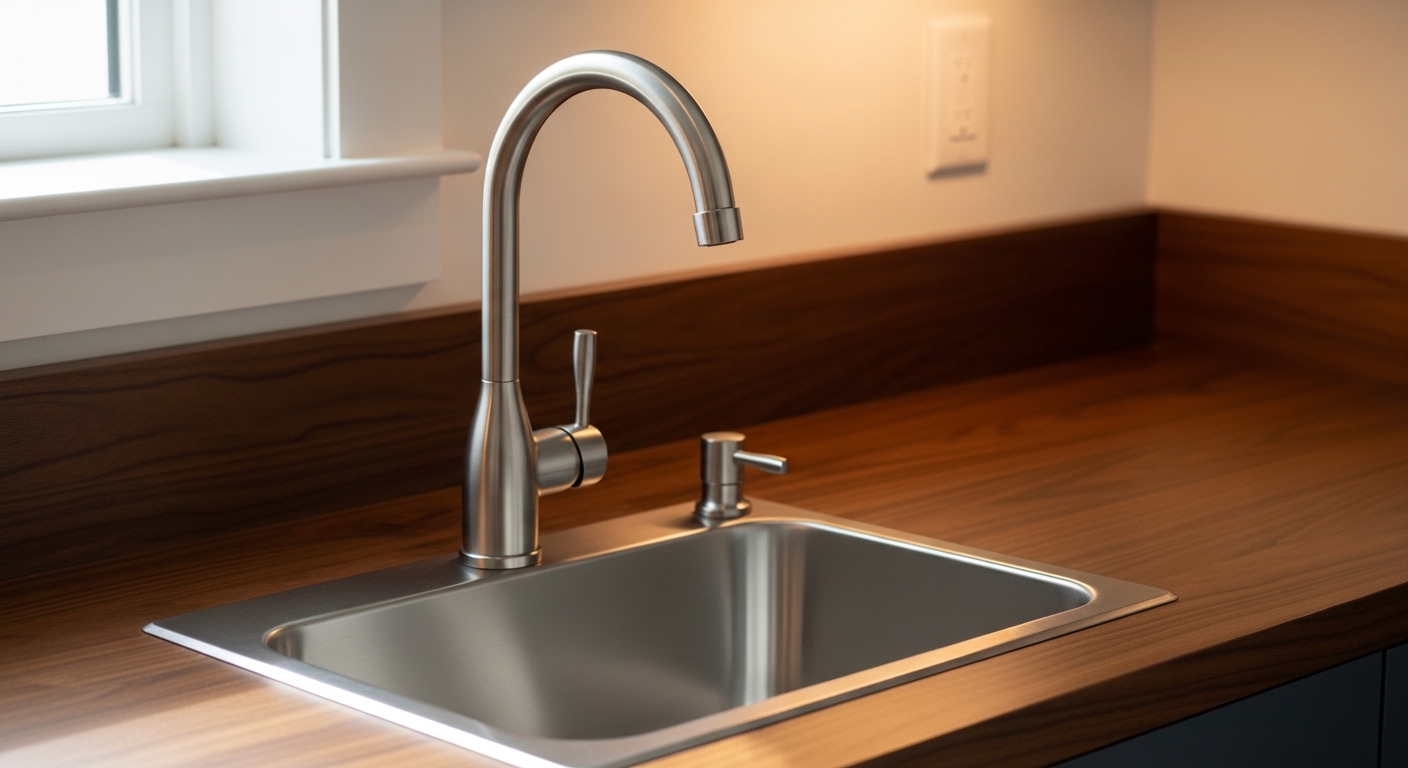
A bar faucet satin nickel finish is the sweet spot for most home bars and prep stations: it’s soft and warm enough to look intentional, muted enough to hide splashes and fingerprints, and neutral enough to sit next to stainless appliances, brushed hardware, or even a little brass without clashing. If you’ve been staring at product pages trying to figure out whether satin nickel is the right call — and which size actually fits a bar sink — this guide gives you the direct answers, the specs that matter, and how to avoid the two or three mistakes that make people return a bar faucet.
At faucitta, we spend our days sizing faucets to real sinks, and bar faucets are the ones people most often get wrong — usually on reach or clearance, almost never on finish. Let’s fix that.
What exactly is a bar faucet, and how is it different from a kitchen faucet?
A bar faucet is a smaller, single-hole faucet built for a bar or prep sink — the compact secondary sink you use for rinsing glasses, prepping garnishes, filling ice buckets, or washing produce on an island. It’s essentially a scaled-down kitchen faucet: shorter, narrower spout reach, and a lower flow rate, because a bar sink is smaller than your main kitchen sink.
The differences that actually matter day to day:
- Spout reach: Bar faucets typically reach 4″–8″ from the base to the water stream, versus 8″–10″ on a full kitchen faucet. Too much reach and the water hits the far wall of a tiny bar sink and sprays back at you.
- Height: Bar faucets run shorter — often 10″–13″ tall — so they don’t tower over a compact prep zone or bang into an upper cabinet or window.
- Flow rate: Many are 1.5–1.8 GPM, plenty for rinsing, without the firehose feel of a 2.2 GPM kitchen sprayer.
- Single hole: Almost all bar faucets are single-hole, single-handle installs, which is what most bar sinks are drilled for.
So when you shop a bar faucet in satin nickel, you’re really shopping for the right size in the right finish — the finish is the easy part.
Why choose satin nickel over chrome, matte black, or stainless for a bar faucet?
Choose satin nickel when you want a warm, forgiving finish that hides water spots and fingerprints and plays nicely with almost any other metal in the room. It’s the most low-maintenance mainstream finish for a bar area, which matters because bar sinks get splashed constantly and rarely get wiped down as often as a kitchen sink.
Here’s how the common bar faucet finishes actually compare in real use:
| Finish | Look | Hides spots/prints? | Best paired with | Maintenance |
|---|---|---|---|---|
| Satin nickel | Warm, soft brushed silver | Yes — very forgiving | Stainless, brass, wood, warm tones | Low — wipe with damp cloth |
| Chrome | Bright, cool, mirror-like | No — shows every spot | Modern, cool color palettes | High — needs frequent wiping |
| Brushed / stainless | Cooler brushed silver | Yes | Stainless appliances | Low |
| Matte black | Bold, contemporary | Shows hard-water/limescale | Modern, high-contrast rooms | Medium — limescale shows on dark |
| Brushed gold / champagne bronze | Warm, luxe | Yes | Statement bars, warm palettes | Low–medium |
People often ask what the difference is between satin nickel and brushed nickel. Honestly, the terms are used almost interchangeably by most brands — both describe a brushed (non-shiny) nickel finish. If there’s a nuance, “satin” tends to read a hair warmer and smoother, and “brushed” a touch cooler with slightly more visible grain. Either one hides fingerprints far better than chrome. If your bar sits near warm wood or brass accents, satin nickel’s warmth is the safer bet — and if you’re mixing metals on purpose, our guide on whether a brass faucet with a silver sink actually looks good walks through how to combine warm and cool metals without it looking like an accident.
What size bar faucet do I need for my prep sink? (This is where people mess up)
Match the faucet’s spout reach to the width of your bar sink bowl and aim for the stream to land near the center of the drain — for most bar sinks (roughly 9″–15″ wide), that means a spout reach of about 4″–7″. Then confirm you have enough vertical clearance above the sink for the faucet height plus room to fit a glass or pitcher under the spout.
Run through this quick checklist before you buy:
- Measure your sink bowl width. A 9″–12″ bowl wants a short reach (roughly 4″–5.5″); a 13″–15″ bowl can take 6″–7″.
- Check the faucet height against anything above the sink — a windowsill, an upper cabinet, a shelf, the underside of a range hood on an island.
- Confirm the deck hole size. Most bar sinks use a standard 1 3/8″ (35 mm) hole. Single-hole faucets usually include a deck plate/escutcheon if you ever need to cover extra holes.
- Look at counter depth behind the sink. A gooseneck that curves backward needs a little clearance from a backsplash.
- Decide swivel vs. fixed. A 360° swivel spout is handy if you load the sink from both sides or fill tall containers off to the side.
Spout reach is the number most people ignore and then regret. If you want to go deeper on what that measurement actually means and how it changes the ergonomics of a sink, our explainer on what an 11″ spout reach kitchen faucet means and whether it fits your sink uses a full-size example, but the same logic scales down to a bar faucet — you just want a much shorter number.
High-arc gooseneck or low-profile — which shape is better for a bar?
Pick a high-arc gooseneck if you fill pitchers, ice buckets, or tall glasses; pick a low-profile spout if your bar sits under a cabinet or window with limited height. A tall gooseneck gives you clearance to slide a wine decanter or a 2-quart pitcher underneath, which is the whole point of a bar sink. A low-arc faucet trades that clearance for a more compact, tucked-away look and fewer clearance headaches.
For a wet bar on an island with nothing above it, go tall — it looks purposeful and is more useful. For a bar built into a run of cabinetry with a shelf above, measure first and consider a lower profile or a pull-down that collapses more compactly.
Should I get a pull-down bar faucet or a fixed spout?
Get a pull-down bar faucet if you rinse the sink walls, wash produce, or fill containers that don’t fit under a fixed spout; get a fixed spout if you mostly rinse glassware and want the simplest, most reliable, easiest-to-clean option. A pull-down spray wand adds versatility but also adds a hose, a spray head, and one more component that can eventually wear.
Quick way to decide:
- Pull-down makes sense for a hardworking prep sink where you actually chop and wash food, or if the bar doubles as an overflow kitchen sink.
- Fixed gooseneck makes sense for a true wet bar — drinks, ice, glass rinsing — where a clean silhouette and minimal maintenance win.
Either way, the finish decision is the same: satin nickel holds up beautifully on both, and on a pull-down it does a nice job hiding the handprints that collect on the spray head. If you’re weighing a compact prep-and-bar faucet specifically, the breakdown in our review of the Trinsic prep faucet for a modern kitchen is a useful reference point for how a good bar/prep faucet is built and what to expect at different price tiers.
How much should a good satin nickel bar faucet cost in 2026?
Budget $80–$250 for a quality satin nickel bar faucet; under $80 you start gambling on cartridge and finish quality, and above $250 you’re mostly paying for a designer brand name or solid-brass premium construction. The single biggest predictor of whether a faucet lasts is the cartridge, not the price tag.
| Price range | What you typically get | Good for |
|---|---|---|
| Under $80 | Lighter construction, budget cartridge, sometimes coated (not solid) finish | Rentals, rarely-used bars, tight budgets |
| $80–$150 | Ceramic disc cartridge, decent brass or zinc body, reliable satin nickel finish | Most home bars — the value sweet spot |
| $150–$250 | Solid-brass body, premium ceramic cartridge, smoother handle feel, better warranty | Daily-use prep sinks, long-term homes |
| $250+ | Designer/luxury brands, statement design, lifetime warranty | Show kitchens, high-end wet bars |
What to look for regardless of budget: a ceramic disc cartridge (drip-resistant and long-lasting), a solid-brass or stainless body where possible, a PVD or otherwise durable finish so the satin nickel doesn’t wear off at the handle, and a real warranty — ideally lifetime on the faucet and finish. If you’re setting a firm budget, the logic in our guide to the best budget kitchen faucet under $200 applies almost directly to bar faucets: spend on the cartridge and finish, not on gimmicks.
Does satin nickel finish wear off or tarnish over time?
A quality satin nickel finish — especially a PVD (physical vapor deposition) finish — resists tarnishing, corrosion, and wear for many years and won’t rub off with normal use. Cheaper electroplated or lacquer-coated finishes can eventually thin at high-touch spots like the handle. That’s why the finish process matters more than the color name. To keep any satin nickel looking new, wipe it with a soft damp cloth and mild soap; skip abrasive pads, ammonia, and harsh bathroom cleaners, which can dull the brushed texture over time.
What are common problems with bar faucets, and how do I avoid them?
The most common bar faucet problems are choosing the wrong spout reach (spray-back), a low-flow trickle from a clogged aerator, and drips from a worn cartridge — and all three are avoidable with the right pick and a little maintenance. None of them are reasons to fear a bar faucet; they’re just the predictable failure points.
- Spray-back: Caused by too much spout reach for a small sink. Fix it on the front end by matching reach to bowl width (see the sizing section above).
- Weak or reduced flow: Usually a clogged aerator from hard-water mineral buildup, not a faulty faucet. Unscrew the aerator, soak it in white vinegar, rinse, and reinstall. The same limescale logic that chokes shower heads applies here — our piece on the best shower head for very low water pressure and how to fix a weak shower explains the mineral-buildup mechanism in detail.
- Dripping spout: Almost always a worn cartridge, which is a cheap, replaceable part on a good faucet — another reason to buy a brand with available spare cartridges.
- Loose handle or wobbly base: The mounting nut under the sink backed off. Retighten it; use the included mounting hardware and a basin wrench.
The takeaway: buy the right size, buy a ceramic cartridge, and keep the aerator clean. Do that and a satin nickel bar faucet will run quietly for a decade-plus.
A quick word on installation
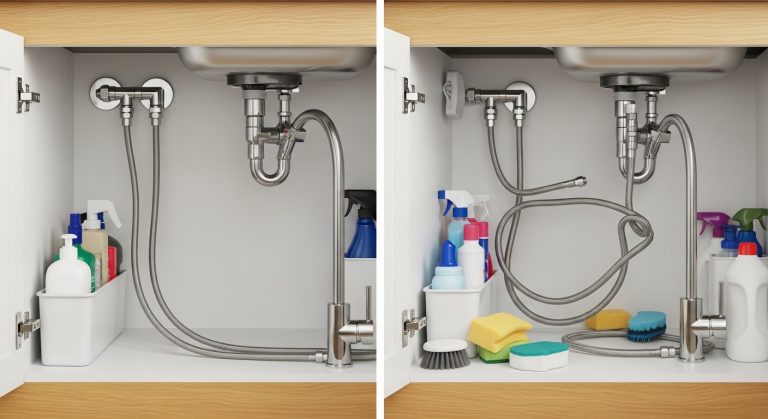
Most single-hole satin nickel bar faucets are a genuine DIY job — 30 to 60 minutes with basic tools. Shut off the water at the supply valves under the bar sink, disconnect the old faucet, drop the new single-hole faucet through the deck hole, secure the mounting nut from below, connect the two braided supply lines (hot and cold), turn the water back on, and check for leaks. If your bar sink uses flexible supply lines and you’re wondering about compatibility, our straight answer on whether you can use a faucet supply line for a toilet is a handy primer on how these lines and connections are rated — the fittings and standards it covers are the same ones you’ll tighten under your bar sink.
The bottom line: is a satin nickel bar faucet the right pick?
For the vast majority of home bars and prep sinks, yes. A satin nickel bar faucet gives you a warm, versatile finish that hides fingerprints and water spots, coordinates with almost any surrounding metal, and asks very little in maintenance. Get the sizing right — short spout reach for a compact bar sink, enough height to fit your glasses and pitchers — pick a model with a ceramic disc cartridge and a durable PVD satin nickel finish, and spend somewhere in the $80–$250 range. That combination is where the value lives, and it’s a faucet you won’t think about again for years.
FAQ
Is a bar faucet the same as a prep faucet?
Essentially yes. “Bar faucet” and “prep faucet” both describe a compact, usually single-hole faucet for a small secondary sink. “Bar” leans toward drink service (rinsing glasses, filling ice buckets) and “prep” leans toward food prep (washing produce), but the faucets are built the same way and are interchangeable. A pull-down version is slightly more useful for prep; a fixed gooseneck is plenty for a drinks-focused bar.
What spout reach do I need for a small bar sink?
For most bar sinks (roughly 9″–15″ wide), a spout reach of 4″–7″ is right, with the stream landing near the center of the drain. A 9″–12″ bowl wants about 4″–5.5″; a 13″–15″ bowl can handle 6″–7″. Too much reach on a tiny sink causes water to spray back at you off the far wall.
Does satin nickel match stainless steel appliances?
Yes — satin nickel pairs well with stainless because both are brushed, non-shiny silver tones. Satin nickel reads a touch warmer than stainless, which most people find complementary rather than clashing. It’s one of the most forgiving finishes for mixing with existing hardware and appliances.
Are satin nickel and brushed nickel the same thing?
For practical purposes, yes — both are brushed (matte) nickel finishes and most brands use the terms interchangeably. Any subtle difference is in warmth and grain: satin often looks a hair warmer and smoother, brushed slightly cooler with more visible texture. Both hide fingerprints and water spots far better than polished chrome.
How do I clean a satin nickel bar faucet without damaging the finish?
Wipe it with a soft cloth dampened with warm water and a little mild dish soap, then dry it. Avoid abrasive scrubbers, ammonia-based cleaners, and harsh bathroom chemicals, all of which can dull the brushed texture over time. For hard-water spots, a cloth dampened with diluted white vinegar works — just rinse and dry afterward so no acid sits on the finish.
Can I install a bar faucet myself?
Most single-hole bar faucets are a straightforward DIY install in 30–60 minutes: shut off the supply valves, remove the old faucet, mount the new one through the deck hole, tighten the mounting nut from below, connect the hot and cold supply lines, and check for leaks. A basin wrench makes the under-sink work much easier. If your shutoff valves are corroded or you don’t have any, that’s the point to call a plumber.
Author’s note: This guide was written by the faucitta fixtures team, who size and spec faucets to real sinks every day and have installed and pressure-tested bar and prep faucets across dozens of configurations. faucitta manufactures and curates faucets built to industry standards, and our recommended bar faucets use ceramic disc cartridges rated for long-term drip-free performance and finishes tested for corrosion and wear — backed by our warranty. Always confirm your sink’s hole size and clearances against a product’s spec sheet before purchasing.