If you’re dealing with Delta touchless faucet low water pressure, the good news is that it’s one of the most fixable problems on a modern kitchen or bathroom faucet. Delta’s Touch2O and touchless (VoIce/motion) faucets add a solenoid valve and a small electronic control box between your supply lines and the spout — and that extra hardware gives sediment and mineral scale two brand-new places to collect. Ninety percent of the “my touchless faucet suddenly went weak” complaints come down to a pinched flow path somewhere in that chain, and you can walk it end to end with a wrench, a toothbrush, and about twenty minutes.
Below I’ll walk through exactly where the flow is getting choked, in the order you should check it, so you don’t tear apart the whole faucet chasing a $2 clog. I’ve repaired and installed hundreds of these, and the failure pattern is remarkably consistent.
What actually causes low water pressure on a Delta touchless faucet?
The cause is a restriction in the water path, and on a touchless Delta there are five usual suspects: a clogged aerator, a dirty solenoid inlet screen, a half-open shut-off valve, a kinked or debris-filled supply hose, and — less often — a weak or failing solenoid that isn’t opening fully. It is very rarely the touch sensor or the motor itself, because those control whether water flows, not how hard it flows.
Here’s the key mental model: touchless doesn’t mean the water pressure comes from electronics. Your home’s water pressure still does all the pushing. The solenoid is just an electric on/off gate. So if pressure dropped, something physical is squeezing the stream. The table below ranks the causes by how common they are and how hard they are to fix.
| Likely cause | How common | Symptom clue | Fix difficulty | Typical cost |
|---|---|---|---|---|
| Clogged aerator | Very common | Weak, spitting, or uneven spray at the tip | Easy | $0–$8 |
| Dirty solenoid inlet screen | Common | Low flow in both touch and manual modes | Easy–Medium | $0 |
| Partially closed shut-off valve | Common (after repairs) | Started right after under-sink work | Easy | $0 |
| Kinked / clogged supply hose | Occasional | One temperature weaker than the other | Medium | $0–$15 |
| Failing solenoid valve | Uncommon | Weak only in touch/touchless mode | Medium | $40–$70 |
Notice the pattern: the cheap, easy fixes are also the most likely ones. Always work top-to-bottom on this list before you spend a dime on parts.
How do I know if it’s the aerator or something deeper?
Do the “aerator removal test” first — it takes 60 seconds and tells you which half of the faucet the problem is in. Unscrew the aerator from the tip of the spout and turn the water on. If the flow roars back to full strength with the aerator off, your problem is the aerator (or the pull-down spray head). If it’s still weak with the aerator removed, the restriction is upstream — the solenoid screen, a valve, or a hose.
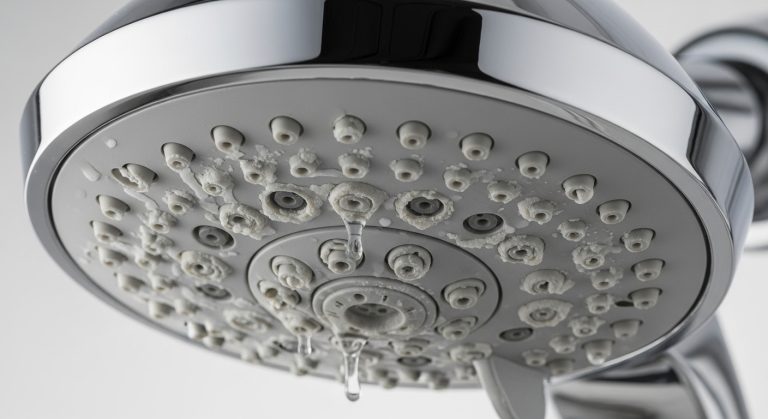
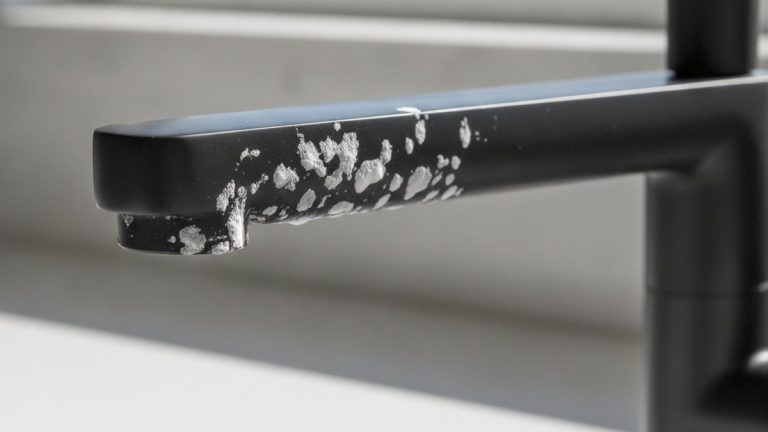
On most Delta pull-down and pull-out touchless models the aerator is inside the spray head and unscrews with a plastic key (or by hand). On standard spouts it threads into the tip; use a rag and pliers so you don’t scratch the finish. Once it’s out, hold it up to the light — a clogged aerator looks gray, chalky, or has visible grit trapped in the fine screen.
To clean it: soak the aerator in a 50/50 white vinegar and warm water solution for 30–60 minutes, then scrub the screen with an old toothbrush and rinse. If your water is hard, this is the exact same descaling chemistry behind the well-known shower head Ziploc bag trick — vinegar dissolves the calcium carbonate scale that’s plugging the tiny holes. Badly corroded aerators are cheap; if the plastic is cracked or the screen is torn, just replace it.
What if cleaning the aerator didn’t help?
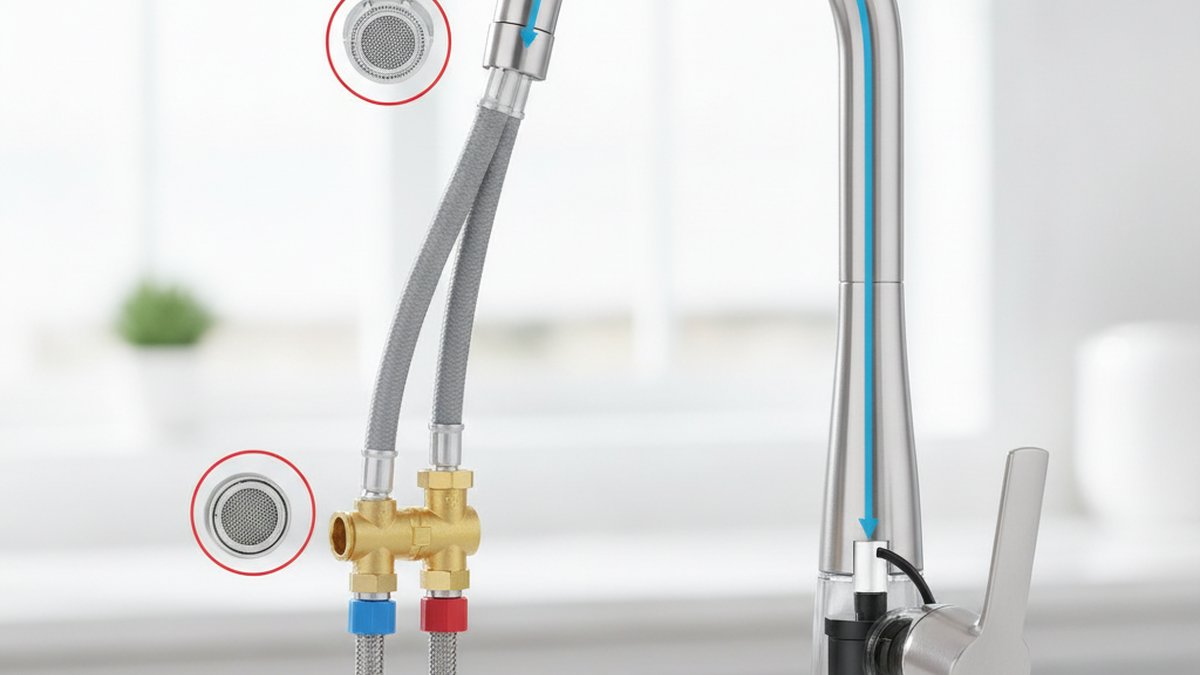
Then move upstream to the solenoid inlet screen, which is the number-one hidden culprit on touchless Deltas specifically. The solenoid valve sits under the sink and has a small filter screen at its water inlet to protect the valve from debris. On a fresh install — or after any city water main work — that screen catches a slug of pipe scale, sand, or PEX shavings and chokes the flow to a trickle. Manufacturers even warn about this in the manual.
How do I clean the solenoid screen on a Delta touchless faucet?
Shut off both supply valves, disconnect the supply line at the solenoid inlet, pull the small mesh screen with needle-nose pliers, rinse it clean, and reinstall. This is the single most effective fix for “brand new touchless faucet has low pressure” and for faucets that got weak after nearby plumbing work stirred up the pipes. Here’s the full sequence:
- Turn off both hot and cold shut-off valves under the sink. Open the faucet to release pressure.
- Locate the solenoid box — it’s the plastic housing (often gray or black) where the two supply lines meet before the flexible hose runs up to the faucet.
- Place a small bowl or towel underneath; a little water will spill.
- Disconnect the water supply line feeding into the solenoid inlet.
- Gently remove the small inline filter screen/washer with needle-nose pliers or by tapping it into your hand.
- Rinse it under strong flow and, if scaled, soak it in vinegar for 15 minutes.
- Reinstall the screen the same way it came out, reconnect, and slowly reopen the valves.
- Run the faucet in both manual and touch modes to confirm full flow.
If you have a Delta model where the solenoid and the manual valve are separate, check the screens on the quick-connect fittings too. Delta’s push-fit connectors have tiny O-rings and occasionally a screen where debris parks itself.
Could a shut-off valve or supply line be the problem?
Yes — and this is the fix people overlook because it feels too simple. If your low pressure started right after you (or a plumber) worked under the sink, a shut-off valve almost certainly didn’t get turned back to fully open. A quarter-turn ball valve should be parallel with the pipe; an older multi-turn valve should be backed all the way open, then a quarter-turn closed. Half-open valves are the classic cause of “sudden” weak flow.
While you’re down there, look at the braided supply hoses. A sharp kink acts like a permanent flow restrictor, and old rubber hoses can delaminate internally so a flap of rubber flutters over the opening. If only your hot or only your cold side is weak, suspect one specific hose or valve rather than the faucet itself. And length matters less than people think — if you’re wondering whether a too-long line is throttling you, the honest answer is covered in our breakdown of whether faucet supply lines can be too long; a kink or clog is far more likely than length.
Is low pressure ever a battery or electronics problem on a touchless faucet?
Occasionally, yes — but it shows up as a specific symptom: the faucet flows fine when you use the manual handle, but is weak, hesitant, or won’t run at all in touch/touchless mode. That points to the solenoid not opening fully, which is usually a power problem, not a plumbing one.
Delta touchless faucets run on either 6 AA batteries or an AC adapter. As batteries drain, some units get erratic before they die completely — the solenoid may not pull the valve fully open, giving you weak flow on a hands-free activation. Try this:
- Swap in fresh batteries. Use all-new alkalines, not a mix of old and new. This alone resolves a surprising share of “weak in touchless mode” complaints.
- Reseat the power connector. Unplug the battery pack or AC module from the solenoid, wait 30 seconds, and reconnect — this power-cycles the electronics and clears glitches.
- Check the solenoid’s LED. Most Delta solenoids blink to signal status; a steady or unusual blink pattern in the manual can point to low power or a stuck valve.
- Test manual vs. touch mode. If manual is strong and touch is weak, it’s electronic/solenoid. If both are weak, it’s plumbing — go back to the aerator and screen.
If manual mode is full-strength but touch mode stays weak even with new batteries and a reseated connector, the solenoid valve itself is likely failing and should be replaced. Delta sells the solenoid as a serviceable part, and if your faucet is within its warranty window, they frequently ship it free.
How do I diagnose it step by step so I only fix what’s actually broken?
Work the water path from the tip backward — spout to valves — and stop at the first restriction you find. This ordered approach means you never replace an expensive solenoid when a $3 aerator was the real problem. Here’s the decision flow in plain terms:
- Remove the aerator and run water. Full flow now? Clean or replace the aerator — you’re done.
- Still weak with aerator off? Check the pull-down spray head, if your model has one, for internal clogs.
- Still weak? Clean the solenoid inlet screen and any quick-connect screens.
- Still weak? Confirm both shut-off valves are fully open and inspect hoses for kinks or internal collapse.
- Weak only in touch mode? Replace batteries, reseat power, then replace the solenoid if needed.
- Every faucet in the house is weak? The problem isn’t your Delta at all — it’s whole-home pressure (check your PRV or main shut-off, or call the utility).
That last point is worth repeating: if low pressure hits every fixture, don’t disassemble the faucet. You have a house-wide pressure issue, and it’s often a failed pressure-reducing valve or a barely-open main.
Does the pull-down spray head cause weak flow too?
It can. On pull-down and pull-out Delta touchless models, the spray head contains the aerator and a small rubber diverter that switches between stream and spray. Mineral buildup or a torn diverter causes weak, split, or spitting streams. If cleaning the aerator screen inside the head doesn’t fix it, the head is a replaceable wear part — you don’t need a whole new faucet. Our guide to pull-down kitchen faucet sprayer head replacement walks through matching and swapping the head, which is a five-minute job on most quick-connect hoses.
What flow rate should a healthy Delta faucet actually deliver?
A healthy modern kitchen faucet delivers around 1.5 to 1.8 gallons per minute (GPM), and a bathroom faucet about 1.2 GPM — so if yours dropped noticeably below that, you have a real restriction, not just “how it’s supposed to be.” Since 1994, U.S. federal standards cap kitchen faucets at 2.2 GPM (many states like California now require 1.8 GPM or less), and bathroom faucets at 2.2 GPM with tighter state limits down to 1.2 GPM.
Why this matters for diagnosis: a lot of people install a new WaterSense faucet, feel the lower (but normal) flow, and assume it’s broken. If your faucet is metering the intended 1.5–1.8 GPM, that’s by design, not a fault. But if it went from a strong stream to a dribble, that’s a clog. If you want to sanity-check what “normal” feels like and how GPM is measured, our explainer on the flow rate of standard kitchen faucet models gives you a bucket-and-timer test you can run in one minute.
| Fixture | Federal max GPM | Typical modern GPM | “Too weak” — investigate below |
|---|---|---|---|
| Kitchen faucet | 2.2 | 1.5–1.8 | Under ~1.0 GPM |
| Bathroom faucet | 2.2 (states to 1.2) | 1.2 | Under ~0.8 GPM |
| Touchless in touch mode | Same as manual | Should match manual | Noticeably weaker than manual |
When is it time to stop repairing and replace the faucet?
Replace the faucet only if the solenoid, spray head, and internal valve have all been cleaned or swapped and flow is still weak, or if the faucet body itself is corroded or cracked — otherwise, repair is cheaper and faster. A touchless Delta is built to be serviced part-by-part, so a genuine “the whole thing is dead” situation is rare. The parts you’d realistically replace — aerator, spray head, solenoid, supply hoses — total far less than a new faucet.
That said, if your faucet is 10+ years old, out of warranty, and you’re on your second solenoid, buying new can make sense. If you go that route, choose a reputable brand with real serviceable parts and a strong warranty; our roundup of the best bath faucet brands covers what separates a faucet you can fix for a decade from one you throw away.
FAQ
Why does my brand-new Delta touchless faucet already have low water pressure?
New installs almost always have a clogged solenoid inlet screen. When water is turned back on after installation, a slug of pipe scale and debris gets flushed into the faucet and caught by the protective screen at the solenoid inlet. Shut off the water, remove and rinse that screen, and full pressure typically returns. Also confirm both shut-off valves are 100% open.
Why is my Delta touchless faucet weak only in touchless mode but fine with the handle?
That’s an electronic or solenoid issue, not a plumbing clog. Start with fresh batteries (all six, all new) or check the AC adapter, then unplug and reseat the power connector at the solenoid to reset it. If manual flow stays strong but touch mode remains weak, the solenoid valve isn’t opening fully and should be replaced — it’s a serviceable part, often covered under warranty.
How often should I clean the aerator to prevent low pressure?
Every 3–6 months if you have hard water, once a year if your water is soft. Hard-water scale is the leading cause of gradual flow loss. A 30-minute vinegar soak and a quick toothbrush scrub keeps the aerator and spray head clear and is the cheapest maintenance you can do.
Can low home water pressure be the real problem instead of the faucet?
Yes. If every faucet, shower, and appliance in the house is weak, the faucet is fine — you have a whole-home pressure problem. Common causes are a failing pressure-reducing valve, a partly closed main shut-off, or a utility-side issue. Don’t disassemble the faucet in that case; check the main and PRV, or call your water provider.
Is it safe to replace the solenoid myself, and will it void the warranty?
Yes, it’s a homeowner-friendly repair — it uses quick-connect fittings, no soldering, and takes about 15 minutes with the water off. Replacing a Delta solenoid with a genuine Delta part does not void the warranty; using it as intended is exactly what the serviceable design is for. Contact Delta first, because in-warranty solenoids are often shipped free.
Does hard water permanently damage a touchless faucet?
Not usually — the damage is buildup, and buildup is removable. Scale clogs aerators, screens, and diverters, but vinegar dissolves it. The one long-term risk is scale inside the solenoid valve over many years, which is why periodic aerator and screen cleaning matters. A whole-home water softener is the permanent fix if your water is very hard.
Author note: This guide was written by the faucitta fixtures team, drawing on hands-on repair and installation of hundreds of touch and touchless kitchen and bath faucets. We test common failure points against manufacturer service manuals and real under-sink diagnostics rather than guesswork.
About faucitta: faucitta (faucitta.net) specializes in faucets, shower systems, and bathroom fixtures, with a focus on practical repair and buying guidance. Flow-rate figures cited here reflect U.S. federal EPAct standards (2.2 GPM kitchen) and WaterSense/state limits; always follow your faucet’s included warranty and installation documentation, and use genuine manufacturer replacement parts to keep coverage intact.