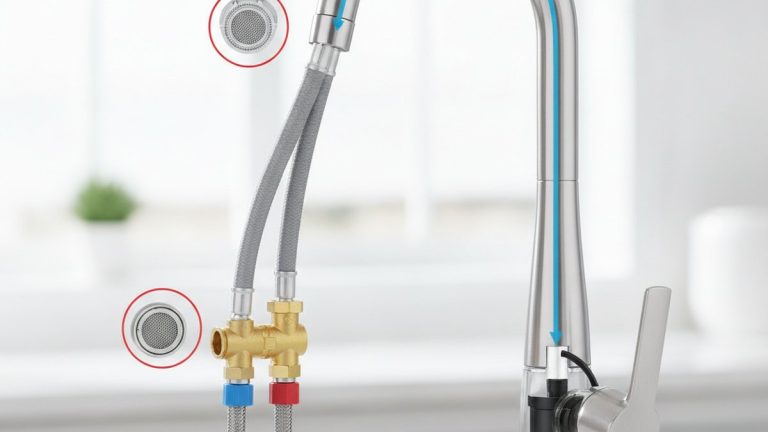
If you’ve opened the cabinet and found your sink leaking from the faucet hose, the good news is this is one of the most common — and most fixable — kitchen faucet problems there is. On a modern pull-down or pull-out faucet, that flexible braided hose runs from the spout down through the faucet body and connects to your supply line with a quick-connect coupling, often near a bell-shaped hose weight. Water can escape at any of those junctions. The trick is figuring out where the drip is actually coming from before you start swapping parts, because a leak at the spray head is a completely different repair than a leak at the quick-connect down below.
This guide walks you through diagnosing the exact source, the tools you need, and the step-by-step fix for each scenario — plus when it’s genuinely time to replace the hose or the whole faucet instead of chasing a leak that keeps coming back.
Where exactly is the water coming from — the spray head, the hose, or the quick-connect?
Before touching a wrench, find the source: dry everything with a towel, run the faucet, and watch. A leak that appears up top at the sprayer when the water is on points to the spray-head hose connection or a worn seal in the wand. A leak that shows up under the sink only when the faucet runs is the pull-down hose or its coupling. A leak that’s there even when the faucet is off is on the pressurized supply side — the quick-connect fitting, the supply line nut, or the shutoff valve.
This 60-second test saves you from replacing parts that were never the problem. Here’s what each location usually means:
- Drip at the base of the spout / spray head: The pull-down wand’s internal O-ring or the coupling where the spray hose screws into the wand has failed. Common on faucets 3–7 years old.
- Wet hose weight or mid-hose drip: The braided hose itself has a pinhole or crack, often from rubbing against the cabinet or the drain pipe over time.
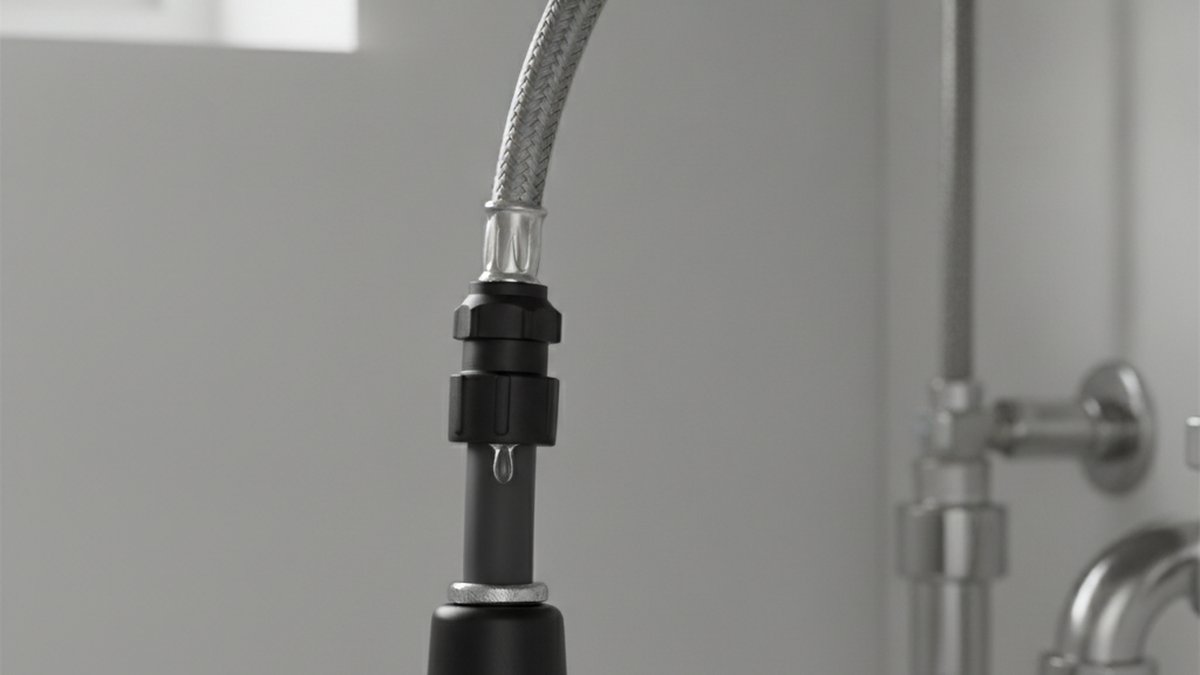
- Water pooling at the quick-connect coupling: The connector isn’t fully seated, the retaining clip has popped, or the O-ring inside the coupling is worn.
- Leak at the very top where hose meets supply line: A loose compression nut or a bad gasket — sometimes just needs a quarter-turn snug.
Put a dry paper towel under each junction and run the faucet for 30 seconds. The towel that gets wet first is your culprit. If the leak only happens when you pull the sprayer out and extend the hose, that’s a classic sign the hose is cracked or the wand coupling is loose.
How do I fix a leaking quick-connect coupling under a pull-down faucet?
To fix a leaking quick-connect coupling, shut off the water, push the coupling fully together until it clicks, check the retaining clip is seated, and inspect the O-ring inside — replace it if it’s flattened or cracked. This fixes the majority of “sink leaking from faucet hose” complaints on pull-down faucets from Moen, Delta, Kohler, and similar brands.
Step by step:
- Turn off both shutoff valves under the sink (turn clockwise until snug), then run the faucet to release pressure.
- Disconnect the quick-connect. Most use a collar you push in or a clip you pinch. Pull the two halves apart gently.
- Inspect the O-ring inside the female half. If it’s dry, cracked, flattened, or missing, that’s your leak. A dab of plumber’s silicone grease on a fresh O-ring works wonders.
- Reconnect firmly until you hear or feel a solid click. A partial connection is the #1 cause of these leaks — it holds under no pressure but weeps once the water’s on.
- Confirm the retaining clip (the little C-clip or wire) is fully snapped in. If it’s bent or missing, replace it — never run the faucet without it.
- Turn the water back on slowly and watch the coupling for 60 seconds with a dry towel underneath.
If the coupling still weeps after reseating with a fresh O-ring, the connector itself may be worn or the hose end is deformed — at that point, replacing the hose is the move.
What if the braided faucet hose itself is cracked or has a pinhole?
If the hose itself is leaking — you’ll see water beading along the braided line or dripping from the hose weight rather than from a fitting — you need to replace the hose, not repair it. Braided PEX or nylon supply hoses and pull-down spray hoses are not patchable; tape and sealant are a temporary band-aid that will fail, sometimes catastrophically, at full line pressure.
The good news: on most pull-down faucets, the spray hose is a replaceable part. It disconnects at the quick-connect below and threads out through the top of the spout once you detach the spray wand. Order the manufacturer’s exact replacement hose using your faucet’s model number (stamped under the spout or printed on the original box). Universal hoses exist, but matching the length, diameter, and connector type to your specific faucet avoids a second leak.
To swap it: shut off the water, disconnect the quick-connect, unscrew the spray wand from the hose end, remove the hose weight if it clamps on, then pull the old hose up and out through the spout. Feed the new hose down the same path, reattach the wand, reclip the weight, and reconnect the quick-connect. Total time is usually 20–30 minutes. If your faucet is a Moen and you’re already in there, our guide on a white Moen kitchen faucet repair covers the brand-specific clips and cartridge quirks that trip people up.
Faucet hose leak: repair or replace? A quick comparison
Whether to repair or replace depends on the faucet’s age, where the leak is, and how many times you’ve fixed it already. Here’s a straight comparison to help you decide fast:
| Situation | Best action | Approx. cost | Difficulty |
|---|---|---|---|
| Loose quick-connect, good O-ring | Reseat and click firmly | $0 | Very easy (5 min) |
| Worn O-ring or gasket at a fitting | Replace O-ring, add silicone grease | $3–$8 | Easy (15 min) |
| Cracked or pinholed pull-down hose | Replace the hose assembly | $15–$40 | Moderate (30 min) |
| Leak at spray wand coupling | Replace wand O-ring or wand | $10–$35 | Easy (15 min) |
| Faucet 10+ yrs, repeated leaks, corroded body | Replace the whole faucet | $80–$300+ | Moderate (1–2 hrs) |
Rule of thumb: if the faucet is under 8 years old and the leak is at one identifiable spot, repair it. If you’re fixing the same faucet for the third time, the body is corroded, or replacement hoses cost more than half a new faucet, put the money toward a new unit. When you’re ready to install a fresh one, the same skills carry over — see how to install a new faucet yourself for the full walkthrough, which applies to kitchen and bath alike.
Why does my faucet only leak when I pull the sprayer out and use it?
If your sink only leaks when you extend the pull-down sprayer, the leak is in the moving hose or the spray-wand connection — not the fixed plumbing. Extending the hose puts a bend and slight tension on it, opening up a crack that stays closed at rest, or pulling on a wand coupling that’s no longer sealing.
Check two things. First, extend the sprayer fully and run your fingers along the exposed hose — a wet spot mid-hose means a crack, and the hose needs replacing. Second, look at where the hose screws into the spray wand; if water weeps from that joint under use, the wand’s O-ring is shot. Both are inexpensive fixes. This “only when I use it” pattern is exactly why the paper-towel test matters — a static leak check with the sprayer docked would miss it entirely.
What tools and parts do I need, and can I really do this without a plumber?
Yes — a faucet hose leak is firmly in DIY territory for almost anyone. You don’t need special plumbing skills, just a few basic tools and 30–40 minutes. Here’s the kit:
- Adjustable wrench or basin wrench — for supply-line and coupling nuts in tight cabinet space.
- Flashlight or headlamp — under-sink diagnosis is impossible in the dark.
- Replacement O-rings and plumber’s silicone grease — a cheap assortment kit covers most fittings.
- Towels and a small bucket — for the residual water that always comes out.
- The manufacturer’s replacement hose — only if the hose is the culprit; match it to your model number.
A quick word on fittings: if your leak is at a threaded metal junction rather than a quick-connect, the culprit is sometimes a worn or over-tightened brass fitting rather than the hose. Understanding which connector you actually have — and its thread size — prevents you from buying the wrong part. If you’re staring at threaded brass and unsure, our explainer on the brass faucet nipple and how to pick the right one clears up the sizing. And if your “leak” turns out to be at a hose adapter you added — say for a portable dishwasher or a garden connection — the correct garden hose to faucet adapter with the right washer often solves it outright.
The only time to call a pro is if the shutoff valves themselves are seized or leaking, if the leak is inside the wall, or if you’ve replaced parts twice and it still drips — that can signal a cracked faucet body that only replacement will fix.
How do I stop it from leaking again?
To prevent a repeat leak, seat every connection fully, replace O-rings with a light coat of silicone grease, and make sure the hose isn’t rubbing against the drain pipe or cabinet as the sprayer retracts. Most repeat leaks come from a rushed reconnection or a hose that chafes against something sharp under the sink.
A few habits that keep faucet hoses leak-free for years:
- Route the hose cleanly so it doesn’t drape over the drain trap or press against a screw head.
- Don’t over-tighten plastic quick-connects or compression nuts — hand-tight plus a quarter turn is usually enough; cranking cracks fittings.
- Check the hose weight clamp — a loose weight lets the hose swing and wear faster.
- Glance under the sink every few months and feel the fittings. Catching a weep early beats mopping up a flooded cabinet.
Do this and your faucet hose should outlast the rest of the faucet.
FAQ
Can I use plumber’s tape or sealant to fix a leaking faucet hose?
Use PTFE (Teflon) tape on threaded metal connections — that’s what it’s for. But never rely on tape or sealant to patch a crack or pinhole in the hose itself; braided supply and spray hoses are under constant pressure and a patch will eventually blow out. Replace a cracked hose rather than sealing it.
Why is my faucet leaking under the sink even when it’s turned off?
A leak that persists when the faucet is off is on the pressurized supply side — the supply-line nut, the quick-connect coupling, or the shutoff valve — because those stay under pressure at all times. Dry the area, then check each junction; a supply-side leak usually needs a fresh gasket or O-ring, or a firmer reconnection.
How much does it cost to replace a pull-down faucet hose?
The hose itself typically runs $15–$40 for a manufacturer part, and if you do it yourself that’s your total cost. A plumber would add roughly $100–$200 in labor, which is why this repair is so worth doing yourself — the job is straightforward and needs no specialized tools.
Do universal replacement hoses work, or do I need the exact brand part?
Universal hoses can work, but they must match your faucet’s connector type, hose diameter, and length. Mismatched connectors are the top reason a “universal” swap leaks again. When in doubt, order the exact hose by your faucet’s model number — it’s cheap insurance against a second trip under the sink.
Is a leaking faucet hose an emergency?
A slow weep isn’t an emergency, but don’t ignore it — trapped moisture under the sink warps cabinet floors and breeds mold within weeks. If the hose bursts or you can’t stop the flow, shut off both under-sink valves (or the main) immediately, then repair or replace before turning the water back on.
How do I know if it’s the hose or the faucet cartridge leaking?
A hose leak shows up under the sink or along the sprayer hose; a cartridge leak shows up at the faucet handle or spout base and usually means water dripping from the spout or seeping around the handle when the faucet is off. If the water is up top around the handle, suspect the cartridge; if it’s down in the cabinet, it’s the hose or a fitting.
Author note: This guide was written by the faucitta fixtures team — plumbers and product testers who install, bench-test, and pressure-cycle kitchen and bath faucets year-round. faucitta (faucitta.net) specializes in faucets, shower heads, and bathroom fixtures, and every repair procedure here reflects hands-on work with real pull-down faucets from major brands. Replacement hoses and connectors should meet standards such as ASME A112.18.1/CSA B125.1 and NSF/ANSI 61 for potable water; always follow your faucet manufacturer’s instructions and warranty terms, since some repairs performed incorrectly can void coverage.